How to Speak Basic Khmer: Greetings, Courtesies and Phrases That Open Doors
You do not need to speak Khmer to travel in Cambodia. Guesthouse staff, guides and many market sellers handle English, and phone translation fills most gaps. But twenty carefully chosen words will change how people respond to you more than almost anything else you can pack. A greeting offered with the right gesture, a thank you in the local language and a polite particle at the end of a sentence all signal that you are a guest rather than a customer.
This guide is practical rather than academic. It covers the greeting ritual, the small words that carry politeness, the numbers and directions you will use daily, and the phrases that matter at the table and in a tuk-tuk. Romanisation of Khmer varies widely between sources, so treat the spellings below as pronunciation aids, not fixed standards.
Why a few words matter more than a phrasebook
Khmer is the national language and is spoken by the vast majority of Cambodians. It is not a tonal language, which makes it more forgiving for English speakers than Vietnamese or Thai, and it has no verb conjugation in the European sense. What it does have is a strong sense of social register: how you address someone depends on age and standing.
You do not need to master that. Learn a handful of phrases well, say them slowly and smile, and people will meet you halfway. Mistakes are received with good humour. What lands badly is not an accent but the absence of any effort at all, especially in small towns where visitors are fewer.
A useful rule is to learn in the order you will need things: greeting, thank you, yes and no, numbers, directions, food. Everything else can be handled by pointing and phones.
One request. Up to five tailored proposals.
Skip contacting agencies one by one — share your trip once and let up to five trusted Cambodia agencies come to you. Free, with no obligation.
Get my free quotesThe greeting: sampeah and chom reap suor
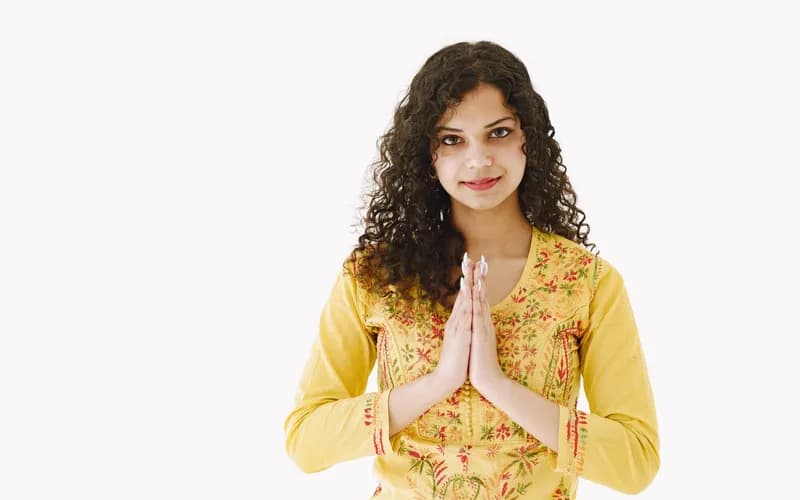
The traditional Khmer greeting is the sampeah, in which you press your palms together in front of the chest or face and bow the head slightly. It accompanies the spoken greeting, and the height of the hands signals respect: lower for peers or younger people, higher for elders, and higher still for monks and in temples.
Two spoken greetings cover most situations:
- Chom reap suor is the formal hello, used with elders, officials, hosts and anyone you want to treat with respect.
- Sua s'dei is the casual hello, used among friends and peers.
Goodbyes follow the same pattern. Chom reap lea is the formal farewell, and lea hoey is the informal one. You will also hear sok sabay, a phrase used both to ask how someone is and to answer, with the intonation shifting between question and reply.
If you are unsure, use the formal form with the sampeah. You will not offend anyone by being too polite. A few practical notes: do not offer the sampeah to young children, who are not expected to return it in the same way, and do not shake hands with monks. Women should avoid touching monks or handing things to them directly. At temple sites this etiquette matters, and our guide to Angkor temple etiquette and the multi-day pass covers dress and behaviour in more detail.
Yes, no and the polite particles
This is the part that surprises most visitors, and it is the most useful. In Khmer, yes is not a single word. Men say baat and women say jaa, and both are used not only to mean yes but also to signal that you are listening and being polite. A woman who says jaa at the end of a sentence is being courteous, not necessarily agreeing.
- Baat (men) and jaa (women): yes, or a polite acknowledgment.
- Ot teh: no.
- Arkun: thank you.
- Som toh: sorry, or excuse me.
You will hear locals repeat baat or jaa often when helping you, and they will usually smile if you use the right one. Do not worry about the gender distinction if you forget. People will understand and appreciate the attempt.
Another useful word is som, which works like please. Som toek is water please, and som chop is please stop, which is the polite way to tell a driver to halt. Adding som softens any request.
Get matched with up to 5 trusted Cambodia agencies
- Free
- No obligation
- Up to 5 agencies
Numbers, prices and bargaining
Numbers are among the most practical words you can learn, because they let you follow prices, bus times and room numbers. The first ten are:
- moi
- bee (sometimes written pi)
- bai (sometimes written bei)
- boun
- bram
- bram moi (five-one, meaning six)
- bram bee
- bram bai
- bram boun
- dop
Once you know that six to nine are built from five plus a digit, the system feels logical. Pair numbers with the common question how much, usually heard as tlay pon-maan, and you can start a price conversation politely. Many prices are quoted in US dollars, and small change often comes in Cambodian riel, so numbers help you check what you are given. Our guide to money and connectivity in Cambodia explains how the two currencies work in practice.
Bargain with a smile, not a script. In markets and with tuk-tuk drivers, a first price is an opening, but the goal is a fair deal for both sides. Pushing hard over small sums is rarely worth the social cost.
Directions and getting around
With a driver, a handful of directional phrases is enough:
- Baht schweng: turn left.
- Baht sadam: turn right.
- Tov trong: go straight.
- Tini: here.
- Chop: stop. Som chop is the polite form.
Learn these and you can steer a tuk-tuk through a confusing junction or ask to be dropped at the right corner. For longer days, or when you want someone who can explain what you are seeing, read our guide on how to hire a driver, guide or tuk-tuk in Cambodia. A good driver will usually teach you more words along the way if you ask.
Place names are worth practising separately. Many Khmer names do not match the way they are spelled in Latin letters, and pronouncing Siem Reap or Phnom Penh in a way that a driver recognises is more useful than a perfect textbook accent. Showing the name on your phone, written in Khmer script, is the most reliable fallback.
At the table
Food is where a few words earn the most goodwill. Cambodians love to talk about food, and a simple compliment opens conversation fast.
- Chhnganh: delicious.
- Knyom khlean: I am hungry.
- Som toek: water, please.
- Som ket loy: the bill, please.
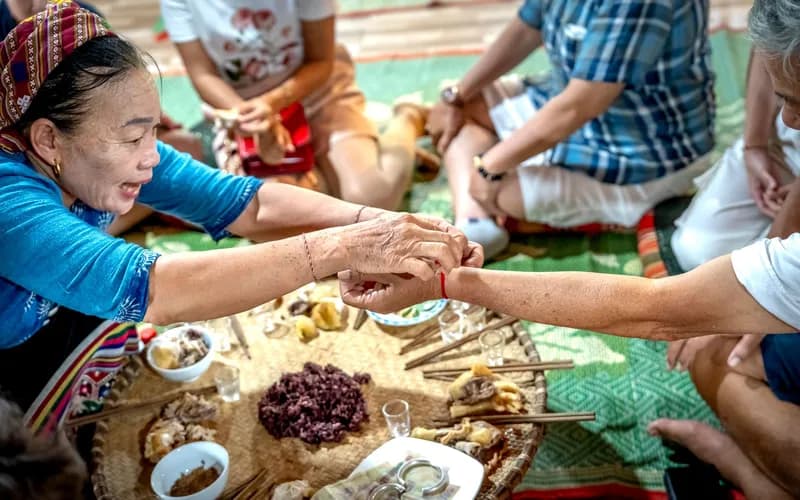
Meals are usually shared, with rice as the base and dishes in the middle. Wait for the host or eldest person before starting, and use the serving spoon rather than your own. If you are staying with a family, the thank you before and after the meal matters. Our guide to staying in Cambodian homestays covers etiquette in the home, from shoes at the door to how to accept a second helping.
Pronunciation and how to practise
Some practical pronunciation tips make the phrases much easier:
- Khmer has sounds English lacks, so do not worry about perfection. A confident approximation is understood.
- Syllables are generally given even weight, without strong stress.
- Say the phrase slowly and watch the listener. If they repeat it back correctly, copy them.
- Record a short voice note when someone says a phrase for you, then replay it later.
A short daily routine works better than cramming. Learn two or three words each morning, use them that day, and add more when they feel natural. By the end of a week you will have a working base. If you take an early evening walk through a market or neighbourhood, you will find plenty of low-pressure chances to practise.
Phones, apps and when to use them
Translation apps are useful for menus, signs and complicated questions, and downloading Khmer for offline use before you travel saves time in places with weak signal. They are less useful as a replacement for greetings, because handing someone a phone before you have said hello feels transactional.
A good pattern is to greet in Khmer, speak simply in English, and use the phone for details. Photograph signs and menus for translation rather than typing, and keep important addresses saved in Khmer script so a driver can read them.
A slower way to arrive
Language is a form of attention. The traveller who takes ten minutes to learn the greeting will meet a different Cambodia from the one who walks in speaking only English. If you are still planning your route, our slow traveller's guide to Cambodia will help you choose where to spend enough time for these small exchanges to matter.
What to Do Next
- Learn chom reap suor, arkun and the baat or jaa particle before you land.
- Practise the sampeah in front of a mirror so it feels natural rather than staged.
- Memorise numbers one to ten and the phrase for how much.
- Save key addresses in Khmer script on your phone, and download Khmer for offline translation.
- Use one new phrase a day, and listen carefully to how people answer.
Frequently Asked Questions
Do I need to learn Khmer to travel in Cambodia?
No. English is widely used in tourist areas, and phones fill many gaps. But a few Khmer phrases, especially a greeting and thank you, noticeably improve interactions and are appreciated everywhere, particularly outside the main tourist centres.
How do I say hello in Khmer?
Use chom reap suor in formal situations and sua s'dei with friends and peers. Pair either with the sampeah, palms together in front of the chest or face and a slight bow. If you are unsure which to use, choose the formal form.
What is the difference between baat and jaa?
Both mean yes or serve as polite acknowledgment. Men say baat and women say jaa. They are used constantly in conversation, not only to agree, so hearing them does not always mean agreement.
Is Khmer a tonal language?
No. Unlike Vietnamese or Thai, Khmer does not rely on tone to distinguish words, which makes it easier for English speakers to be understood. Vowels and consonants matter more than pitch.
How do I say thank you in Khmer?
Say arkun. Adding the sampeah makes it warmer. At the end of a meal, a stay or a helpful encounter, it is always appropriate.
Should I give the sampeah to everyone?
Use it for elders, hosts, monks, officials and in temples. You do not need to offer it to young children or to staff in a transactional setting such as a shop counter, where a smile and a nod are enough.
Are the spellings in this guide official?
No. Khmer is written in its own script, and there is no single standard for Latin spellings. The versions here are pronunciation aids drawn from common usage, so you may see slightly different spellings elsewhere.