How to Plan a Cambodia Trip Around the Khmer Festival Calendar
Most travel advice about Cambodia treats the calendar as weather: dry season good, wet season wet. That misses the more consequential rhythm. Cambodia's year is shaped by a handful of Buddhist and royal observances that close banks for a week, empty the capital, fill every bus and minivan in the country, and turn quiet provincial towns into the busiest places you will see all trip. Time your visit badly and you will spend three days trying to change money. Time it well and you will see the parts of Cambodian life that no itinerary can manufacture.
Why the calendar matters more in Cambodia than you expect
Two things make Cambodia different from its neighbours in this respect. The first is the sheer number of official holidays: the government gazette runs to more than two dozen days a year, and several of them come in blocks. The second is internal migration. A large share of the urban workforce has a home province, and at the two big festivals they all go back to it at once. Phnom Penh does not slow down at Khmer New Year; it hollows out.
For a traveller this cuts both ways. Services thin out and transport strains, but the countryside comes alive, and the pagoda-centred rituals that are normally private become visible. If you are still choosing dates, our guide on where to go in Cambodia and when sets out the seasonal picture; this article is the layer on top of it.
One structural note before the dates. Most of Cambodia's major festivals follow the lunar calendar, and the exact days are fixed each year by royal sub-decree, usually published some months in advance. Websites that give you a confident date two years out are guessing. Always confirm against the official holiday list for the year you are travelling.
One request. Up to five tailored proposals.
Skip contacting agencies one by one — share your trip once and let up to five trusted Cambodia agencies come to you. Free, with no obligation.
Get my free quotesKhmer New Year: the one that stops the country
Choul Chnam Thmey, Khmer New Year, falls in mid-April, normally across 13 to 16 April, and in 2026 ran from 14 to 16 April. It is the largest event of the Cambodian year by a wide margin. Officially it is three days; in practice many businesses close for the better part of a week, and staff take additional days to travel.
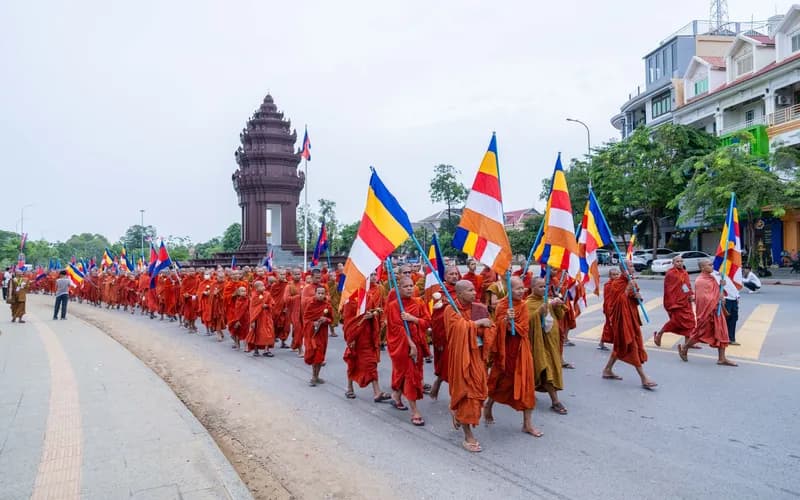
What you will see depends entirely on where you are. In Phnom Penh, shutters come down, traffic evaporates and restaurants close. In the provinces, families clean houses and graves, bring offerings to the pagoda, build small sand stupas in the temple grounds, play traditional games in the yard, and throw water and talcum powder at each other with escalating enthusiasm. It is genuinely joyful and completely unselfconscious.
The honest warnings: intercity transport sells out days ahead and drives at holiday speeds on holiday roads, road casualties spike, provincial guesthouses fill with returning families, and rural ATMs run dry. Angkor stays open and is busy with Cambodian visitors rather than foreign ones, which is a different and better experience than high season.
What actually closes, and for how long
Banks, government offices and most professional services close on the official days and often either side. That has specific consequences: immigration and administrative counters shut, so anything involving a visa extension or an address registration has to be done before or after, not during. Post offices and courier services stop. Many family-run restaurants close entirely for the week rather than shortening hours.
What stays open: temples and pagodas, of course, plus markets for at least part of each day, larger supermarkets, hotel restaurants, and the Angkor Archaeological Park. Ferries and tourist boats usually run but on reduced timetables.
Cash deserves its own paragraph. ATMs in small towns are refilled less often over long holidays and do run empty, and card acceptance outside cities is still uneven. Draw more than you need before a holiday block, and keep small-denomination dollars and riel separately. Our article on money and connectivity in Cambodia explains how the dual-currency system works in practice and where QR payment now covers you.
Get matched with up to 5 trusted Cambodia agencies
- Free
- No obligation
- Up to 5 agencies
Pchum Ben: the most meaningful and the least visible
Pchum Ben, Ancestors' Day, is arguably the most important religious observance in the Cambodian year and the one visitors are least likely to notice. It runs for fifteen days during the lunar month of Photrob, falling in September or October, and culminates in a three-day public holiday.
The practice is precise. For those fifteen days, families rise before dawn and bring offerings of food, especially bai ben, small balls of sticky rice, to the pagoda, where monks chant and the offerings are dedicated to ancestors for seven generations back. The belief is that the gates of the other world open and the hungry dead can receive merit. People who do not attend a pagoda at all in an ordinary year attend during Pchum Ben.
It is not a spectacle, and it should not be treated as one. There are no boat races or parades. What there is, if you are in a provincial town and happen to be awake at four in the morning, is a stream of people walking to the pagoda in the dark with covered dishes. Phnom Penh empties again, though less dramatically than at New Year. Our piece on Phnom Penh at walking pace covers the capital's pagodas, which are the right places to understand what is happening.
Bon Om Touk: the festival that may not happen
Bon Om Touk, the Water and Moon Festival, marks the moment the Tonle Sap river reverses its flow and drains back into the Mekong. It falls in late October or November, and it has historically been Phnom Penh's great public spectacle: long boat races on the river in front of Sisowath Quay, crews from every province, a million or more spectators, fireworks, the moon salutation known as Sampeah Preah Khae, and ambok, flattened rice eaten with banana and coconut.
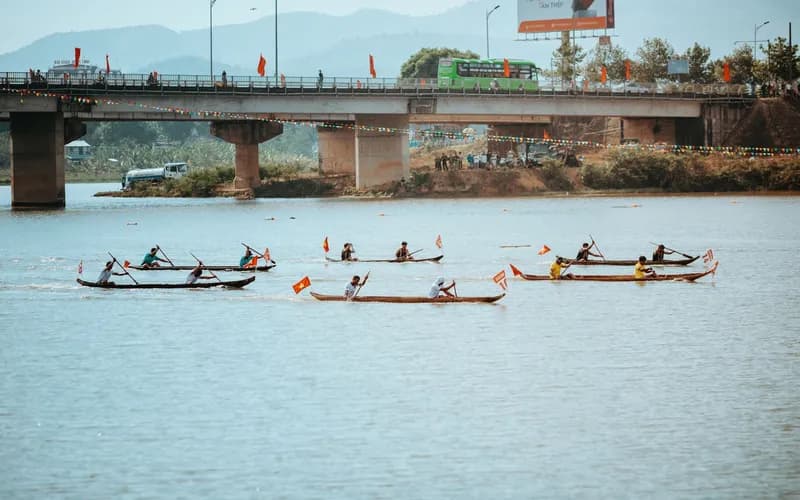
Here is the current reality, and it is important. The Phnom Penh festival was cancelled in 2026. The government announced on 2 July 2026 that the celebration originally scheduled for 23 to 25 November would not go ahead, citing the priority of the border response. That was the second consecutive year the capital's races had been called off.
Do not build a trip around it without confirming, in the year you travel, that it is actually happening. The public holiday days typically remain even when the races do not, so you may still get the closures without the festival. Smaller provincial races sometimes continue when Phnom Penh's are cancelled, but that varies by province and year.
The underlying hydrology is worth understanding regardless, because it explains the whole rhythm of the lower Mekong basin. Our guide to visiting the Tonle Sap floating villages responsibly covers what the reversal means for the lake and the communities that live on it.
The smaller observances worth timing for
Several quieter dates reward a traveller more than the big two. Meak Bochea, on the February full moon, brings candlelit processions around pagoda compounds in the evening: beautiful, low-key, easy to attend respectfully. Visak Bochea, the May full moon, marks the Buddha's birth, enlightenment and death, and is similar in character.
The Royal Ploughing Ceremony, Pithi Chrat Preah Nheangkal, takes place in May and is a genuinely unusual piece of state ritual in which sacred oxen are offered trays of food and grain, and their choices are read as a forecast for the harvest. Independence Day on 9 November brings parades and a floral tribute at the Independence Monument in Phnom Penh.
If you want to see a Cambodian festival without navigating a national shutdown, these are the ones to aim for.
How to book around the peaks
Three rules cover most of it. Book intercity transport for holiday periods as far ahead as the operator allows, and prefer trains or reputable coach companies over minivans, which are the least safe option on the busiest roads of the year. Book provincial accommodation earlier than you would for high season, because domestic demand, not foreign demand, sets availability. And do not schedule anything administrative, from visa extensions to shipping, inside a holiday block.
There is a counterintuitive upside. Siem Reap and the coastal resorts sometimes soften on price during the big Khmer holidays because foreign arrivals are low, while provincial towns spike. If your dates are flexible, that asymmetry is worth exploiting.
If you would rather not manage the logistics of a festival period yourself, a local operator who knows which roads and which guesthouses to avoid earns their fee in that week more than any other. Our page on travel agencies for Cambodia explains what to look for and what to ask.
Etiquette: being present without intruding
Cambodians are generous about including outsiders, which makes it easy to overstep without noticing. A short list that covers most situations. Dress covered at pagodas, shoulders and knees, and remove shoes and hats before entering a vihara. Do not point your feet at a Buddha image or at monks. Women should not hand objects directly to a monk; place them down instead.
At Pchum Ben, photograph sparingly and never with flash inside a hall during chanting. If someone invites you to eat, accept a little even if you have eaten. During Khmer New Year water fights, assume anything you carry will get soaked, and understand that your participation is welcomed rather than merely tolerated; refusing coldly reads as unfriendly.
If you are invited to a family observance, the honest advice is to go. Our article on staying in Cambodian homestays covers the wider etiquette of being a guest in a Khmer household, including how to handle gifts and money without causing embarrassment.
A month-by-month shape for planning
January and February are the easy months: dry, cool, and with Meak Bochea as a gentle highlight. March is hot and quiet. Mid-April is Khmer New Year, which you should either commit to or avoid entirely, with no middle ground. Late April and May are the hottest weeks of the year, with Visak Bochea and the Royal Ploughing Ceremony as compensations.
June to September is the green season, when the landscape is at its best and the crowds at their thinnest. Pchum Ben arrives at the tail of it. October and November bring the water levels to their peak, the possibility of Bon Om Touk, and Independence Day. December is peak foreign season and the most expensive time to be in the country.
For the practicalities of the wet months, including what actually gets difficult and what gets better, see our guide to travelling Cambodia in the green season.
What to Do Next
- Look up the official public holiday list for your travel year rather than trusting a generic festival calendar, and note the multi-day blocks.
- Decide deliberately whether you want to be inside Khmer New Year or outside it, then build the itinerary from that decision.
- If Bon Om Touk is part of your plan, confirm in the travel year that the Phnom Penh races are actually going ahead.
- Book intercity transport and provincial rooms for any holiday block as early as the operators allow.
- Move anything administrative, visa extensions included, to outside the holiday days.
- Draw extra cash before a holiday block and keep small notes in both currencies.
- Pack one set of clothes you do not mind having soaked if you will be in the country in mid-April.
Frequently Asked Questions
When is Khmer New Year, and should I avoid it?
Khmer New Year falls in mid-April, usually 13 to 16 April, and ran 14 to 16 April in 2026. Avoid it if you need banks, offices and reliable transport. Choose it deliberately if you want to see Cambodian family life at its most visible, and accept that a week of your trip will run on holiday rules.
What are the exact dates of Pchum Ben and Bon Om Touk?
They move each year with the lunar calendar and are confirmed by royal sub-decree, usually published months in advance. Pchum Ben falls in September or October, Bon Om Touk in late October or November. Any source giving you firm dates far ahead is estimating, so check the official list for your year.
Was the Water Festival cancelled?
The Phnom Penh celebration was cancelled in 2026. The government announced on 2 July 2026 that the races scheduled for 23 to 25 November would not take place, citing the border response, the second consecutive cancellation of the capital's event. Confirm the position for your own travel year before planning around it.
Do Angkor and the main sites close during festivals?
No. The Angkor Archaeological Park stays open through the holidays, as do most temples and museums, though some museums observe the official closure days. Expect a large Cambodian audience rather than a foreign one, especially at Angkor around Khmer New Year.
Will I be able to get money out during a holiday week?
Usually in cities, often not reliably in small towns. Banks close and rural ATMs are refilled less frequently over long holidays, so they do run empty. Withdraw before the holiday starts, carry small-denomination dollars and riel, and do not rely on card acceptance outside the main centres.
Is it rude to photograph a festival?
It depends on the festival. Boat races and public parades are fair game. Pchum Ben offerings and pagoda chanting are private religious acts happening in a shared space: no flash, no close-ups of people praying, and stop if anyone looks uncomfortable. Asking with a gesture takes two seconds and is almost always answered warmly.
Can I join in the Khmer New Year water fights?
Yes, and you are expected to. Participation is read as friendliness rather than intrusion. Keep your phone and passport in something waterproof, do not aim at people on motorbikes, and be careful with the talcum powder around anyone elderly or very young.