

A night in a Cambodian village homestay costs less than a cocktail on the Siem Reap riverside and will be the part of the trip you remember in five years. That is not a sentimental claim. It is a structural one: Cambodia has one of the best-developed community-based tourism networks in mainland Southeast Asia, built over two decades with NGO support and now largely run by the villages themselves. The barrier is not price or availability. It is that most travellers do not know how the system works, what is expected of them, or how to book something that is not on the usual booking platforms.
What a Cambodian Homestay Actually Is
The word covers two quite different things. The first is a genuine community-based tourism homestay: a room in a family house within a village that operates a rotation system, so that bookings are shared among participating households and the income spreads. These are usually coordinated by a village committee with an office, a price list and trained guides, and they exist because a conservation or development project helped set them up. The second is a commercial guesthouse that calls itself a homestay for marketing reasons and is functionally a small hotel.
Both can be pleasant. Only the first does what community tourism claims to do. The distinguishing signs are easy to check: a village-level booking office rather than an individual owner, a published price list covering rooms, meals and activities separately, a rotation among households, and guides who are residents rather than staff brought in from town. If you want the wider context on how these networks grew and where they are strongest, our analysis of Cambodia's community ecotourism turn sets out the landscape.
One request. Up to five tailored proposals.
Skip contacting agencies one by one — share your trip once and let up to five trusted Cambodia agencies come to you. Free, with no obligation.
Get my free quotesWhat It Costs
Community homestays are remarkably cheap, and the low headline price is a common source of confusion, because the room is only one line of the bill. At Chi Phat in the Cardamoms, a room for two people costs around US$3, with roughly US$1 for each additional person, breakfast in the village around US$2.50 and lunch or dinner around US$3.50. At Chambok, near Kirirom, a homestay night runs about US$3, with breakfast at US$1.50 and main meals at US$2.50. At Banteay Chhmar in the north-west, a room is closer to US$7 per person, with breakfast at US$2 and lunch or dinner at US$4.
Other networks bundle instead. The Isanborei homestays around the Sambor Prei Kuk temple complex start at roughly US$11 a night including both breakfast and dinner. Add guiding, which typically runs US$6 to US$15 a day depending on the site, plus activity fees for boat trips, ox-cart rides or forest walks. Realistically, budget US$20 to US$30 per person per day all in, which is still less than a mid-range hotel room alone. For the wider picture, see our Cambodia trip cost guide.
Where the Established Networks Are
Four clusters cover most of what a traveller would want. Chi Phat, in the southern Cardamom Mountains, is the best-known: a former logging and poaching community that converted to ecotourism, with mountain biking, river trips and jungle trekking. Chambok, roughly two hours from Phnom Penh near Kirirom National Park, is the easiest to reach for a first attempt and works well as an overnight from the capital.
Banteay Chhmar, in Banteay Meanchey province, pairs a vast and largely unrestored Angkorian temple with stilt-house homestays and is the most atmospheric of the four. Isanborei, at Sambor Prei Kuk in Kampong Thom, combines pre-Angkorian brick temples with bicycle and ox-cart circuits through rice fields, and slots neatly into the Phnom Penh to Siem Reap corridor; our guide to Kampong Thom and Sambor Prei Kuk covers that region in detail. Beyond these, Preah Rumkel near the Lao border, Koh Trong island at Kratie and several villages in Mondulkiri run smaller programmes.
Get matched with up to 5 trusted Cambodia agencies
- Free
- No obligation
- Up to 5 agencies
How to Book, and Why Direct Is Better
Most community homestays are not listed on international booking platforms, and where they appear, it is usually through an intermediary taking a margin. The standard method is to contact the community office directly, by phone, Telegram or Facebook page, one to three days ahead. English is variable; keep the message short, state the number of people, the number of nights and the arrival date, and confirm meals. Payment is almost always cash on arrival.
If direct contact feels uncertain, the reliable fallback is to ask a guesthouse in the nearest town to call for you, or to book through a Cambodian operator that works with the community rather than around it. Same-day walk-ins usually work outside peak season, but the room rotation means the committee needs a little notice to allocate a household. Avoid booking a homestay through a Bangkok or European reseller; it adds cost and removes the direct relationship that makes the arrangement work.
What the Room Will Be Like
Set expectations correctly and you will enjoy it. A typical room is a partitioned space in a wooden stilt house, with a mattress or thin futon on the floor, a mosquito net, a fan if there is mains power, and a shared bathroom that may be a squat toilet with a water scoop. Bedding is clean but basic. There is rarely air conditioning, hot water is uncommon, and in the rainy season the electricity supply can be intermittent, particularly in the Cardamoms.
Privacy is limited and walls are thin. Village life starts before dawn: roosters from about four, then cooking, then children. Wi-Fi is patchy to absent, though mobile data coverage is surprisingly good across most of Cambodia and a local SIM will usually work. None of this is a hardship for a night or two, but it is worth being honest with yourself about whether you want three consecutive nights of it.
Meals and the Rhythm of the Day
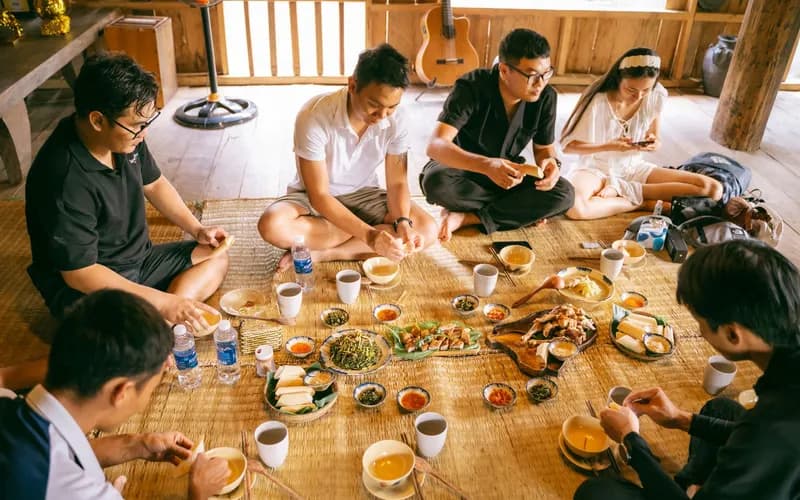
Meals are the centre of the experience and usually eaten with the family. Expect rice at every meal, a soup, a fried vegetable dish, and fish or chicken; pork appears less often in rural households than visitors assume. Breakfast may be rice porridge or noodle soup rather than anything sweet. Portions are generous and refusing more food twice is normal politeness before you are believed.
Order meals when you book, because ingredients are bought that morning rather than held in stock. Vegetarian is easily handled if flagged in advance, though fish sauce and dried shrimp are near-universal seasonings and strict vegans should say so explicitly. Eat what is served, do not photograph the family mid-meal without asking, and let the household set the timing. Dinner is often at six and the house is quiet by nine.
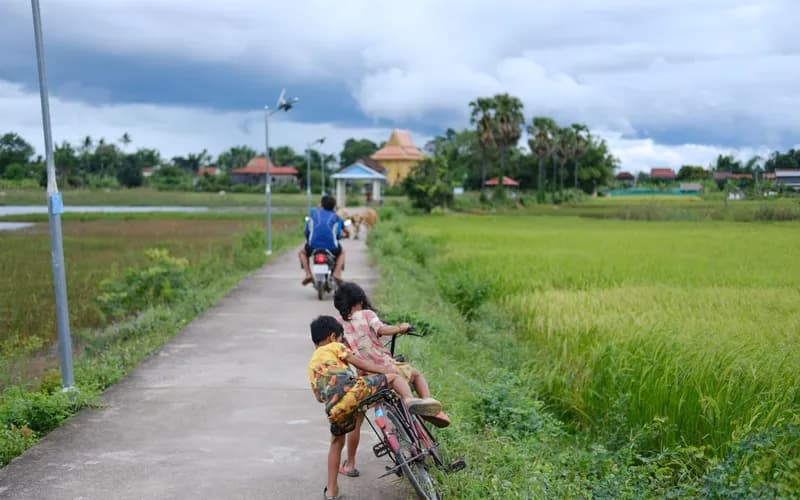
Etiquette That Actually Matters
A short list covers most of it. Remove your shoes before entering the house, and never point your feet at people or at a household altar. Dress modestly at all times, including in the evening; shoulders and knees covered is the standard, and swimwear stays at the river. Greet elders first, and use the sampeah, the palms-together greeting, with your hands at chest height for people of similar age and higher for elders and monks.
Ask before photographing anyone, especially children, and do not hand out sweets, money or pens to children, which entrenches begging and undermines the community's own systems. Alcohol is fine in moderation if the household drinks; excessive drinking in a family home is not. Contribute to the shared spirit by helping carry something or accepting an invitation to join a task, but do not insist on paying for things outside the price list, which distorts the rotation. Our piece on travelling ethically in Cambodia goes further on the wider questions.
What to Bring
Pack a head torch, because village lighting is limited and paths are uneven. Bring a small stock of small-denomination US dollars and riel; there are no card machines and often no ATM within an hour. Add a quick-dry towel, insect repellent with DEET or picaridin, a sarong that works as a wrap, a sheet or liner if you are particular about bedding, earplugs, and a reusable water bottle with a filter or purification tablets.
A useful extra is a small, genuinely practical gift for the household, given at departure rather than arrival: good coffee, quality tea, or fruit from the nearest market. Avoid anything that signals wealth or creates obligation. Also bring more patience with timing than you would in a hotel; schedules in a village are approximate by design, not by failure.
Honest Caveats
Community homestays are not for everyone, and pretending otherwise does nobody a favour. Light sleepers struggle. Travellers with mobility limitations will find stilt houses, ladders and unpaved paths difficult. Anyone who needs reliable air conditioning in April, when temperatures regularly exceed 35C, should choose the cool season instead. Food hygiene is generally good but stomachs adjust; our notes on staying healthy in Cambodia cover water, heat and medical access.
There is also a quality range. Some programmes are excellently run and some are dormant, with committees that have lost funding or momentum. Recent traveller reports matter more than the age of a project's reputation. If a village office does not answer over several days, take the hint and choose another site rather than turning up and hoping.
What to Do Next
- Pick one network that fits your route rather than trying to fit a homestay into an itinerary built around cities.
- Contact the community office directly by phone or Telegram two to three days ahead, stating dates, numbers and meal requirements.
- Withdraw cash before you leave the nearest town, in small US dollar notes plus riel for change.
- Pack a head torch, repellent, earplugs and a filter bottle, and leave the hard suitcase behind.
- Book one or two nights on your first attempt, not four, and see how you find it.
- Pair the stay with a guided village activity, because guiding fees are where much of the community income sits.
Frequently Asked Questions
Do I need to speak Khmer?
No, but a handful of words changes the experience. Learn the greeting, thank you and delicious, and use a translation app for anything longer. Community guides usually speak functional English, and in several networks French as well, but the host family often does not. Gesture, patience and good humour carry the rest.
Is it safe for solo travellers, including women?
Broadly yes. Community homestays are among the safest accommodation in Cambodia precisely because the whole village knows who is staying where. Solo women travellers report positive experiences across the main networks. Normal precautions apply: confirm the booking, share your location with someone, and avoid arriving after dark in a place you have never been.
How far ahead should I book?
One to three days is enough for most of the year. In the December to February peak, and around Khmer New Year in April, give a week for the better-known sites such as Chi Phat and Banteay Chhmar. The rotation system means the committee allocates a household once it has your dates, so more notice genuinely helps them.
Can families with children stay in homestays?
Yes, and rural Cambodian households are generally delighted to host children. The practical constraints are heat, insects, squat toilets and early nights. Children over about six usually cope well. Bring familiar snacks, a good repellent and realistic expectations about bedtime, and consider one night rather than several on a first attempt.
Is it better to pay extra as a tip?
Tip modestly if you wish, but do not pay dramatically above the price list. The rotation and pricing systems exist to keep income even across households, and large individual payments create competition that the committees have worked hard to avoid. Buying additional guided activities is a better way to leave more money in the village.
How does this compare to an eco-lodge?
An eco-lodge offers comfort, privacy and professional service, often with genuine conservation credentials, at perhaps five to ten times the price. A homestay offers proximity to ordinary life and a much higher proportion of your spending staying local. Many travellers do one of each on the same trip, which is a sensible way to balance depth against rest.