

Most travellers cross Kampong Thom at speed. The province sits almost exactly halfway along National Road 6 between Phnom Penh and Siem Reap, and for decades its role in the average itinerary has been a lunch stop: a pause long enough to stretch your legs, buy a bag of fried crickets from a roadside stall and climb back onto the bus. That is a shame. Kampong Thom holds the oldest substantial temple city in Cambodia, a UNESCO World Heritage site that predates Angkor Wat by roughly five centuries, and one of the country's most unhurried rural landscapes. Give the province two nights instead of two hours and the middle of the map stops being a gap between destinations.
Why Kampong Thom Rewards a Stop, Not a Detour
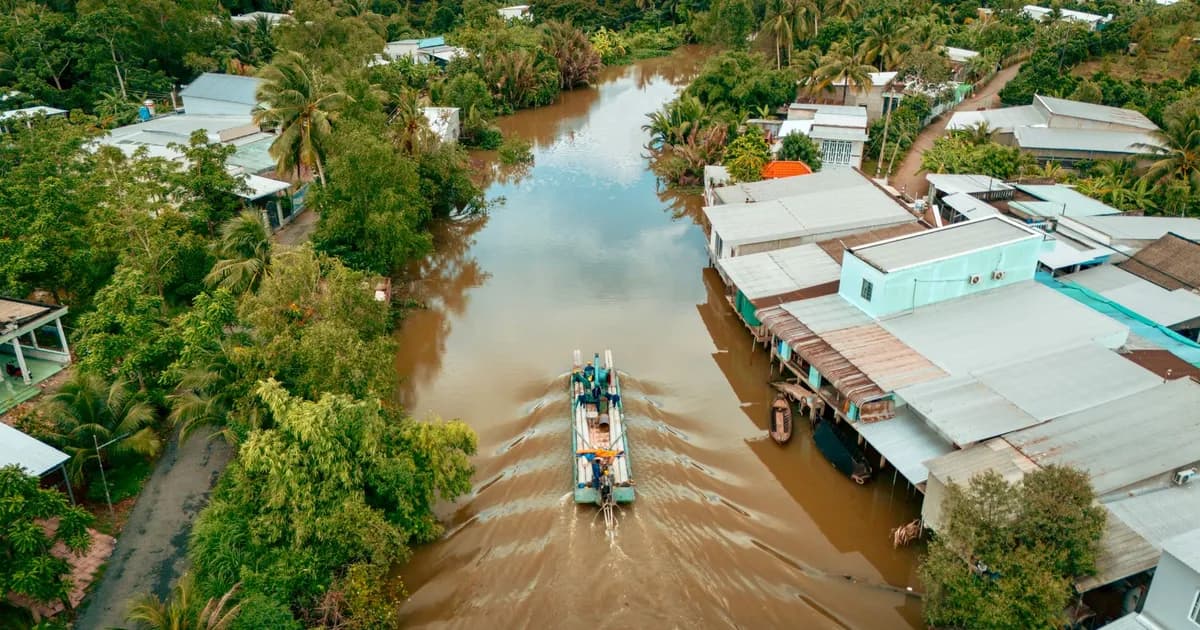
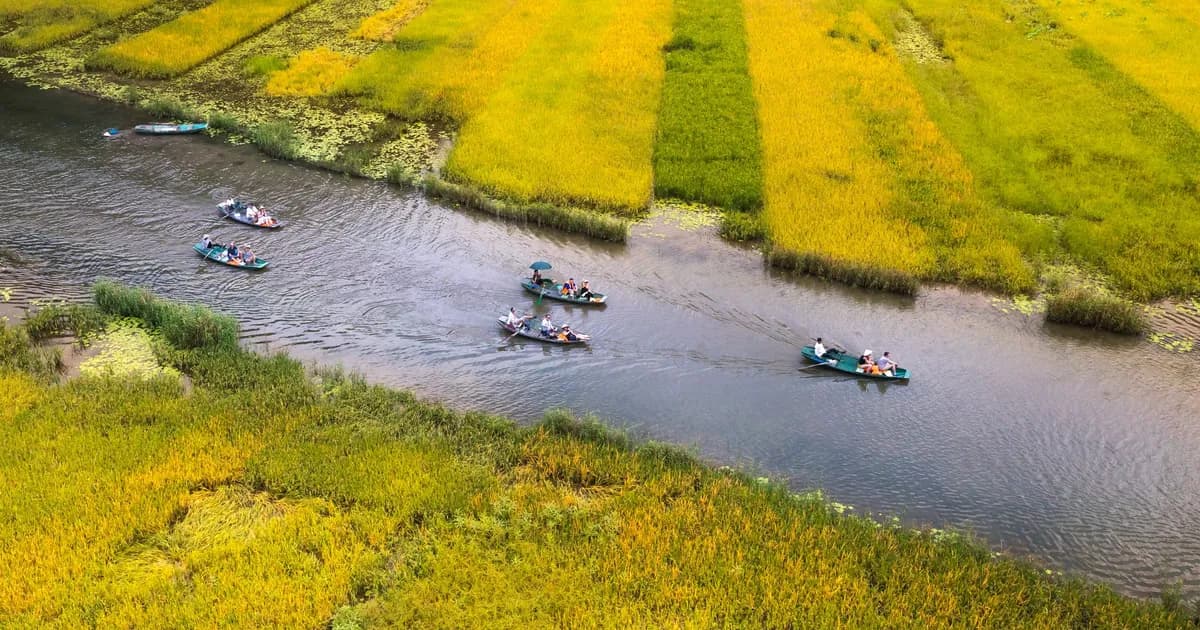
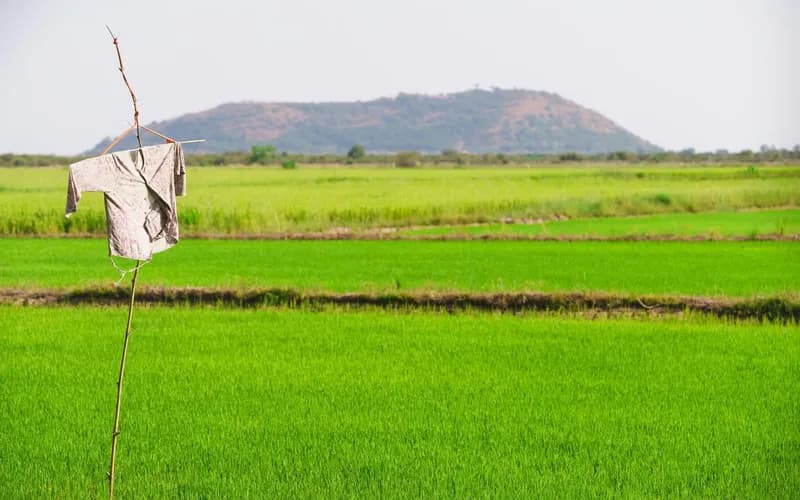
Kampong Thom is one of Cambodia's largest provinces by area: a broad plain of rice fields, sugar palms and seasonal wetlands drained by the Stung Sen, the river that gives the provincial capital its modest waterfront. There is no beach here, no nightlife strip, no signature sunset viewpoint lined with tripods. What there is instead is space. You can walk a temple complex for three hours without meeting another foreign visitor. You can cycle village lanes where the loudest sound is a hand pump filling a bucket. The pace resets your expectations after the intensity of Siem Reap.
That contrast matters more than usual in 2026. Cambodia's international arrivals fell sharply through the first half of the year: the Ministry of Tourism recorded roughly 1.54 million foreign visitors between January and May, down close to 48 per cent year on year, with the prolonged closure of much of the Thai land border the dominant cause. Angkor is quieter than it has been in a decade. Kampong Thom, though, has always been quiet, and its emptiness is not a symptom of anything. It is simply how the province works. If you are building an itinerary around the places that avoid the crowds, this one belongs near the top of the list.
One request. Up to five tailored proposals.
Skip contacting agencies one by one — share your trip once and let up to five trusted Cambodia agencies come to you. Free, with no obligation.
Get my free quotesSambor Prei Kuk: Isanapura Before Angkor
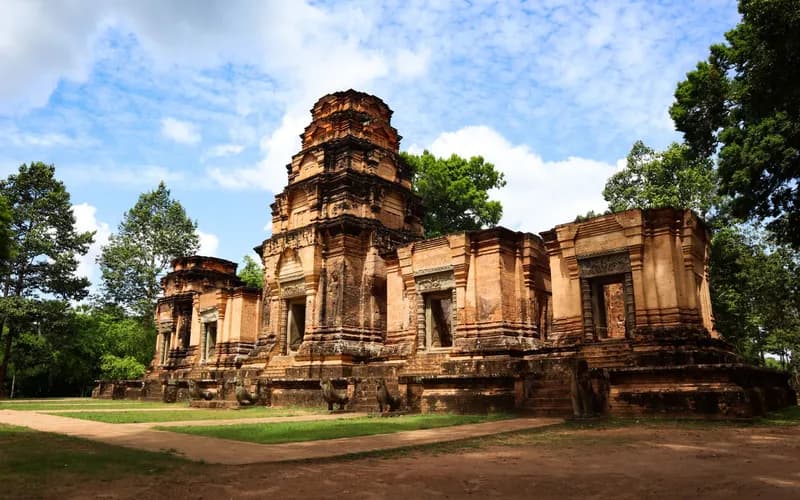
The reason to come is thirty-five kilometres north-east of the provincial town, down a lane that turns to red laterite as soon as it leaves the highway. Sambor Prei Kuk is the surviving core of Isanapura, the capital of the Chenla kingdom built in the early seventh century under King Isanavarman I. It was a genuine city, with a walled royal enclosure, water management and more than a hundred brick sanctuaries, several centuries before the first stones were laid at Angkor. UNESCO inscribed it in 2017, making it Cambodia's third World Heritage property after Angkor and Preah Vihear.
What survives is brick rather than sandstone, and that changes the experience completely. Angkorian temples impress through scale and geometry. Sambor Prei Kuk works through texture: soft red brick furred with lichen, carved directly rather than faced in stone, with lintels and octagonal towers that exist nowhere else in Khmer architecture. The famous decorative panels of flying palaces, small aerial pavilions carved in relief on the outer walls, are among the earliest narrative sculpture in the country. You are looking at the moment Khmer art found its own vocabulary.
Walking the Three Temple Groups
The site divides into three main groups, and the walk between them is a large part of the pleasure. Prasat Sambor, the northern group, is the largest, with a central tower ringed by smaller sanctuaries and a scatter of fallen lintels laid out on the ground where you can study the carving at eye level. Prasat Tao, the central group, is named for the two sandstone lions that guard its stairway, the best-preserved sculpture on the site. Prasat Yeay Poan, the southern group, is the most atmospheric: octagonal brick towers half-swallowed by strangler figs, with root systems that have prised open doorways and then held the walls together.
Counting the connecting trails, the loop across all three groups runs to roughly six or seven kilometres of easy walking through dipterocarp forest. Most of the temples face east, so morning light is far better than afternoon, and the canopy keeps the heat manageable until about eleven. Local guides will also point out shallow depressions in the forest floor, craters left by bombing during the war years, a reminder that this landscape has a recent history as well as an ancient one. Wear closed shoes; the paths are sandy and root-crossed rather than paved.
Get matched with up to 5 trusted Cambodia agencies
- Free
- No obligation
- Up to 5 agencies
The Community That Runs the Site
Sambor Prei Kuk is unusual in Cambodia for how much of its visitor economy stays in the surrounding villages. The Isanborei community-based tourism initiative, founded by residents of the hamlets inside and around the archaeological zone, trains local guides, runs homestays and organises ox-cart and bicycle circuits through the rice fields between temple groups. Entry to the site costs US$10 for foreign visitors, and a licensed local guide adds about US$6, which is one of the better value-for-money arrangements in Cambodian heritage tourism.
Staying overnight is the single change that transforms this from a stop into a visit. Rooms in the Isanborei network start around US$11 and usually include breakfast and dinner, eaten with the family. You get the temples at dawn, before any day-trip minibus from Siem Reap arrives, and you get the village at dusk, when the working day ends and the lanes fill with children, bicycles and returning cattle. If you have never done this before, our guide to staying in Cambodian homestays covers the practicalities and the etiquette.
Kampong Thom Town: A Working River Stop
The provincial capital is not picturesque in any conventional sense, and it does not pretend to be. It is a working market town of perhaps forty thousand people strung along the Stung Sen, with a large covered market, a bridge that everyone crosses at least twice a day, and a riverside road that comes alive around five in the afternoon when the temperature drops and the drinks carts appear. Two or three low-key hotels and a scatter of guesthouses cover accommodation, with the well-regarded Sambor Village at the upper end from around US$60 a night and simple guesthouse rooms from US$15.
Spend an evening walking the riverbank and eating at whichever stall has the longest queue of local families. The food here is unpretentious provincial Khmer cooking: grilled river fish, samlor korko soup thick with vegetables, num banh chok noodles for breakfast. Nothing about the town demands your attention, which is precisely why it is restful after a temple day.
Phnom Santuk, Silk and the Road South
Seventeen kilometres south of town, Phnom Santuk rises out of the plain as a low forested hill with a pagoda on top and 809 steps to reach it. The climb takes twenty-five to forty minutes depending on how often you stop, and the reward is a working monastery, a series of reclining and seated Buddhas carved directly into the rock outcrops, resident macaques with no manners at all, and a long view over rice country that explains the geography of the whole province in one glance. Go early or late; the steps are exposed in places.
At the foot of the hill, the stonecarving village of Kakaoh lines the highway, where families cut sandstone Buddhas and temple lions with hand tools and angle grinders. A little further along National Road 6 is the Santuk silk farm, where you can follow the entire process from mulberry leaf to silkworm to dyed thread to finished krama scarf. Further south again, Prasat Kuha Nokor sits inside a modern pagoda compound, a small, complete eleventh-century sandstone temple that most people drive straight past.
Seasons, Costs and How Long to Stay
November to February is the obvious window: dry, with daytime highs in the low thirties Celsius and genuinely cool mornings. March to May is hot, regularly above 35C, and the forest walk at Sambor Prei Kuk becomes hard work after mid-morning. June to October brings afternoon rain, and while the countryside is at its greenest and the rice is in, the laterite lanes turn slick and ox-cart circuits are sometimes cancelled. The Water Festival in November, when the Stung Sen hosts local boat races, is the province's liveliest moment.
Budget-wise, Kampong Thom is inexpensive even by Cambodian standards. A realistic figure for two nights, covering a mid-range guesthouse, a homestay night, temple entry, a local guide, tuk-tuk transfers and all meals, sits somewhere between US$70 and US$120 per person. Two nights is the sweet spot. Three lets you add Phnom Santuk and a slow morning at the market without ever feeling rushed.
Getting There and Getting Around
Every bus and minivan running the Phnom Penh to Siem Reap corridor passes through Kampong Thom, which makes arrival easy from either direction: roughly three hours from Siem Reap and four to five from Phnom Penh, depending on the operator and the number of stops. Ask specifically for a ticket to Kampong Thom rather than a through fare, and confirm the drop-off point, which is usually on the highway rather than at a terminal. Our overview of how to move around Cambodia overland explains the operator landscape and how to book.
The Phnom Penh to Siem Reap expressway is under construction but is not expected to open before the late 2020s, so National Road 6 remains the artery for now. Once in town, hiring a remorque, the trailer tuk-tuk that is Cambodia's workhorse, for a full day out to Sambor Prei Kuk and back typically costs US$25 to US$35 including waiting time. Agree the price and the itinerary before you set off, and factor in a stop for lunch, because there is little to eat inside the archaeological zone beyond drinks stalls.
A Three-Day Shape for a Slow Visit
Day one: arrive mid-afternoon, drop your bag, walk the market and the riverfront, eat early and sleep. Day two: leave for Sambor Prei Kuk at seven, walk the three groups before the heat, take lunch in the village, spend the afternoon on a bicycle or ox-cart circuit through the rice fields, and stay the night in an Isanborei homestay. Day three: return to town for breakfast, ride south to Phnom Santuk and the silk farm, then continue to Siem Reap or Phnom Penh in the late afternoon.
If you are heading north afterwards, this sequence works particularly well as a prologue to Angkor rather than an epilogue. Seeing seventh-century brick first makes the twelfth-century sandstone legible in a way it simply is not otherwise. Our practical notes on planning your days at Angkor will help you build the second half of the trip.
What to Do Next
- Block two nights in Kampong Thom into your Phnom Penh to Siem Reap leg rather than treating the province as a transit corridor.
- Book an Isanborei homestay directly through the community office at Sambor Prei Kuk, or ask your guesthouse in town to call ahead a day in advance.
- Budget US$10 for site entry plus US$6 for a local guide, and carry small US dollar notes and riel, as card payment is not available at the site.
- Start walking the temple groups by 07:30 to get the eastern facades in morning light and finish the loop before the midday heat.
- Add Phnom Santuk and the Santuk silk farm on your departure morning, both of which sit directly on the road south.
- Use our plan your journey resources to fit the province into a wider slow route through central Cambodia.
Frequently Asked Questions
Is Sambor Prei Kuk worth visiting if I have already seen Angkor?
Yes, and arguably it is more interesting after Angkor than instead of it. The two sites are separated by five centuries and are architecturally unrelated in materials, plan and decoration. Sambor Prei Kuk is also a fundamentally different experience in scale and solitude: a forest walk between ruined brick towers rather than a monumental circuit shared with thousands of people.
How much time do I need at Sambor Prei Kuk?
Three to four hours covers the three main groups at a comfortable pace, including the walking trails between them. If you add a village bicycle or ox-cart circuit, plan a full day. Arriving for opening and leaving after lunch is the most common shape for a day trip from Kampong Thom town.
Can I visit Sambor Prei Kuk as a day trip from Siem Reap?
You can. It is roughly 120 kilometres south-east, which means around two and a half hours each way by private car, and several Siem Reap operators sell it as a full-day excursion. But the drive eats the best light at both ends of the day, and you miss the village entirely. Staying a night in Kampong Thom is a far better use of the same money.
Is there an entrance fee, and what does it cover?
Foreign visitors pay US$10, which covers access to all three temple groups. A licensed community guide costs roughly US$6 extra and is worth it, because the carving details and the site layout are difficult to read without one. Cambodian nationals are charged a lower rate or admitted free.
What should I wear and bring?
Closed walking shoes, a hat, sunscreen and at least a litre and a half of water per person. Shoulders and knees covered is the correct standard for any active religious site, and Phnom Santuk in particular is a working monastery. There is very little shade between the temple groups at midday, and no reliable place to refill water inside the zone.
Is Kampong Thom safe and easy for independent travellers?
Yes. It is an ordinary Cambodian provincial town with normal small-town risks and nothing more. English is limited outside hotels, so a translation app and a written destination in Khmer help. Mobile data coverage is good in town and adequate at the temple site, and QR payment is widely accepted in shops, though not at the archaeological zone itself.