Koh Ker and Cambodia's Northern Temple Frontier: The Quietest Angkorian Circuit
Most visitors fly into Siem Reap, spend three days inside the Angkor Archaeological Park, and leave convinced they have seen Khmer architecture. They have seen its masterpiece. They have not seen its frontier. Two hours north-east of the guesthouse district, in a province most itineraries skip entirely, stand a tenth-century capital that was abandoned after about two decades, a temple enclosure so vast that photographs cannot hold it, and an unrestored ruin that has become the standard shorthand for what Angkor looked like before the archaeologists arrived. This is Cambodia's northern temple frontier, and in 2026 it is quieter than it has been in years, for reasons both good and sobering.
The capital that lasted twenty years
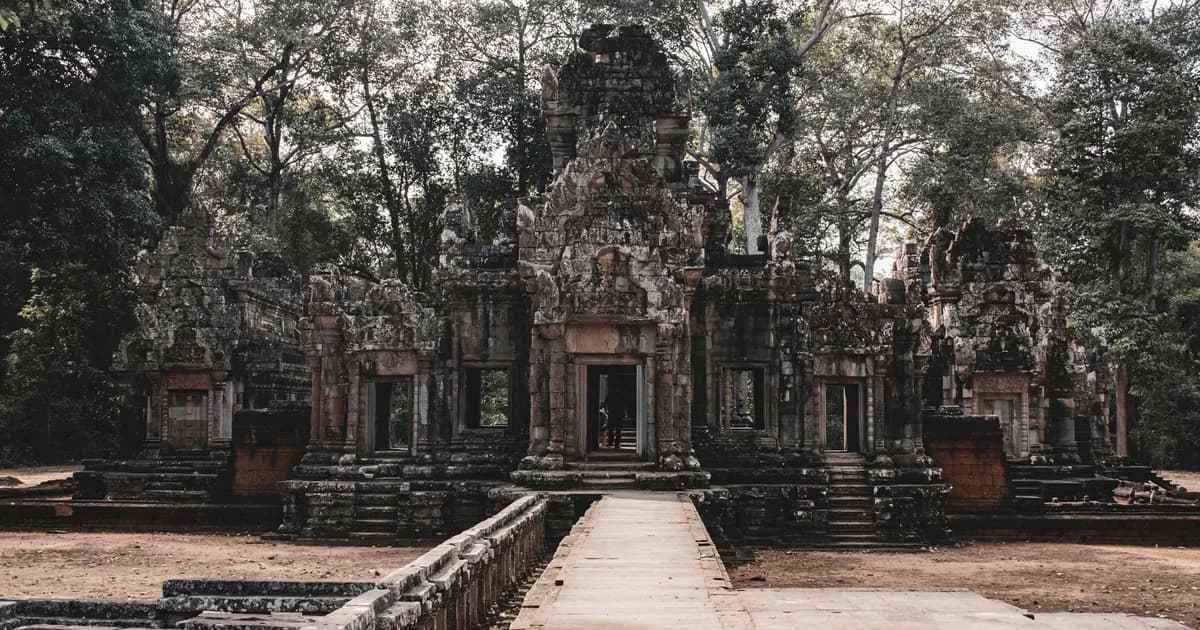
Koh Ker, called Lingapura or Chok Gargyar in the inscriptions, was the seat of Jayavarman IV, who ruled from roughly 921 to 941, and briefly of his son Harshavarman II. For about two decades the centre of the Khmer world sat here rather than on the Angkor plain, and the court built at a speed that still shows. The masonry is heavier than at Angkor Wat, the proportions blunter, the ambition unmistakable. Then the capital moved back west and Koh Ker was left to the forest for a thousand years.
That short occupation is exactly what makes the site legible. There are no later additions confusing the picture, no Bayon-era reworkings, no Buddhist overlay grafted onto Hindu foundations. What you walk through is a single architectural moment, preserved by abandonment. UNESCO inscribed Koh Ker as a World Heritage site on 17 September 2023, recognising it as a planned capital rather than a scatter of ruins.
If early Khmer architecture is what draws you north, the natural companion trip is the brick sanctuary complex further south. Our piece on Kampong Thom and the pre-Angkorian heartland covers what came two centuries before Koh Ker, and the two sites read very differently once you have seen both.
One request. Up to five tailored proposals.
Skip contacting agencies one by one — share your trip once and let up to five trusted Cambodia agencies come to you. Free, with no obligation.
Get my free quotesWhat you actually see at Koh Ker
The centrepiece is Prasat Thom, and specifically Prang, its seven-tiered sandstone pyramid rising roughly 36 metres out of flat forest. A modern wooden staircase runs up the eastern face to the top platform, where the view is 360 degrees of unbroken canopy with almost no sign of human settlement. It is one of the few places in Cambodia where you can stand on an Angkorian monument and see essentially what the builders saw.
Around the pyramid, a linear axis of gates, galleries and libraries runs east, much of it collapsed, and beyond that a scatter of smaller satellite temples spread across several kilometres of forest and reservoir. Prasat Pram, with its trees growing straight out of brick towers, is the most photographed of them. Prasat Krahom, the red temple immediately beside Prasat Thom, holds fragments of the enormous statuary that made Koh Ker a target for looters through the war years and after.
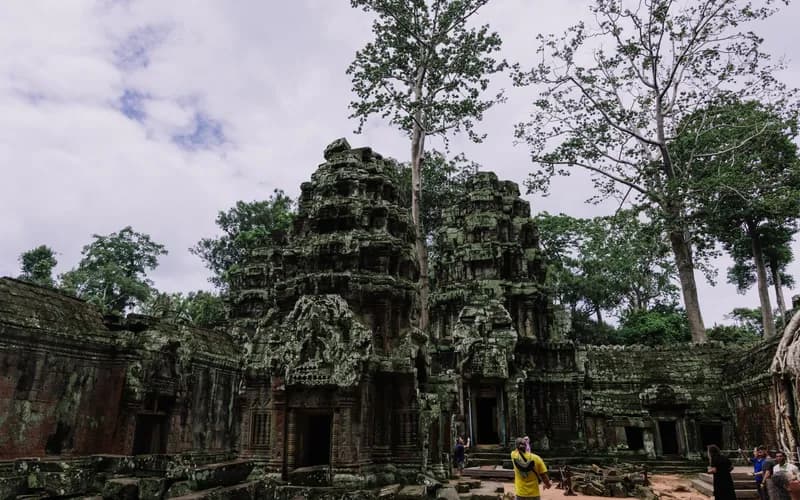
Two practical notes. First, the satellite temples are spread out, so this is not a walking site: you will drive between groups. Second, this was mined country. Clearance work has opened the main groups and the connecting tracks, and the standing advice has not changed in twenty years: stay on cleared paths and marked routes, and do not wander into scrub for a better photograph.
Beng Mealea, the temple that was never rebuilt
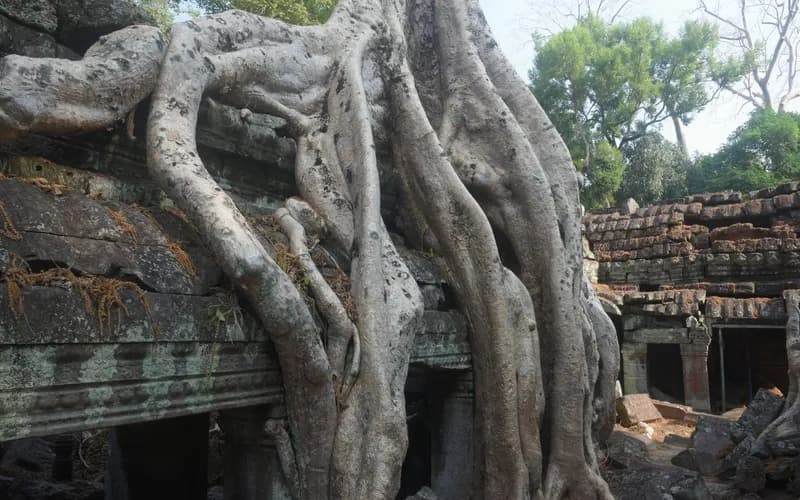
Beng Mealea sits between Siem Reap and Koh Ker, roughly an hour to ninety minutes from town, and most drivers will fold it into the same day. It is a twelfth-century temple in the Angkor Wat idiom, and it has never been reconstructed. Galleries have folded in on themselves, sandstone blocks lie where they fell, strangler figs have taken the courtyards. Wooden walkways now carry you over the worst of the collapse.
The comparison people make is to Ta Prohm, and it is a fair one, except that Beng Mealea has none of the crowd management, none of the barriers, and a fraction of the visitors. It is on Cambodia's UNESCO tentative list and pays a separate ten-dollar entrance fee that is not included in any Angkor pass.
If the appeal of this whole route is the absence of other people, it is worth reading our guide to Cambodia off the beaten path alongside this article. Beng Mealea and Koh Ker are the temple end of a much longer list.
Get matched with up to 5 trusted Cambodia agencies
- Free
- No obligation
- Up to 5 agencies
Preah Khan of Kompong Svay: the largest and loneliest
Preah Khan of Kompong Svay, known locally as Prasat Bakan, is the temple almost nobody reaches. Its outer enclosure is the largest of any Angkorian complex, several kilometres on a side, with a baray big enough to appear clearly on satellite imagery. It lies roughly 105 kilometres east of Angkor, in Preah Vihear province, and it was connected to Angkor Thom by a royal road that passed through Beng Mealea.
It has also been looted more comprehensively than almost any other major Khmer site. Some of the finest sculpture in the world's museums came out of here, often without paperwork, and what remains on the ground is fragmentary. Expect tumbled laterite, a face tower missing its faces, and long walks between structures.
Access is the obstacle and the point. The approach roads are unsealed and seasonal, there are no facilities beyond a drinks stall, and the last stretch can need a motorbike, a pickup or a high-clearance vehicle depending on recent rain. Arrange it through someone who has driven it this season rather than someone who drove it in 2019. Budget a full day from Siem Reap, or better, break the journey and stay in the province.
Preah Vihear: why the cliff temple is off the table
Any honest article about this region has to say this plainly. The cliff-top temple of Preah Vihear, the site that gives the province its name and the most spectacularly sited monument in Cambodia, is closed to visitors and has been since the border fighting of 2025. Shellfire damaged all five of its gateway pavilions, sections of ceiling in the access corridors have come down, and the authorities cite both structural instability and the risk of unexploded ordnance. As of late 2026 there is no announced reopening date.
Do not believe a tour listing that says otherwise. Operators keep old product pages live for years, and several still advertise Preah Vihear and Koh Ker as a single day trip. Ask the question directly when you book, and be sceptical of an answer that sounds rehearsed.
The wider picture matters too, because the crossings in this part of the country have been shut since mid-2025. Our update on the Thailand-Cambodia land border explains which gates are working and how to route around the closures, and it is required reading if you were planning to arrive overland from Thailand.
Tbeng Meanchey and staying in the province
Tbeng Meanchey, the provincial capital, is about as far from a tourist town as a provincial capital gets in Cambodia. There are guesthouses in the fifteen to thirty dollar range, a good morning market, a handful of restaurants where the menu is whatever is cooking, and very little English. It is not charming in the way Kampot is charming. It is simply a working Khmer town, and staying a night there changes the shape of the trip entirely.
The alternative is Srayong or one of the small settlements nearer Koh Ker, where a few basic homestays and guesthouses have appeared since the UNESCO listing. Standards vary wildly and booking platforms barely cover them, so phone ahead or have your driver call. Our article on staying in Cambodian homestays covers what to expect and how to handle payment and etiquette when there is no reception desk.
Getting there, and why not to rush it
The standard route from Siem Reap runs east on National Road 6 to Dam Dek, then north through Beng Mealea, then onto provincial road 2610 for the last stretch into Koh Ker. Reckon on about two and a quarter hours each way to Koh Ker in dry conditions, more in the wet, and add a toll for part of the way. Roads in the region have improved markedly over the past decade; this is no longer the endurance drive it was.
Almost everyone does it as a private car day trip. That works, but it means five hours in a vehicle to spend three hours at the sites, and it forces you into the middle of the day when the light is flat and the heat is at its worst. The better version is two days: Beng Mealea and Koh Ker on day one with a night in the province, Preah Khan of Kompong Svay or a slow return on day two.
Pricing depends on vehicle, season and how hard the second day is. Agree the full itinerary, the waiting time and who pays for fuel and tolls before you leave. Our guidance on hiring a driver or guide in Cambodia explains the norms, including what a licensed guide adds over a driver who speaks good English.
Tickets, costs and where the money goes
Koh Ker charges its own fifteen-dollar entrance ticket, bought at a booth at the site entrance. Beng Mealea charges ten dollars, also separately. Neither is covered by an Angkor pass, which surprises a great many people at the gate. Cambodian citizens and long-term foreign residents holding the relevant pass enter free.
This matters in 2026 more than usual. Angkor ticket sales for the first eight months of the year came to fewer than 475,000, down roughly 29 percent year on year, and officials have pointed to the slow pandemic recovery compounded by the border conflict. Less revenue means less conservation money and thinner staffing at the outlying sites. Paying the separate fees at Koh Ker and Beng Mealea, hiring a local guide, and eating and sleeping in the province are the most direct ways a visitor's money reaches the places that need it.
When to go
November to February is the obvious window: dry roads, cooler air, and the best chance of getting to Preah Khan of Kompong Svay without a recovery vehicle. March to May is punishing on an exposed pyramid with no shade. June to October brings green forest, dramatic skies, far fewer people and genuine road risk on the unsealed approaches.
Whatever the month, leave Siem Reap early. At Koh Ker the reward for a seven o'clock start is having a UNESCO World Heritage site more or less to yourself, which is an increasingly rare thing anywhere in Southeast Asia. If you are still shaping the wider trip, our plan your journey page for Cambodia sets out how this region fits with the Mekong towns and the coast.
What to Do Next
- Confirm the current status of Preah Vihear temple with your operator in writing before you book anything that includes it.
- Block out two days rather than one, and pick a night in Tbeng Meanchey or near Koh Ker.
- Budget the entrance fees separately: fifteen dollars for Koh Ker, ten for Beng Mealea, neither on your Angkor pass.
- Book a driver who has done the Preah Khan of Kompong Svay track this season, and agree the route, waiting time and tolls in advance.
- Carry more water than you think you need, plus cash in small dollars and riel; there are no reliable ATMs past Dam Dek.
- Read the current border guidance if any part of your route touches Thailand.
Frequently Asked Questions
Is Koh Ker included in the Angkor pass?
No. Koh Ker has its own fifteen-dollar ticket sold at the site, and Beng Mealea has its own ten-dollar ticket. Only Cambodian citizens and long-term foreign residents with the relevant Angkor Enterprise pass enter free. Budget both fees as extras.
Can I visit Preah Vihear temple in 2026?
No. The temple has been closed to visitors since the 2025 border fighting, which damaged all five gateway pavilions and left parts of the access corridors unsafe, with unexploded ordnance also a stated concern. No reopening date has been announced. Ignore tour listings that still advertise it.
How long does Koh Ker take from Siem Reap?
About two and a quarter hours each way by car in dry conditions, via National Road 6 to Dam Dek and then north. Longer in the wet season. A day trip is feasible but tight; two days is far more comfortable and lets you add Preah Khan of Kompong Svay.
Is the area safe with regard to landmines?
The main temple groups and connecting tracks have been cleared and are safe to walk. The rule that has not changed is to stay on marked paths and cleared routes, and never to step into uncleared scrub for a photograph. Follow your guide's instructions without improvising.
Can I climb the pyramid at Prasat Thom?
Yes. A wooden staircase on the eastern face runs to the top platform, and the panorama of unbroken forest is the single best reason to make the trip. It is steep, fully exposed and hot by mid-morning, so go early and take water.
Do I need a guide, or is a driver enough?
A driver is enough logistically, and many drivers know the sites well. A licensed guide adds the inscriptions, the chronology and the looting history, which is most of what makes Koh Ker interesting rather than merely quiet. If you take only one guide on your trip, take it here rather than at Angkor Wat.
Where should I sleep if I stay overnight?
Tbeng Meanchey, the provincial capital, has plain guesthouses from roughly fifteen dollars. Closer to Koh Ker there are a handful of basic homestays and guesthouses that barely appear on booking platforms. Have your driver call ahead rather than relying on online availability.
Keep reading
More from the ground · Cambodia