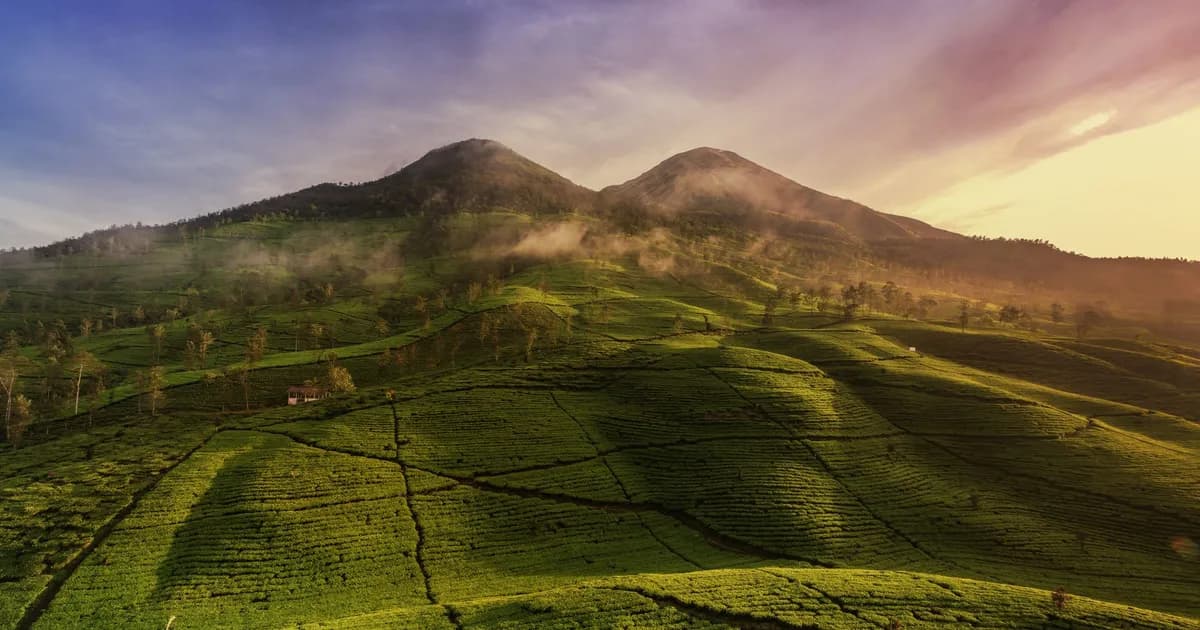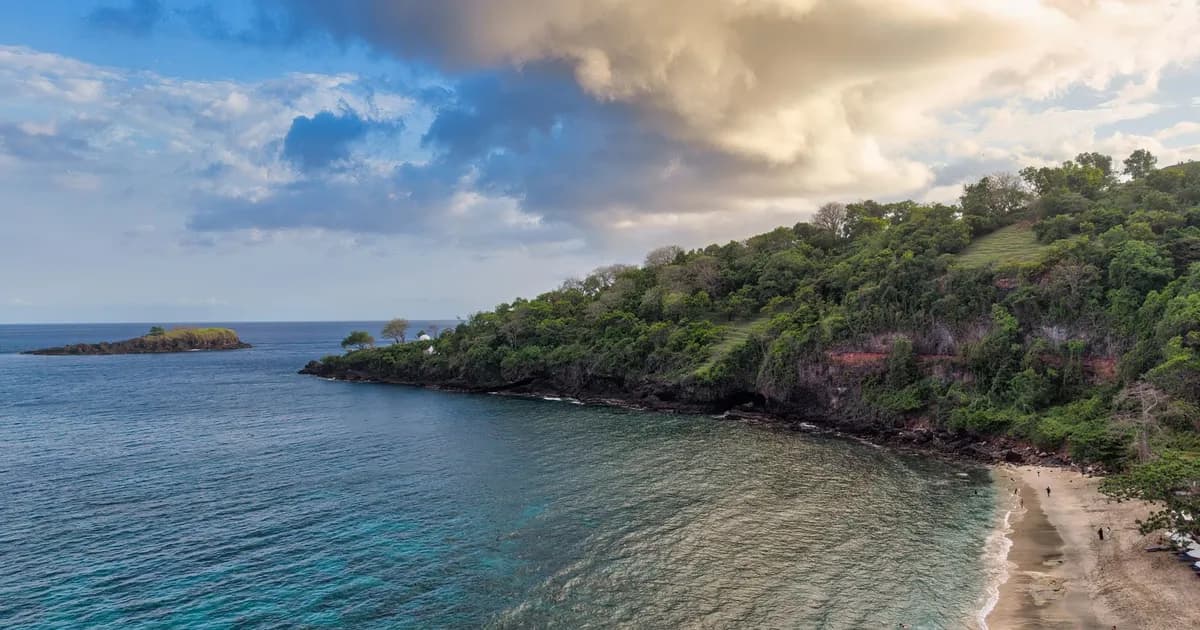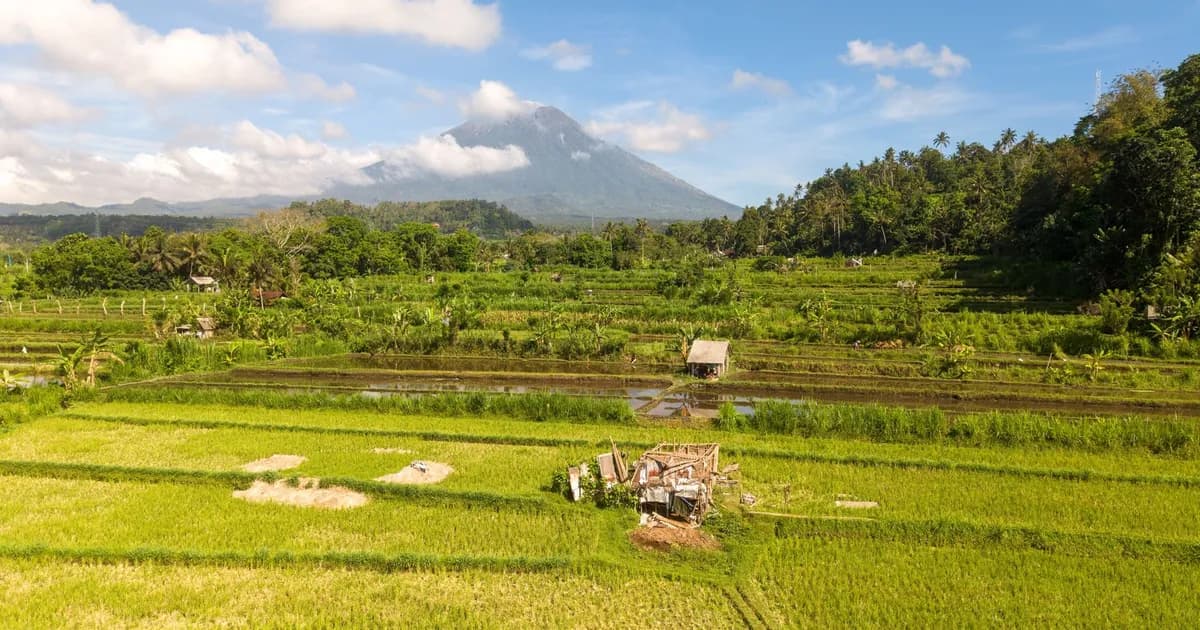


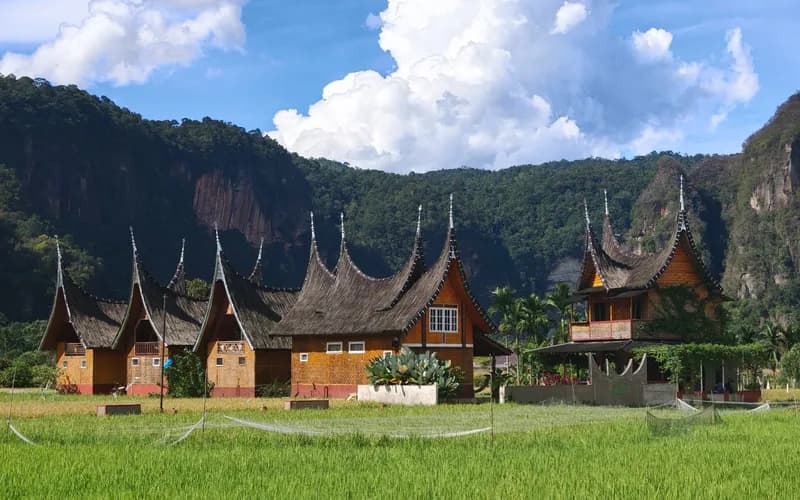
Sumatra's overland routes run mostly north to south, and West Sumatra tends to be a province travellers pass through rather than stop in. That is worth correcting. Two hours inland from Padang the road climbs out of the coastal heat onto a plateau of volcanic soil, terraced rice and market towns whose roofs curve upward like the horns of a buffalo. This is the Minangkabau heartland: one of the largest matrilineal societies on earth, the birthplace of the cooking the world knows simply as Padang food, and a region that has never learned to perform for visitors, largely because there have never been very many.
Where the Highlands Are, and Why They Feel Different
The Minangkabau highlands sit in the middle of West Sumatra province, most of the towns between roughly 900 and 1,000 metres above sea level, ringed by three volcanoes: Marapi, Singgalang and Sago. The altitude does most of the work. Mornings are cool enough for a light jacket, afternoons rarely turn oppressive, and the humidity that flattens you in Padang loosens its grip within the first hour of the climb. Four of Sumatra's major rivers rise in these hills, which explains the fertility, and the fertility explains everything else: rice terraces stacked into every available fold, cinnamon and coffee on the upper slopes, and markets that overflow twice a week.
What makes the region unusual is not the scenery alone. Minangkabau society is matrilineal. Ancestral land and the family house pass from mother to daughter, clan identity descends through the female line, and men have traditionally left home in early adulthood to seek a living elsewhere, a custom called merantau that has scattered Minang restaurants across Indonesia and Malaysia. The result is a place that is at once devoutly Muslim and firmly matrilineal, a combination that surprises visitors who assume the two must be in tension. They are not, and people here will explain the arrangement with some pride if you ask politely and have half an hour.
Travellers arriving from the long, gentle days around Lake Toba will find the highlands busier and more agricultural: less lounging, more walking, eating and conversation. It is a region for people who like small towns.
One request. Up to five tailored proposals.
Skip contacting agencies one by one — share your trip once and let up to five trusted Indonesia agencies come to you. Free, with no obligation.
Get my free quotesBukittinggi: A Market Town That Rewards Slowness
Bukittinggi is the natural base, a hill town of around 120,000 people arranged along ridges with the Jam Gadang clock tower at its centre. It is not beautiful in the postcard sense. It is busy, a little scruffy, full of minibuses and mobile phone shops, and entirely convincing as a working Indonesian town rather than a tourism set piece.
Give it two or three days and it opens up. The Pasar Atas and Pasar Bawah markets are the reason to stay: the upper market for textiles, songket weaving and the region's famous embroidery, the lower for produce, dried fish, chillies and the sort of stall breakfasts that cost less than a coffee at home. Market days on Wednesday and Saturday pull in traders from every surrounding village and are worth planning around.
Other things worth your time include the Japanese wartime tunnels bored into the hillside during the 1942 to 1945 occupation, sobering and matter-of-factly presented; the Rumah Adat Baanjuang museum, which does a decent job of explaining clan houses and marriage customs; and the simple pleasure of sitting in a warung at dusk with a glass of teh talua, the whisked egg-and-tea drink that is a Minang institution.
Sianok Canyon and the Walk Nobody Books
The Sianok Canyon begins at the edge of town, a green gorge roughly 100 metres deep cut by the Sianok river, with cliffs on both sides and a floor of rice fields and small hamlets. Most visitors photograph it from Panorama Park and leave. The better move is to walk down into it.
A path drops from near the park through the village of Sianok Anam Suku and follows the valley floor for several kilometres before climbing out again on the far side. It takes two to four hours depending on how often you stop, needs no guide and no permit, and delivers the single best morning in the region: buffalo in the shallows, women planting in rows, kingfishers, and the cliffs turning gold as the light shifts. Go early, carry water, and expect to be greeted roughly forty times. A local guide is not necessary but will get you invited into houses, which is a different and often better experience.
Get matched with up to 5 trusted Indonesia agencies
- Free
- No obligation
- Up to 5 agencies
Harau Valley: Cliffs, Rice and Very Little to Do
Half an hour east of Bukittinggi, near the town of Payakumbuh, the Harau Valley is the image most people eventually see of West Sumatra: sheer granite walls several hundred metres high enclosing a flat floor of paddy, waterfalls dropping straight off the rim, and a handful of homestays sitting among the fields.
Harau is small. You can walk its length in a morning. That is precisely the point. There is rock climbing on bolted routes for those who want it, several waterfalls that fill and fade with the rains, and otherwise nothing to do except read, walk between hamlets, and watch the light move across the cliffs. Two nights is the minimum for the valley to register; three or four is better. Accommodation is almost entirely family-run and simple, and booking directly is normal here, which is worth understanding before you arrive: our guide to choosing and booking a homestay in Indonesia covers how that works in practice.
One honest caveat: Harau has become popular with domestic weekend visitors, and a few operators have installed photo props and gimmick attractions near the entrance. Walk past them. The valley behind is unchanged.
Lake Maninjau and the Forty-Four Bends
Lake Maninjau lies about 36 kilometres west of Bukittinggi, a caldera lake reached by the Kelok Ampek Puluah Ampek, the road of forty-four hairpin bends that drops from the crater rim to the shore. The descent is the attraction as much as the destination. Numbered signs mark each bend, macaques sit on the walls, and every few turns opens another view down onto the water.
The lake itself is quieter and less prosperous than it once was. Floating fish farms have affected water quality in parts, and periodic fish die-offs are a real local problem rather than a rumour. Swim where locals swim, ask before assuming, and treat the lake as a place to spend a slow day or two rather than a beach resort. The road that circles the shore is roughly 70 kilometres and makes a fine unhurried motorbike or bicycle loop, passing mosques, rice mills and villages where the arrival of a foreigner is still mildly notable.
Pagaruyung, Batusangkar and the Matrilineal Thread
South-east of Bukittinggi, around Batusangkar, sits the historical core of the Minangkabau world. The Istano Basa Pagaruyung is a full-scale reconstruction of the royal palace of the Pagaruyung kingdom, rebuilt after a lightning strike and fire in 2007 and finished in 2013. Purists note that it is a replica; it is still the clearest way to understand the architecture, with three storeys of carved timber, buffalo-horn gables and an interior arranged around the sleeping quarters of married daughters.
More interesting, if you have time, are the surrounding villages. Balimbing and Pariangan are both full of genuine rumah gadang, the long clan houses, many of them a century or more old and still lived in. Pariangan in particular, on the slopes of Marapi, is claimed locally as the original Minangkabau village and has terraced fields, an old mosque and hot springs. These are working settlements, not open-air museums. Ask before photographing houses and people, and dress conservatively, as you would anywhere in rural Sumatra. Our note on everyday etiquette in Indonesian temples, mosques and villages applies with particular force here.
Eating in the Home of Padang Food
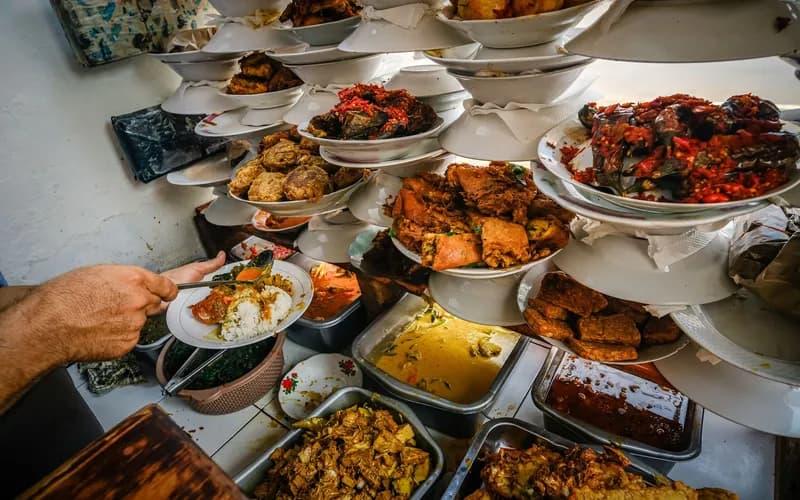
Almost every Indonesian town has a rumah makan Padang, the restaurants where a dozen small dishes are stacked in the window and brought unbidden to your table, with payment only for what you touch. Eating that food in West Sumatra is a different order of experience.
The regional specialities are worth seeking by name. Rendang here is drier, darker and slower-cooked than the wet curry served elsewhere. Dendeng batokok is beef pounded thin, fried and heaped with green chilli. Gulai itiak is duck in a fiercely green chilli gravy, particularly associated with Ngarai and Koto Gadang. Sate Padang, thickened with rice flour and turmeric, is a street-corner dish quite unlike Javanese satay. Katupek gulai paku, a fern-and-rice-cake breakfast, is the thing to order at a market at seven in the morning.
Two practical notes. Portions arrive as a spread and you are charged per dish consumed, so take only what you want and say so plainly. And chilli levels here are genuinely high by Indonesian standards, so ask for tidak terlalu pedas if you need to. For the wider culinary map, our slow traveller's guide to Indonesian food sets Minang cooking in context.
Living With Marapi: The Honest Caveat
Mount Marapi, the volcano that dominates the eastern skyline, is one of Sumatra's most active. It has been at Alert Level II on Indonesia's four-level scale continuously through 2026, with a three-kilometre exclusion zone around the Verbeek crater and repeated ash emissions, including columns of around 2,000 metres in the first half of the year. The 2023 eruption that killed climbers on the summit trail is recent and locally raw.
In practical terms this affects visitors very little. Bukittinggi, Harau and Maninjau are all well outside the exclusion zone and operate normally. What it does mean is that the summit climb is not currently an option, ashfall can occasionally close the trail network or dust the towns downwind, and you should check PVMBG status before planning anything on the mountain's flanks. Anyone tempted to look for a guide willing to bend the rules should read our piece on trekking Indonesia's volcanoes responsibly first. Singgalang, the dormant neighbour, remains a legitimate and demanding day climb.
Getting There and Moving Around
Minangkabau International Airport (PDG) serves Padang with domestic flights from Jakarta, Medan and Kuala Namu, plus a small number of regional international services. The airport rail link runs into Padang city, but for the highlands you want the road.
From Padang to Bukittinggi is roughly 90 kilometres and two to three hours, longer in Friday traffic or heavy rain. Options are a shared travel minibus booked through your guesthouse, a private car with driver for something in the region of 600,000 to 900,000 IDR one way depending on stops, or a public bus from Aur Kuning terminal. The road climbs through the Anai Valley past a roadside waterfall where almost everyone stops.
Once in the highlands, local transport is by angkot minibus, ojek motorbike taxi, and rented scooters at around 100,000 to 150,000 IDR a day. Roads are winding and shared with trucks, so ride conservatively. Ride-hailing apps work in Padang and patchily in Bukittinggi. Distances are short but slow: assume 40 kilometres per hour as a planning figure and you will not be disappointed.
Two weeks is generous for the region and lets you add the Mentawai ferry or a run north towards Toba. Five to seven days covers Bukittinggi, Sianok, Harau, Maninjau and Batusangkar without rushing.
What to Do Next
- Fix your base first. Book three nights in Bukittinggi and two or three in Harau, and leave the rest open. That framework covers the whole region without backtracking.
- Check the volcano status. Look up the current PVMBG alert level for Marapi before you commit to anything on the mountain, and confirm again on arrival.
- Time your visit around market day. Wednesday or Saturday in Bukittinggi transforms the town; build your itinerary so you are there for one of them.
- Arrange transport from Padang in advance. Message your guesthouse on WhatsApp and ask them to organise the pickup, with a stop at Anai Valley written into the plan.
- Learn ten words of Indonesian. Terima kasih, permisi and berapa harganya will carry you a long way in a region with very little English.
- Talk to a specialist if you want village access. Homestays inside working rumah gadang and introductions to weavers are usually arranged locally, and the vetted Indonesian operators in our directory can set that up properly rather than as a staged visit.
Frequently Asked Questions
How many days do I need in the Minangkabau highlands?
Five to seven days is the realistic minimum for Bukittinggi, Sianok Canyon, Harau Valley, Lake Maninjau and the Batusangkar villages at a comfortable pace. Ten days lets you slow right down, add day walks between villages and spend a proper stretch in Harau. Anything under four days means driving more than looking.
Is West Sumatra safe for travellers right now?
Yes, with the usual caveats. The region is calm, crime against visitors is rare, and the main risks are road conditions and volcanic activity rather than security. Mount Marapi remains at Alert Level II with a three-kilometre exclusion zone, so the summit is off limits, but the towns and valleys are unaffected. Check current PVMBG advice before any activity on the volcano's flanks.
What is the best time of year to visit?
May to September is driest and best for walking and rice-terrace views. December and January bring the heaviest rain, which can make canyon paths slippery and waterfalls dramatic in equal measure. The highlands are cooler year-round than coastal Sumatra, and the shoulder months of April and October are often quiet and pleasant.
Do I need to book accommodation in advance?
In Bukittinggi, one or two nights booked ahead is sensible; after that you can move freely. In Harau Valley, book ahead for weekends and Indonesian public holidays, when domestic visitors fill the small guesthouses. Outside those windows, arriving and choosing in person is normal and often cheaper.
How conservative should I dress?
West Sumatra is more observant than Bali or Java's tourist corridors. Shoulders and knees covered is the sensible default for everyone, and women will feel more comfortable with loose clothing in villages and markets. A scarf is useful for mosque visits. Swimwear is for the water only, not for walking through a village.
Can I visit as a vegetarian?
It takes effort. Minang cooking is built on beef, chicken, fish and eggs, and even vegetable dishes often use meat stock or dried fish. That said, gulai nangka (jackfruit curry), sayur daun singkong (cassava leaf), tempeh and tofu dishes are widely available, and saying saya tidak makan daging clearly at the counter usually works. Larger towns have Padang restaurants with enough options; remote villages will be harder.
Is the region easy to combine with other parts of Sumatra?
Reasonably. Lake Toba is a long but feasible overland run north, typically broken into two days. Ferries to the Mentawai Islands leave from Padang and Bungus, taking roughly ten to twelve hours on the slower services. Flights from Padang connect to Medan, Jakarta and Batam, which makes the highlands a practical start or finish rather than a detour.