Community Tourism in Laos in 2026: Who Actually Benefits from Slow Travel
Laos has spent the past few years accumulating the vocabulary of responsible tourism. Community-based tourism, homestay standards, ecotourism benefit funds, protected-area concessions, certification schemes. The country collects regional awards for these things in quantity, and the awards are not fraudulent: some of the arrangements behind them are among the better-designed community tourism models anywhere in Southeast Asia. But 2026 is also the year Laos expects between five and six million international visitors, and a well-designed model serving a few thousand people a year sits inside a tourism economy of a very different scale. The interesting question is not whether community tourism in Laos works. It is how much of the country's tourism it actually accounts for.
The Numbers Behind the Story
Laos passed 4.5 million international arrivals in 2025 and government projections for 2026 sit in the five to six million range, with Chinese visitors alone expected to account for around two million. That growth is not evenly distributed. It concentrates overwhelmingly in Luang Prabang, Vientiane, Vang Vieng and the corridor served by the Laos-China railway, with a secondary cluster around Pakse and the Bolaven Plateau.
Community-based tourism, by contrast, is distributed almost exactly inversely. The village networks, homestay clusters and protected-area programmes sit in Luang Namtha, Houaphanh, Khammouane, Phongsaly, Sekong and Attapeu, which is to say the provinces where visitor numbers are smallest and growing slowest. The result is a structural mismatch: the places best equipped to distribute tourism income fairly receive the least tourism, and the places receiving the most have the least developed mechanisms for spreading it.

This is not a secret inside the Lao tourism sector, and it is one of the tensions running through the national strategy. We have looked at the headline ambitions in detail in our analysis of Laos's tourism plan for 2026 to 2030, and the gap between volume targets and distribution goals is the thread worth pulling.
One request. Up to five tailored proposals.
Skip contacting agencies one by one — share your trip once and let up to five trusted Laos agencies come to you. Free, with no obligation.
Get my free quotesWhat the Awards Actually Recognise
Laos has performed strongly in the ASEAN tourism standards system, collecting 29 awards across categories in a single recent round. Four of those came under the ASEAN Homestay Standard, going to one homestay in Vang Vieng district and three in Champasak. Five came under the ASEAN Community-Based Tourism Standards, recognising wildlife viewing at Nam Et-Phou Louey National Park in Houaphanh alongside village initiatives in Khammouane, Luang Namtha and Luang Prabang provinces.
It is worth being precise about what this means, because the phrase "award-winning community tourism" does a lot of work in marketing copy. These standards assess things like management structure, benefit-sharing arrangements, safety, hygiene, guide training and environmental practice at a specific property or programme. They are audits of individual operations, not of the country. Nine awards across homestay and community-based categories means nine operations met a regional benchmark. It does not mean the sector as a whole has.
That said, the operations that win these are usually genuinely worth visiting, and the certification is a reasonable shortcut for travellers with no other way to tell a real village programme from a rebranded tour. The same logic applies to protected-area tourism, which we cover in our piece on Laos's protected areas moment.
The Nam Et-Phou Louey Model
The most instructive example in Laos is the Ecotourism Benefit Fund at Nam Et-Phou Louey National Park in Houaphanh, because it does something most community tourism does not: it makes the payment conditional on the outcome.
The structure works roughly like this. Every visitor on a park tour contributes a fixed amount to a village development fund, shared between the villages around the tour area. Around the Nam Nern night safari, that fund has been divided equally between fourteen villages. On top of the fixed amount, villages receive an additional payment that varies with the wildlife visitors actually see, recorded by guests on a monitoring form at the end of the trip. More animals seen, more money to the villages.
The logic is direct. If income rises when wildlife is abundant and visible, the community has a financial interest in animals being alive rather than sold. Over time the programme has extended to around 26 villages, roughly 30 per cent of the communities surrounding the protected area.
It is a good model and it has been studied and published as such. It is also small. A night safari that takes a handful of visitors at a time, in a province most itineraries skip, in a country expecting millions of arrivals, is a demonstration rather than a solution. Getting there is itself a commitment, which is part of why Houaphanh remains quiet; our guide to Vieng Xai and Sam Neua gives a sense of the journey involved.
Get matched with up to 5 trusted Laos agencies
- Free
- No obligation
- Up to 5 agencies
Where the Money Leaks
Follow a typical visitor's spending through Laos and the leaks become visible. An international flight booked abroad. A hotel owned by a regional chain or a foreign investor. A tour bought through a platform headquartered elsewhere. Meals in restaurants catering to visitors, often with imported ingredients. Entrance fees that go to a provincial authority rather than a village. In many destinations across the region, studies have repeatedly found that the share of visitor spending retained in the local economy is far lower than travellers assume, and there is no reason to think Laos is an exception.
The upper end of the Lao market is growing, and it is growing largely through international capital. New luxury and boutique openings continue through 2026, including the return of a well-known Luang Prabang hilltop property under an international brand later in the year. These developments bring jobs, training and tax revenue, and they raise standards. They also mean a larger share of a larger pie leaving the country. Our survey of where Laos's new hotels are going traces who is building what.
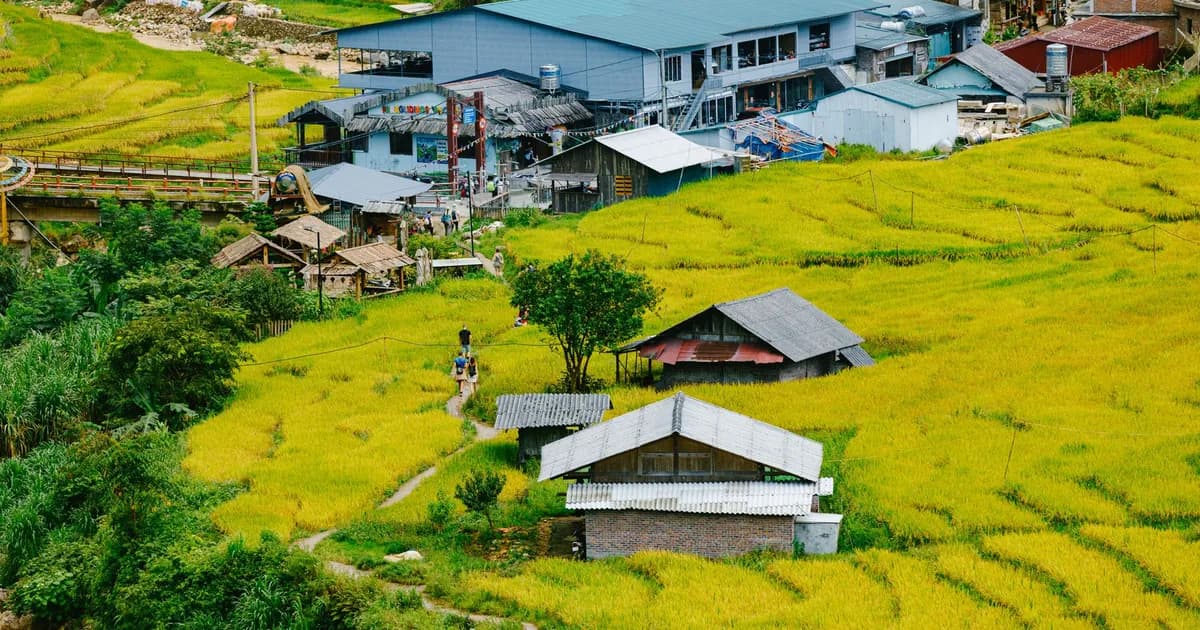
The counter-example is instructive in its simplicity. A family guesthouse, a market breakfast, a bus ticket, a village guide, a bowl of noodles and a bag of tea bought from the household that grew it: almost all of that money stays within a few kilometres of where it was spent. The mechanism that makes community tourism work is rarely a certification scheme. It is usually just proximity.
The Short-Stay Problem
There is a second structural issue, and it is arguably more important than ownership. Laos has a short average stay relative to the length of the country and the slowness of its transport. A large share of arrivals are regional visitors on short trips, cross-border traffic, and increasingly rail passengers who enter, spend a night or two in Luang Prabang or Vientiane, and leave.
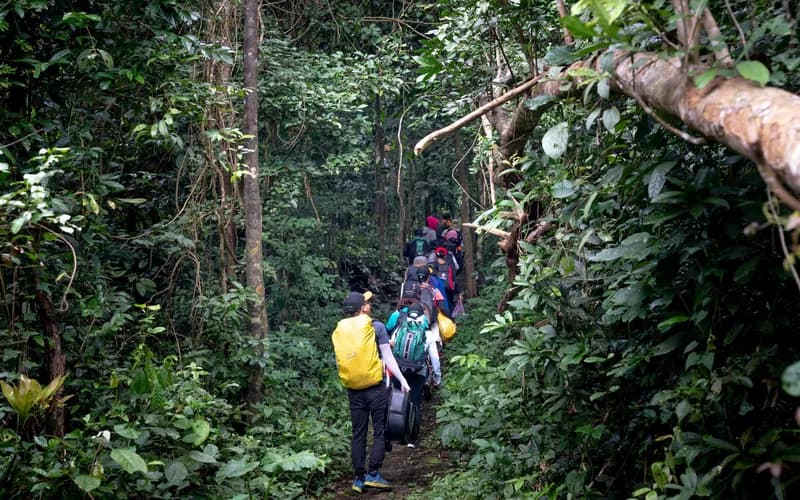
Short stays and community tourism are close to incompatible. A village homestay requires a day to reach, a night to experience and a day to leave. A protected-area night safari requires two or three days end to end. A trek requires a minimum of two nights before the arithmetic works for either the visitor or the host. None of that fits a three-night itinerary built around a train timetable.
This is where slow travel stops being a lifestyle preference and becomes an economic argument. Length of stay, more than budget level, determines how much of a visitor's money reaches households outside the main towns. A traveller spending three weeks in Laos on a modest budget, moving slowly through four provinces, will almost certainly distribute more money more widely than a traveller spending the same total amount over four nights in Luang Prabang.
What 2026 Changed
Two shifts are worth noting this year. The first is regulatory: Lao authorities tightened documentation requirements for inbound tourism, instructing operators to submit confirmed accommodation covering the full duration of a visitor's stay. Whatever the intent, one practical effect is to formalise the accommodation sector and push visitors towards properties that can issue paperwork, which small village homestays typically cannot.
The second is strategic. The ASEAN tourism sectoral plan for 2026 to 2030 explicitly identifies wellness travel, long stays and digital detox as growth segments. Laos is unusually well positioned for all three, for reasons that are partly accidental: limited connectivity, few large resorts, genuine quiet and a landscape that rewards staying put. If that demand materialises, the country's comparative advantage is precisely the thing that its volume targets risk eroding.
What This Means for Slow Travellers
The practical conclusions are unglamorous but they hold.
- Length of stay is the single most consequential choice you make. Three provinces in three weeks distributes money far better than eight in the same period.
- Book village-level experiences on the ground, through provincial tourism offices or village committees, rather than through international platforms that take a cut.
- Ask what proportion of a tour price reaches the village, and expect a specific answer.
- Prefer operations with recognised community certification when you have no other information, while understanding what that certification does and does not cover.
- Spend on things that have short supply chains: local food, local guides, local transport, local crafts.
Our guide to choosing a community homestay trek turns this into a set of questions you can actually ask at a counter.
The Honest Caveats
Three things complicate the picture, and it would be dishonest to leave them out.
First, community tourism is not automatically good for communities. Poorly managed homestay programmes concentrate income in a few households, create dependency on a seasonal and fragile income stream, and put real strain on families hosting strangers in small houses. Rotation, caps and fixed payments exist because the failure modes are well documented.
Second, villages are not museums, and the slow traveller's preference for the unchanged is not a development strategy. People in remote Lao provinces generally want roads, electricity, mobile coverage and options for their children. A visitor's wish that a valley stay exactly as it is has no moral claim on the people living in it.
Third, remoteness cuts both ways. The provinces with the best community tourism structures are also the hardest and most expensive to reach, which limits visitor numbers, which limits income. There is no version of this where you can visit the far north lightly; getting to somewhere like Phongsaly and the far north costs days, and those days are the price of the thing being worth visiting at all.
What to Do Next
- Build your Laos itinerary around fewer places and longer stays. Set a floor of three nights anywhere you stop.
- Include at least one province outside the Vientiane to Luang Prabang corridor, and give it a week rather than a weekend.
- Arrange treks, homestays and protected-area visits locally, on arrival, not through an international booking platform.
- Carry enough cash to pay village-level operators directly, in kip and in small notes.
- Ask every operator the benefit-sharing question, and use the quality of the answer as your filter.
- If you want a vetted starting point, our directory of Laos travel agencies lists operators working in this way.
- Return to the same place twice rather than adding a new one. Repeat visits build relationships that single visits cannot.
Frequently Asked Questions
How many international visitors does Laos expect in 2026?
Government projections put arrivals in the five to six million range for 2026, following more than 4.5 million in 2025, with Chinese visitors expected to account for around two million of that total.
Does community-based tourism in Laos actually pay villages?
In well-structured programmes, yes, through fixed per-visitor payments into village development funds and paid work for local guides. The Ecotourism Benefit Fund at Nam Et-Phou Louey goes further by linking part of the payment to the wildlife visitors report seeing. Outside such programmes, the share reaching households is much less predictable.
What do the ASEAN homestay and community tourism awards mean?
They certify that a specific homestay or community tourism operation meets a regional benchmark on management, benefit sharing, safety, hygiene and guide training. They are audits of individual operations rather than of a country's tourism sector as a whole.
Is it better to spend more money or more time in Laos?
More time. Length of stay has a larger effect than budget on how widely a visitor's money is distributed, because slow itineraries reach places and businesses that short ones cannot physically include.
Which provinces have the strongest community tourism networks?
Luang Namtha, Houaphanh, Khammouane and Phongsaly have the longest-established village tourism and trekking networks, with further initiatives around several protected areas and in Champasak in the south.
Can I book a Lao village homestay online?
Usually not. Genuine village homestays are arranged through provincial tourism offices, village tourism committees or local operators, typically a day or two ahead and often as part of a trek or boat trip.
Does mass tourism undermine community tourism in Laos?
Not directly, but it competes for the same investment, infrastructure and attention while concentrating visitors in a handful of towns. The greater risk is that short, high-volume itineraries leave no room for the multi-day formats that community tourism depends on.