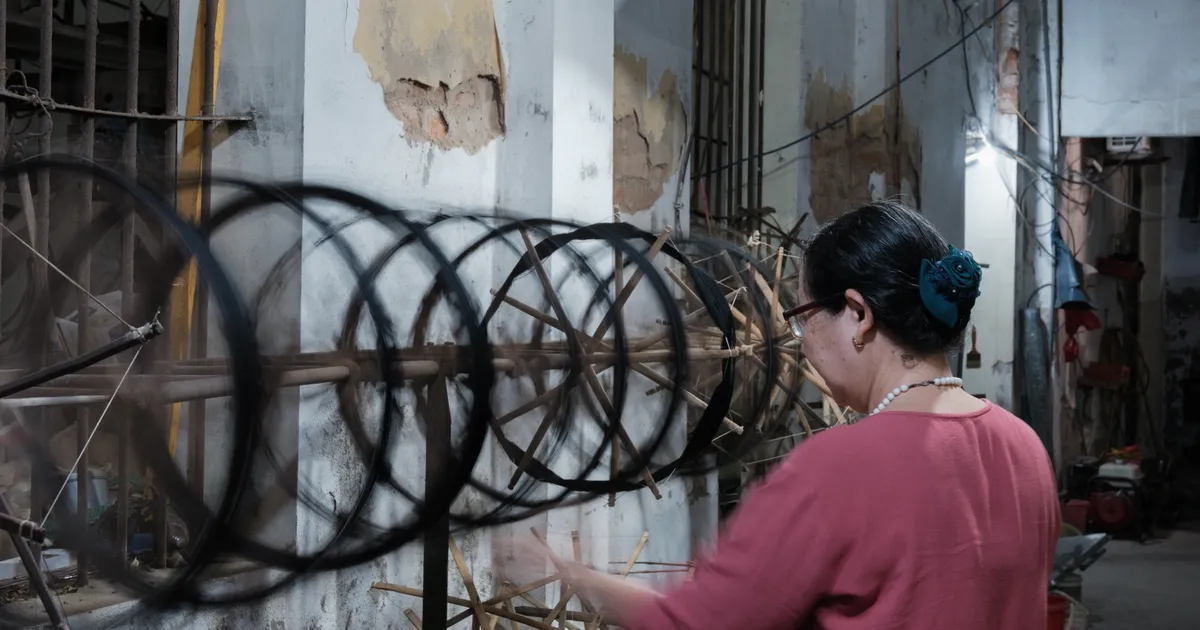


There is a moment, usually on the third or fourth day, when a traveller in Laos says sabaidee to a woman selling noodles and she answers with a full sentence instead of a nod. Nothing else has changed. The transaction is the same, the price is the same, the noodles are the same. But the register of the encounter has shifted, and it will stay shifted for the rest of the trip. Learning a little Lao is not about competence. It is about signalling that you consider the people around you worth the effort, and in a country where very few visitors bother, that signal carries an unreasonable amount of weight.
Why Ten Words Change Everything
Laos is not a country with deep English penetration outside the tourism corridor. In Luang Prabang and on the Vang Vieng strip you will manage on English alone. In Sam Neua, Thakhek, Attapeu or any village guesthouse, you will not. The gap between a trip where you can only speak to people paid to speak to you, and one where you can exchange a greeting with anyone, is the difference between watching a country and being in it.
There is also a courtesy dimension that is easy to miss. Lao social life runs on softness: indirect requests, avoided confrontation, and a strong preference for a smile over a raised voice. A greeting delivered properly, with the right gesture, does more to make an interaction go well than any amount of fluent English delivered briskly.
Forty words is a realistic target for a two-week trip. Ten is enough to change how you are treated. You can learn ten on the flight.
One request. Up to five tailored proposals.
Skip contacting agencies one by one — share your trip once and let up to five trusted Laos agencies come to you. Free, with no obligation.
Get my free quotesWhat Lao Actually Is
Lao is a tonal language of the Tai family, closely related to Thai. Most Lao speakers understand Thai easily, partly through structural similarity and partly through decades of Thai television and music. The reverse is less reliably true. This matters practically: Thai phrases will usually be understood in Laos, but using them is not a substitute, and speaking Thai at a Lao person is a small discourtesy that people notice.
The written script is a sibling of Thai script, descended from the same Khmer-derived tradition. It is written left to right, without spaces between words inside a sentence, which makes reading signs almost impossible for beginners. Do not attempt the script for a two-week trip. Learn the sounds, not the letters.
Romanisation is inconsistent to the point of comedy. The same word appears as khop chai, khawp jai and kop jai on three signs in the same street. There is no single official system, so treat every written transliteration you see, including the ones below, as an approximation of a sound rather than a spelling.
Pronunciation and Tones Without the Panic
Lao is tonal, and the Vientiane variety is usually described as having six tones. In theory this means the same syllable carries entirely different meanings depending on pitch. In practice, as a visitor speaking single words and short phrases in obvious contexts, you will be understood far more often than tone-anxiety suggests, because context does most of the work.

Three habits will get you most of the way:
- Keep it short. Single words and two-word phrases are much easier to pronounce correctly than sentences.
- Copy the melody, not just the consonants. Listen to how a phrase rises or falls when it is said to you, and repeat the shape.
- Do not shout. Volume does not fix tone, and raising your voice reads as anger in Lao social terms.
The one sound worth practising deliberately is the vowel in kip and in sip, which sits somewhere between the English i and e. And the ng at the start of words such as ngeun, meaning money, which English speakers find awkward because English never begins a word that way.
Get matched with up to 5 trusted Laos agencies
- Free
- No obligation
- Up to 5 agencies
The Core Twelve: Greetings and Courtesy
If you learn nothing else, learn these.
- Sabaidee. Hello, good day, and often goodbye. Universal, all day, all situations.
- Khop chai. Thank you. Add lai lai for thank you very much.
- Kho thot. Sorry, or excuse me, including for squeezing past someone.
- Baw pen nyang. Never mind, no problem, you are welcome. The single most useful phrase in the language and a fair summary of the national temperament.
- Chao. Yes, in its ordinary polite form.
- Baw. No. Combine it: baw mee means there is none, baw dai means cannot.
- Khoy baw khao chai. I do not understand.
- Khao chai. I understand.
- Phop kan mai. See you again, a warmer goodbye than sabaidee.
- Yu sai. Where is it. Attach it to a noun: hong nam yu sai for where is the toilet.
- Duai. Please, appended to soften a request.
- Sep. Delicious. Say it about food and watch what happens.
Many Lao speakers, particularly in Vientiane and in towns with heavy Thai media exposure, add a polite particle at the end of a sentence, khap for men and kha for women. Using it is not required of a visitor, but copying it when you hear it is well received and costs nothing.
Numbers, Prices and Bargaining
Kip numbers are large, which means the number words you need most are the big ones. One is neung, two song, three sam, four si, five ha, six hok, seven jet, eight paet, nine kao and ten sip. After that, twenty is sao, one hundred is hoi, one thousand is phan, ten thousand is meun and one hundred thousand is saen.
So a fifty thousand kip room is ha sip phan, and a twenty thousand kip bowl of noodles is sao phan. Being able to hear sao phan and understand it is more useful than being able to say it, because it removes the calculator from the transaction.
Thao dai means how much. An ni thao dai is how much is this. Phaeng means expensive, and lut noi dai baw asks whether the price can come down a little. Bargaining in Laos is gentle and low-stakes: a smile, one counter-offer, and acceptance of the answer. Hard haggling is culturally off-key and rarely saves much.
Cash mechanics matter as much as vocabulary here. If you have not sorted out how you will actually pay for things, our guide to paying in Laos with kip, dollars and baht covers the ATM situation and which currencies are genuinely accepted where.
Food Words That Earn Their Keep
Food is where a handful of Lao words converts directly into a better trip, because it moves you off the English menu and onto whatever the kitchen actually cooks.
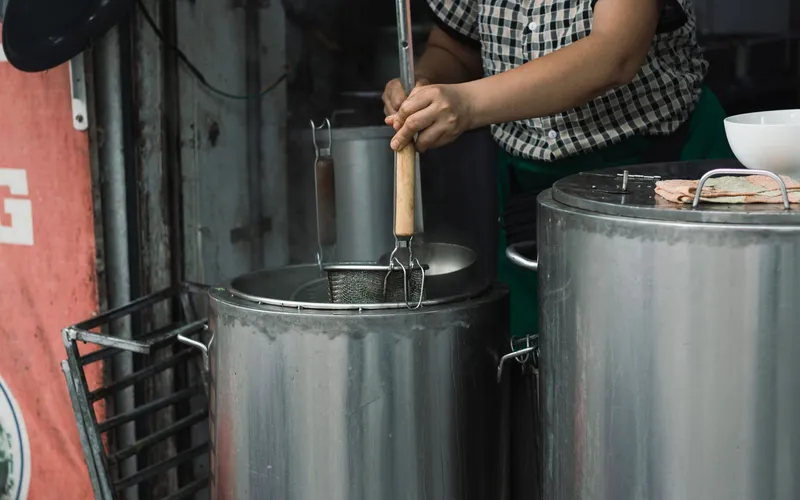
Khao is rice, and khao niaw is the sticky rice eaten by hand across most of the country. Nam is water. Sin is meat, pa is fish, kai is chicken and phak is vegetables. Khoy kin jay says that you eat vegetarian, and it is understood in most towns, though be aware that fish sauce is often not counted as meat, so specify.
Pet means spicy, and baw sai pet means do not add chilli. Baw sai phong nua asks for no MSG. Sep, as above, means delicious, and sep lai lai will make a cook's day. If you want to know what you are ordering before you order it, our guide to Lao food and what to eat walks through the dishes these words attach to.
Getting Around: Transport Vocabulary
Pai means go. Pai Luang Prabang thao dai asks the fare to Luang Prabang. Sathani means station, and sathani lot may means bus station. Lot may is bus, lot fai is train, heua is boat and tuk tuk needs no translation.
Two words save real time. Bok, meaning stop or tell, gets used to ask a driver to stop: bok yu ni, stop here. And nyang baw, roughly meaning not yet, is the honest answer you will hear about whether the bus is leaving, and the answer you should give when asked whether you are ready.
Times are usually given on a twelve-hour clock with a period marker, and buses depart when they are full rather than when the timetable says. The vocabulary helps; the patience helps more. Our overview of how to get around Laos by bus, boat and train explains what to expect from each mode.
The Nop, and What Not to Say
The nop is the Lao greeting gesture: palms pressed together in front of the chest, a slight bow of the head. Height matters. Hands at chest level for peers, higher for monks and elders. As a visitor, the safe rule is to return a nop when one is offered and to offer one to monks, older people and anyone you are thanking sincerely. Do not nop shop staff or children, which reads as odd rather than polite.
A few things not to do. Do not touch anyone's head, including children. Do not point your feet at people or at Buddha images. Do not raise your voice or show visible irritation in a dispute, which loses you the argument socially regardless of the merits. And do not use Lao words you have half-learned in a mocking tone; the effort is appreciated, the performance is not.
Temple behaviour has its own rules that go well beyond vocabulary. Our guide to cultural etiquette in Laos covers what to wear, how to sit and how to behave around the morning alms procession, which is where visitors most often get it wrong.
Beyond Lao: The Other Languages of Laos
Lao is the national language, but it is a first language for roughly half the population. Laos recognises around fifty ethnic groups, and in the uplands you will hear Khmu, Hmong, Akha, Tai Dam and many others. In a Hmong village in Xieng Khouang or a Khmu village in Luang Namtha, Lao is a second language for your hosts as much as it is a foreign one for you, which is oddly levelling.
Do not assume. Ask your guide which language a village speaks and learn its word for hello. In Hmong that is nyob zoo; in Khmu, greetings vary widely by area. Getting this right, or even trying, is noticed immediately.
French persists among older and formally educated Lao, particularly in Vientiane, Luang Prabang and Savannakhet, and on street signs, in bakery names and in the vocabulary of bureaucracy. English is the language of the young and of tourism, and its reach is expanding quickly along the railway corridor.
How to Actually Learn Forty Words
Do not use an app that teaches you the script. Write your list on paper, one column of sound and one of meaning, and carry it. Ten courtesy words, ten numbers, ten food words, ten transport words. Practise each new word on the same day you learn it, out loud, with a real person.
Ask people to correct you. Lao speakers are generally delighted to, and the correction is where the tone finally lands. Guesthouse owners are the best teachers because you see them repeatedly and the stakes are low. By the end of two weeks a diligent traveller has forty words and, more importantly, the confidence to use them badly, which is the actual skill. This is the same principle behind everything in our slow travel charter: fewer places, more attention, and a willingness to be a beginner in public.
What to Do Next
- Learn the core twelve courtesy words before you land, starting with sabaidee, khop chai and baw pen nyang.
- Write a paper cheat sheet in four columns: courtesy, numbers, food, transport. Do not rely on your phone.
- Practise the big number words, sao, hoi, phan, meun and saen, so you can hear prices rather than read them.
- Add one word a day from what you actually hear around you rather than from a list.
- Return every nop offered to you, and offer one to monks and elders.
- Ask each guesthouse owner to correct your pronunciation once, and let them.
- In upland villages, ask which language is spoken at home and learn its greeting before you use Lao.
Frequently Asked Questions
How hard is Lao to learn for a traveller?
The basics are easier than the tonal reputation suggests. Grammar is simple, with no verb conjugation, no gender and no plurals, so short phrases are quick to build. Tones make fluency genuinely difficult, but they rarely block a visitor using single words in obvious contexts. Forty words in two weeks is a realistic and useful target.
Can I use Thai in Laos?
You will usually be understood, since most Lao speakers follow Thai media and the two languages are close. It is still better to use Lao. Speaking Thai to a Lao person can come across as assuming the two countries are interchangeable, which is a sensitivity worth respecting. Use Thai only as a fallback when nothing else works.
What is the single most useful Lao phrase?
Baw pen nyang. It covers never mind, no problem, do not worry about it and you are welcome, and it defuses almost any minor mishap. Sabaidee gets you the greeting, khop chai gets you the thanks, and baw pen nyang gets you through everything in between.
Do I need to learn the Lao script?
No, not for a normal trip. The script has no spaces between words within a sentence and takes weeks of study before signs become readable. Your time is far better spent on sounds and phrases. If a longer stay is planned, then the script becomes worthwhile, but not otherwise.
Is English widely spoken in Laos?
In Luang Prabang, Vang Vieng, central Vientiane and among younger people working in tourism, yes, reasonably. Almost everywhere else, no. Provincial towns, rural guesthouses, buses and markets run on Lao. This is precisely why a small vocabulary pays such a disproportionate return outside the main corridor.
How do I say numbers for kip amounts?
Learn the big units first. Twenty thousand kip is sao phan, fifty thousand is ha sip phan, one hundred thousand is saen. Prices in Laos are almost always quoted in thousands, so hearing phan, meun and saen correctly matters far more than knowing the words for one through ten.
Is bargaining expected in Laos?
Mildly, in markets and for tuk tuk fares, and not at all in shops, restaurants or guesthouses with posted prices. The Lao approach is soft: ask thao dai, offer one gentle counter with lut noi dai baw, then accept the answer with a smile. Aggressive haggling over small sums is poorly received and marks you out.