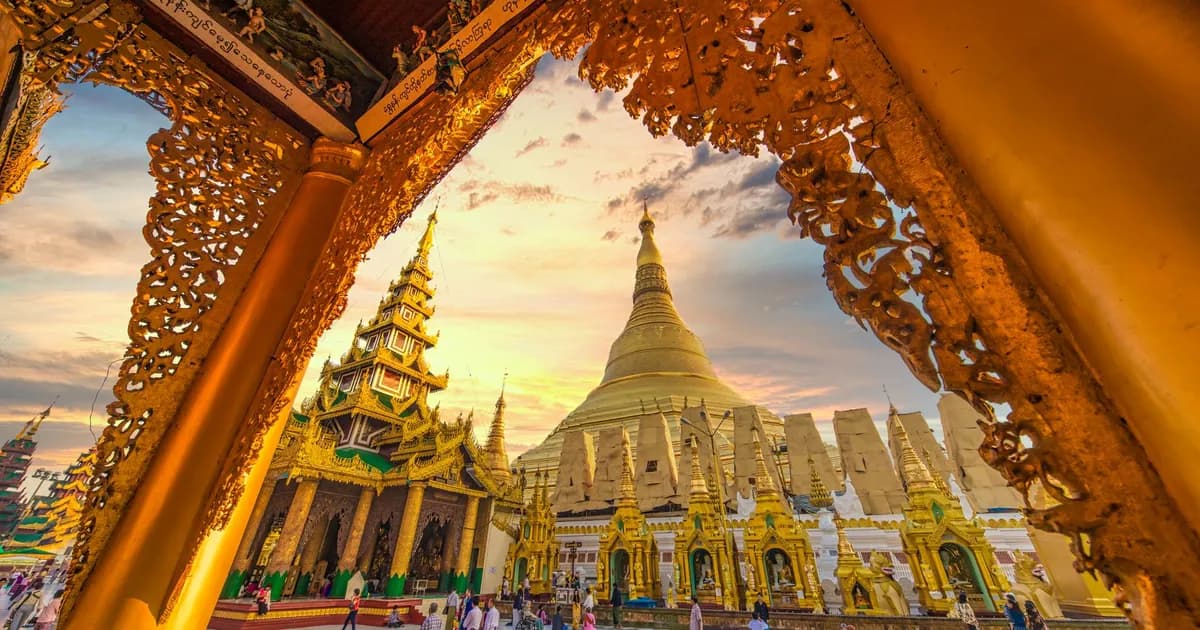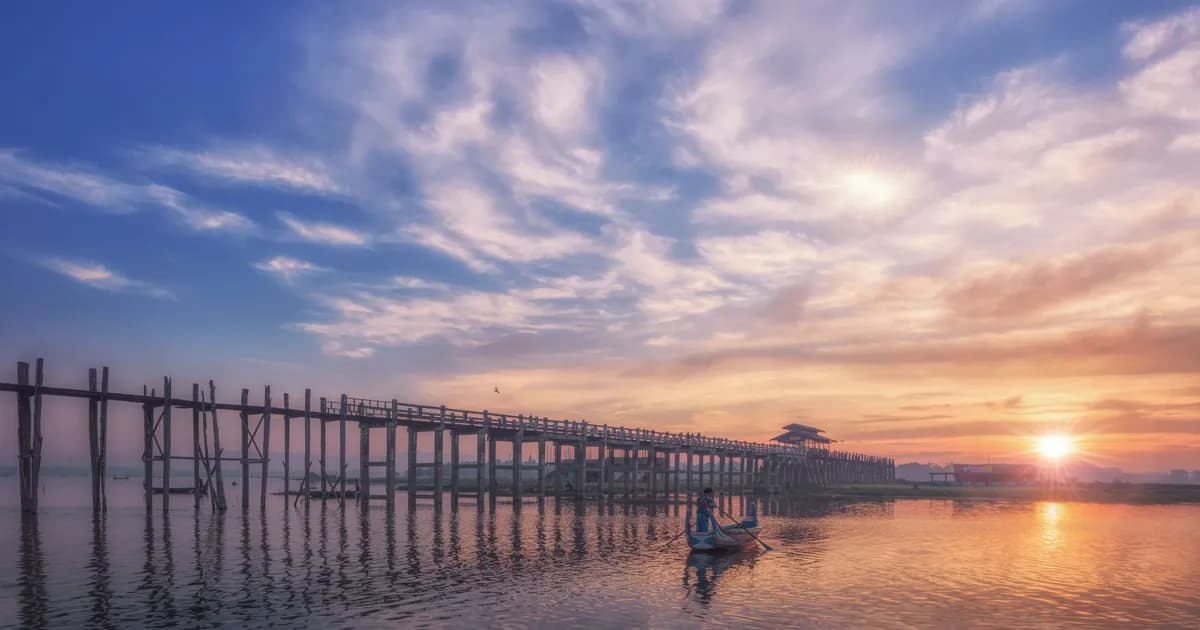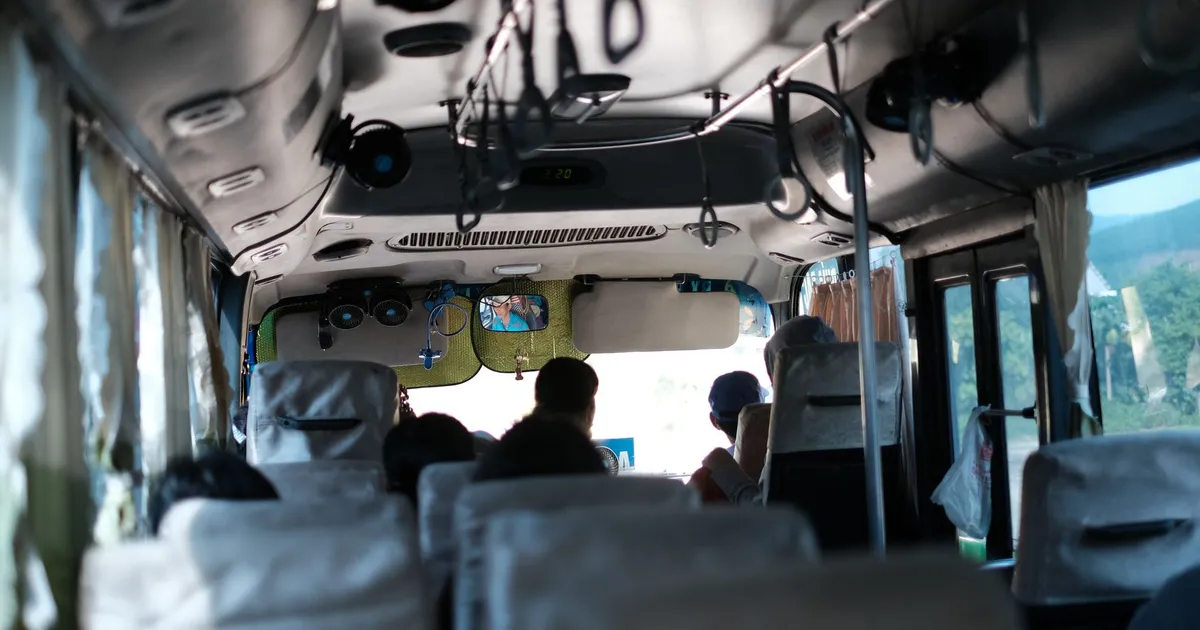


Inle Lake lies in a broad, shallow valley in Shan State, a pale sheet of water ringed by hazy blue hills and stitched together by villages that stand entirely on stilts. It is roughly twenty-two kilometres long, yet in most places barely a few metres deep, and its surface changes character through the day: mirror-still at dawn, ruffled by wind by mid-morning, gold and rose again as the light drops. Inle sits within the accessible core of the country's central circuit, an easy pairing with Bagan and Mandalay, and it is the kind of destination that repays slowness rather than speed. Rush it, and it becomes a checklist of boat stops. Give it time, and it becomes a floating world with its own rhythm, one you begin to read only after a day or two on the water.
This is a slow guide to that world: how to arrive, what to look for, and how to move through it with the care the lake and its communities deserve. If you are still shaping the wider trip, our overview of where to go and when in Myanmar sets Inle in the context of the seasons and the rest of the route.
Nyaungshwe: the gateway town
Almost every visit begins in Nyaungshwe, the small, walkable town at the northern edge of the lake. It is not on the water itself but connected to it by a canal, along which long wooden boats idle and load. Nyaungshwe is the practical base for Inle: a grid of quiet streets with guesthouses, tea shops, bicycle-rental stands, a lively morning produce market and boat piers where you arrange your time on the lake. Many travellers treat it purely as a launch pad, but it deserves a day of its own.
Spend a morning on foot or by bicycle and the town rewards you. There is a handsome teak monastery, a modest cultural museum in the former palace of the Shan sao pha, or hereditary chiefs, and a slow procession of daily life that has nothing to do with tourism. Rent a bicycle and you can ride out to the edge of the fields, where the flat farmland meets the first channels of the lake. Staying two or three nights in Nyaungshwe, rather than a single hurried one, lets you go out onto the water early, before the day boats gather, and return in the soft light of late afternoon. For help sequencing this into a longer itinerary, our plan your journey resources are a good starting point.
One request. Up to five tailored proposals.
Skip contacting agencies one by one — share your trip once and let up to five trusted Myanmar agencies come to you. Free, with no obligation.
Get my free quotesThe Intha and the art of leg-rowing
The people of the lake are the Intha, whose name means, fittingly, sons of the lake. Over generations they have built an entire way of life on the water, and their most famous emblem is the leg-rowing technique you will see the moment you leave the canal. Standing at the stern of a narrow boat, a fisherman wraps one leg around the oar and rows with a fluid, rolling motion, keeping both hands free to manage a conical net. The posture lets him stand tall above the reeds and see the fish below the surface, something impossible from a seated position.
It is genuinely beautiful to watch, and genuinely practical rather than performed, though you should be aware that a few rowers now pose near the piers for photographs and expect a tip. That is a fair exchange if you want a close portrait, but the real reward is quieter: drifting past working fishermen going about an ordinary morning, the only sound the dip of the oar and the flap of a net settling on the water.
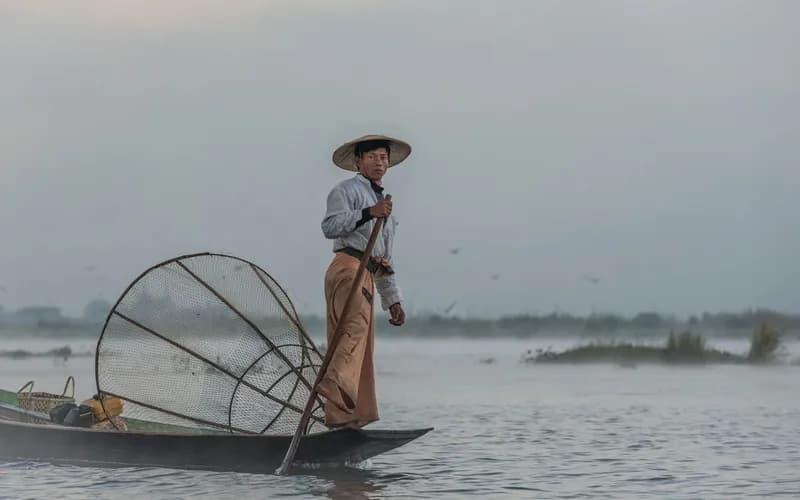
Ask your boatman to slow down and simply sit for a while. The Intha world is not a sequence of attractions but a texture, and it comes into focus only when the engine is off.
Floating gardens and stilt villages
Perhaps the most extraordinary sight on Inle is agriculture that floats. The Intha have, over centuries, built long garden beds from lake-bottom mud and mats of water hyacinth, anchored to the lakebed with bamboo poles. These floating gardens rise and fall with the water level and never flood, and they produce a remarkable quantity of vegetables, above all the tomatoes for which the lake is famous across the country. Gliding between the beds, you pass farmers tending rows of plants from their boats, hoeing and harvesting while standing in the water.
Around and beyond the gardens spread the stilt villages, whole communities of teak and bamboo houses standing on poles above the shallows, linked by water rather than roads. Children paddle to school, monks collect alms by boat, and workshops, shops and monasteries all sit on their own platforms. Life here is lived at the pace of the paddle. It is worth remembering, as you pass, that these are homes and not exhibits; a slow, unintrusive presence is the most respectful way to travel through them. The lake's produce also shapes the regional table, and if food is part of how you understand a place, our guide to what to eat in Myanmar explains the Shan dishes you are likely to meet here.
Get matched with up to 5 trusted Myanmar agencies
- Free
- No obligation
- Up to 5 agencies
Indein and the forest of stupas
A long, narrow channel winds west from the main lake, through reed beds and past a scattering of hamlets, to the village of Indein. The journey there is half the pleasure, the boat threading a waterway barely wider than itself while buffalo graze the banks. At the end lies one of Inle's most atmospheric sights: the Shwe Inn Thein complex, a hillside covered in hundreds of stupas, many of them centuries old, some restored to gold and whitewash, others left to crumble gently under moss and grass and sprouting shrubs.
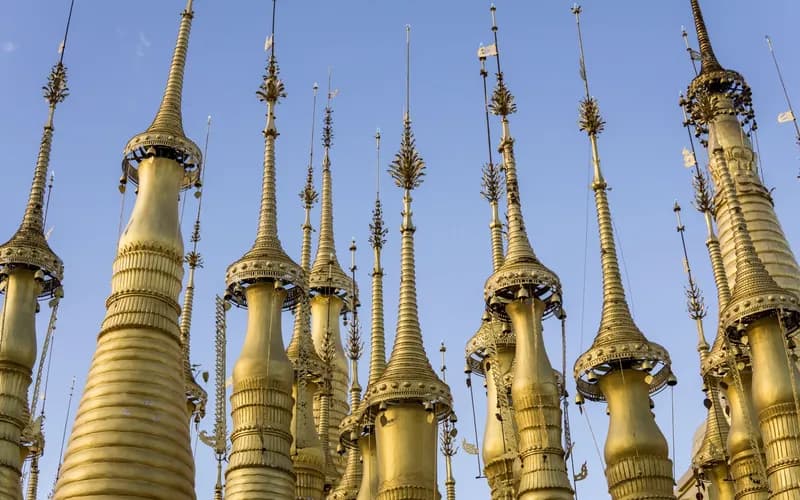
You climb to the complex along a covered stairway lined with small stalls, and at the top the ruined and restored spires stand close together in a quiet, almost forgotten crowd. Early or late in the day, with few other visitors, Indein has a particular stillness. It is also a fine example of the detours that reward those willing to leave the busiest routes; for more in that spirit, see our collection of hidden gems for slow travellers.
The five-day market and Phaung Daw Oo Pagoda
Life around Inle turns on a rotating five-day market that moves between different villages and towns in the valley, so that each community takes its turn as host. Catching the market on the right day is one of the great pleasures of a slow visit: farmers from the surrounding hills, including Pa-O and other Shan communities in their distinctive dress, arrive by boat and on foot to trade vegetables, textiles, tools and food. Ask locally which village holds the market on which day, and plan a morning around it. The genuinely local markets, away from the most heavily visited stops, are the most rewarding, and the earlier you arrive the better.
The lake's spiritual heart is Phaung Daw Oo Pagoda, home to five small Buddha images so thickly covered in gold leaf, applied by devotees over generations, that they have lost their original shape entirely. The images are deeply revered. Note that, by long custom, only men are permitted to apply gold leaf directly to them, while everyone may visit and pay respects. Each autumn the pagoda is the focus of Inle's most important festival, when the images are carried around the lake in a magnificent gilded barge shaped like a mythical bird, rowed by teams of leg-rowers in a slow procession from village to village.
Lotus-weaving, silversmiths and the crafts of the lake
Inle is one of the few places on earth where cloth is woven from lotus. Artisans snap the stems of lotus plants and draw out the fine, sticky fibres within, rolling them by hand into a thread that is then woven into a prized, breathable fabric once reserved for robes offered to senior monks. It is painstaking work, a single scarf drawing on thousands of stems, and watching it done is a lesson in patience that suits the lake perfectly. Many workshops also weave silk and cotton on traditional looms, often in the same stilt buildings.
The lake sustains other crafts too: silversmiths hammering and chasing bowls and jewellery, blacksmiths working iron at open forges, boat-builders and cheroot-rollers assembling Myanmar's mild green cigars by hand. Some workshops lean toward the commercial, with a showroom at the end of the demonstration, but the skills on display are real and centuries deep. There is no obligation to buy; a genuine interest in the work is welcome, and a fair purchase directly supports the households that keep these traditions alive.
Birdlife and the slow rhythm of the water
Inle is quietly one of the better places in the country for birdwatching, especially in the cooler months when migratory species arrive. The reed beds, marshes and open water host egrets, herons, jacanas, warblers and a range of ducks and waders, and a portion of the wetland is protected as a wildlife sanctuary. An early, unhurried boat trip with a boatman who knows where to drift is far more rewarding for birds than a fast run between craft workshops.
More broadly, the lake rewards travellers who slow down to its own tempo. The best hours are the first and the last, when the light is low, the water calm and the day boats absent. Consider building in a full day with no fixed programme at all, simply moving where the boatman suggests and stopping when something catches your eye. That unstructured time, more than any single sight, is what stays with people who love Inle.
Travelling Inle slowly and responsibly
A slow, responsible approach matters here more than in many places. Stay two or three nights at least, choose locally owned guesthouses and workshops where you can, buy directly from artisans and farmers, and let your boatman set an unhurried pace. Ask before photographing people, remember that stilt villages are homes rather than a stage, and dress and behave modestly at the pagodas and monasteries. Small choices, repeated by many visitors, add up to a real difference for the lake's communities.
It is also honest to note that Myanmar's wider situation is complex and changeable. Conditions, access and travel advisories shift over time, and several governments maintain significant advisories for the country as a whole. This is not a reason to moralise or to take sides, but a practical matter: check the current status close to your departure, keep your plans flexible, and travel with knowledgeable, well-established local operators who understand conditions on the ground and can adapt as needed. Working with a trusted partner is the single most useful thing you can do; our directory of Myanmar travel agencies is a place to start, and if you would rather have a journey shaped entirely around your own pace, our slow-travel charter is built for exactly that.
What to Do Next
- Read our guide to where to go and when in Myanmar to decide how Inle fits your season and route.
- Block at least two or three nights in Nyaungshwe so you can be on the water early and late, when the lake is at its best.
- Ask locally which village holds the five-day market during your stay, and plan a morning around it.
- Set aside one unstructured day on the water with no fixed programme, for birdlife, quiet channels and whatever the boatman suggests.
- Talk to a knowledgeable local agency about current conditions and a route paced for slow travel.
Frequently Asked Questions
How many days should I spend at Inle Lake?
Plan for at least two or three nights based in Nyaungshwe. That gives you a full unhurried day on the lake, time for a detour to Indein and the five-day market, and the chance to be on the water in the early morning and late afternoon, when the light and the atmosphere are at their finest and the day boats have not yet gathered.
When is the best time to visit Inle Lake?
The cooler, drier months from roughly November to February are the most comfortable and the best for birdlife, though the lake can be chilly at dawn. The rainy season brings lush green hills and higher water. The famous Phaung Daw Oo festival falls in the autumn; dates follow the lunar calendar and shift from year to year, so confirm them if you hope to see it.
Is the leg-rowing genuine or just for tourists?
It is a genuine, practical technique the Intha have used for generations, allowing a fisherman to stand, see into the water and keep his hands free for the net. A small number of rowers do now pose for photographs near the piers and expect a tip, but away from those spots you will see people fishing this way as ordinary daily work.
How do I reach Inle Lake?
Most travellers arrive via the nearby town of Nyaungshwe, reached by road or by a short domestic flight to Heho airport followed by a transfer. Inle pairs naturally with Bagan and Mandalay on the central circuit. Because routes and services change, arrange transfers and confirm current options with a local operator when you plan.
What can I buy directly from artisans on the lake?
Lotus and silk textiles, silverwork, ironwork and hand-rolled cheroots are all made in workshops around the lake, and buying directly supports the households that keep these skills alive. There is no obligation to purchase; genuine interest is welcome. For quality lotus cloth in particular, expect prices that reflect the extraordinary labour involved.
Is it responsible to visit Inle Lake right now?
Myanmar's situation is complex and changeable, and several governments maintain travel advisories for the country. Rather than generalise, check the current status close to your departure, keep plans flexible, and travel with well-established local operators who know conditions on the ground. Choosing locally owned guesthouses and workshops helps keep the benefits of your visit within the lake's communities.