Yangon Slowly: Heritage Streets, Markets and Everyday Rhythm
Yangon does not perform for visitors. It is a working city of roughly five million people, laid out on a colonial-era grid between the Yangon River and the gold cone of the Shwedagon Pagoda, and in 2026 it is a city under genuine strain: rotating blackouts, fuel queues, high prices, and a political situation that most foreign governments describe in blunt terms. That is the honest starting point. What follows is a description of what the city is actually like on the ground, written for people who already have a reason to be there — family ties, diaspora visits, humanitarian or professional work — and for anyone doing careful due diligence before deciding. Many people read the same facts and conclude they should not travel to Myanmar at all. That is a legitimate conclusion, and nothing here is written to argue against it.
Where the Advisories Stand as of September 2026
Myanmar has been governed by the military since the coup of February 2021. Armed conflict continues in numerous regions, martial law applies in parts of the country, and the elections held in phases from late 2025 into 2026 left the military leadership in place — an outcome that opposition groups and many foreign governments rejected as neither free nor fair. Conscription has been enforced since 2024 under the People's Military Service Law, covering men aged roughly 18 to 35 and women aged roughly 18 to 27; this can affect Myanmar citizens including dual nationals, and it is a question to put to your own embassy rather than to a travel blog.
As of September 2026, the French Ministry for Europe and Foreign Affairs discourages travel to Myanmar and formally advises against travel to large parts of it, and the United States, United Kingdom, Canada and Australia all maintain advisories against all or non-essential travel. Consular assistance is limited. Travel insurance frequently excludes countries under such advisories, which in practice means medical evacuation may not be covered. Before anything else, read the current position in full on your own government's page and our summary of what the advisories actually say and how to check them. None of what follows overrides that.
One request. Up to five tailored proposals.
Skip contacting agencies one by one — share your trip once and let up to five trusted Myanmar agencies come to you. Free, with no obligation.
Get my free quotesThe Shape of the City
Yangon is easier to understand than most Southeast Asian capitals because its centre was drawn with a ruler. The downtown grid runs east to west in long avenues and north to south in short numbered streets, bounded by the river to the south and by Bogyoke Aung San Road to the north. North of that the city loosens into the leafier districts around Kandawgyi and Inya lakes, then into the sprawling townships where most residents actually live.
That geometry is why Yangon suits slow travel so well in ordinary times. You can walk a single street from the river to the railway and pass a mosque, a Hindu temple, a Chinese clan house, a Baptist church and a Buddhist monastery, because the colonial port drew labour and capital from across the Indian Ocean and the descendants of those communities are still here. The city was never a monoculture and it does not read like one now.
Downtown: The Grid, the Grime and the Blue Plaques
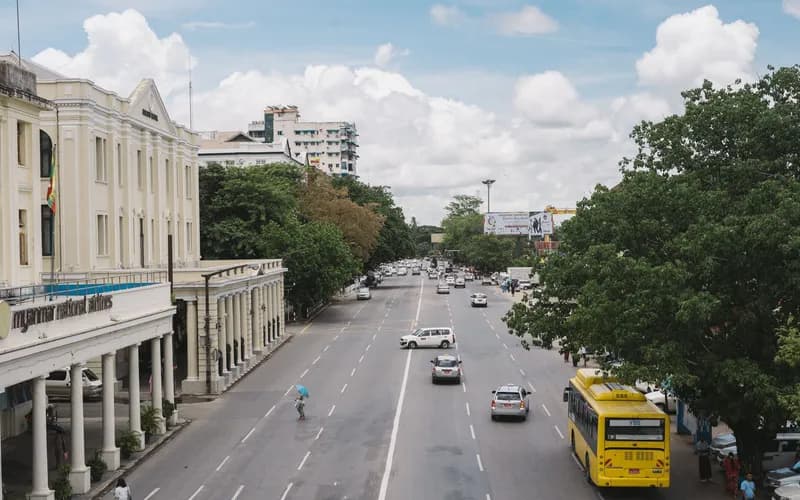
Downtown Yangon holds one of the largest surviving concentrations of late-nineteenth and early-twentieth-century architecture in Southeast Asia. The Secretariat, the High Court, City Hall, the old Rangoon General Hospital and the customs and port buildings along Strand Road are the landmarks, but the texture lies in between: five-storey walk-ups with ferns growing from the cornices, shopfronts with hand-painted signage, staircases open to the street.
The Yangon Heritage Trust, founded in 2012, has advocated for the protection of the listed heritage buildings in the downtown area and installed blue plaques on significant structures, beginning with City Hall in 2014. Preservation has always been precarious. After the capital moved to Nay Pyi Taw in 2005 many government buildings emptied out, and the boom years that followed took down a great deal of what remained. Since 2021 the economics of conservation have been harder still. Walking these streets slowly, with attention to what is boarded up as well as what is restored, tells you more about the city than any single monument.
Get matched with up to 5 trusted Myanmar agencies
- Free
- No obligation
- Up to 5 agencies
Markets, Tea Shops and the Working Day
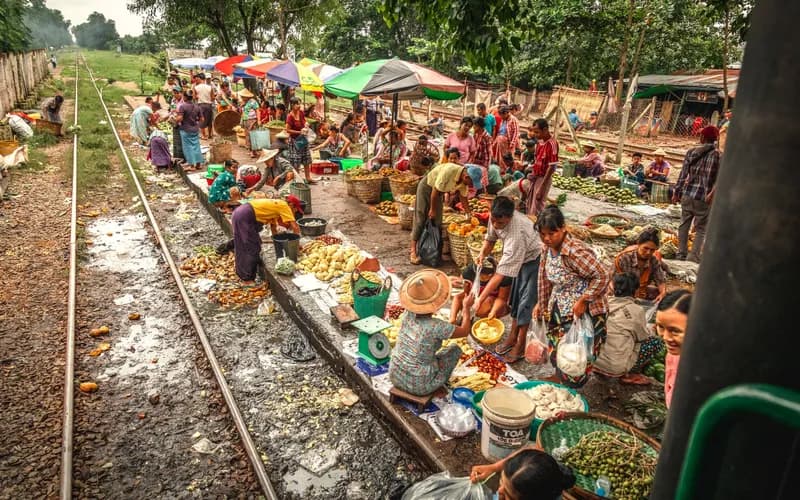
Yangon runs on tea shops. They open early, serve sweet milky tea and a rotating cast of fried snacks, and function as the city's informal newsroom. Sitting at a low plastic table for an hour is not a cultural experience packaged for anyone; it is simply how the day is structured, and it costs very little.
The markets follow the same logic. Bogyoke Aung San Market is the well-known one, built in 1926 and full of gem dealers, lacquerware and textiles, but the smaller wet markets scattered through the townships are where the city buys food. A few things worth knowing before you wander:
- Mornings are the working hours. Much of the market trade is done by ten.
- Photography is not neutral. Ask, accept a refusal, and do not photograph anyone who looks uncomfortable.
- Prices in 2026 reflect severe inflation. Bargaining hard over small sums lands differently than it might have a decade ago.
Shwedagon and the Quieter Pagodas
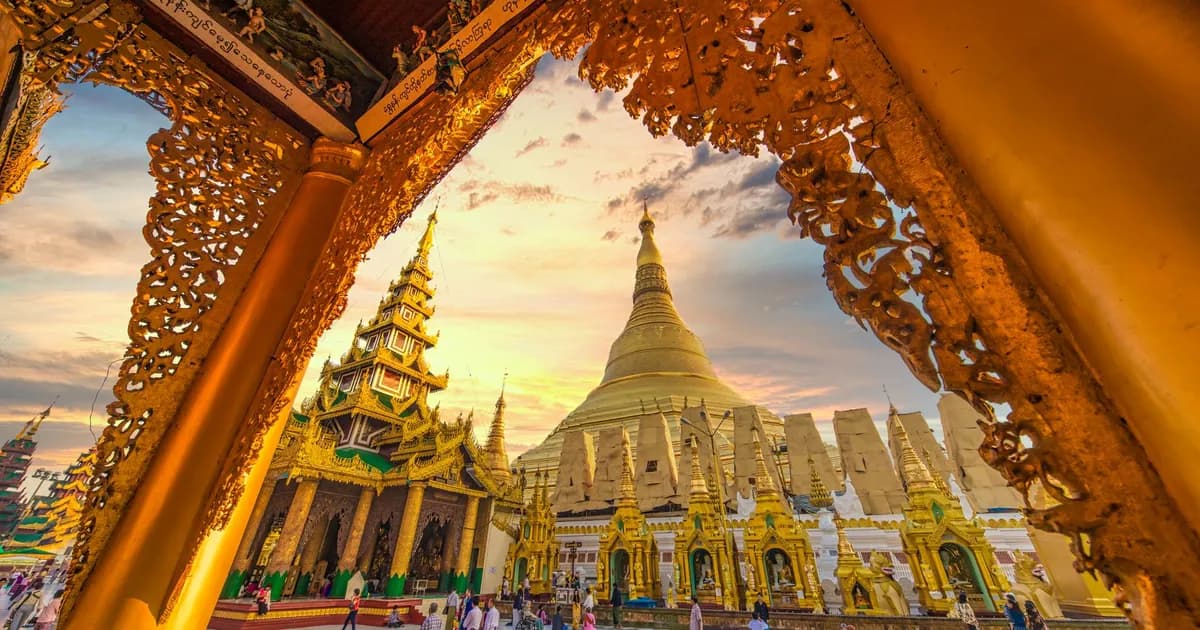
Shwedagon Pagoda is the reason many people know the city's name, and it deserves the hours rather than the forty-minute circuit. Go at dawn or in the last hour of light, walk the platform clockwise, and sit. It is an active place of worship first and a monument second, which is also true of Sule Pagoda downtown, Botataung by the river, and the reclining Buddha at Chaukhtatgyi.
Foreign visitors pay an entry fee at the major pagodas, and it is worth understanding that such fees are collected by state-linked bodies. Dress and conduct matter here more than at almost any other kind of site in the country; our guide to temple and monastery etiquette in Myanmar covers the specifics, including footwear, shoulders and knees, and the conventions around monks and nuns.
The Circular Railway and the Edges of Town
The Yangon Circular Railway loops roughly fifty kilometres around the city and its outskirts, stopping at dozens of small stations, and it remains the cheapest and most revealing ride in Myanmar when it is running. Services have been reduced and rescheduled repeatedly in recent years, and fuel and power constraints in 2026 have made timetables unreliable, so treat any schedule you read online as a starting point rather than a fact. Ask locally on the day.
The line matters because it shows you the city that the downtown grid hides: vegetable plots, workshops, commuter crowds, the long low sprawl of the northern townships. For how the railway fits alongside buses, domestic flights and river boats, see our overview of getting around Myanmar.
Where Your Money Goes
This is the part that cannot be skipped. Two military conglomerates, Myanmar Economic Holdings Limited and Myanmar Economic Corporation, hold interests across dozens of sectors including tourism, construction, banking and transport, and both have been the subject of sanctions and of a United Nations fact-finding mission that documented their ownership structure. In January 2024 several United States government departments issued a supplemental business advisory naming high-risk sectors, and European Union measures against Myanmar have been rolled over repeatedly.
For a visitor this translates into unglamorous, concrete questions. Who owns the hotel. Who operates the domestic airline. Whether an entry fee goes to a ministry or to a monastery. Small, family-run guesthouses, independent drivers, market traders and neighbourhood restaurants keep money closer to households; state-linked hotels and big-ticket concessions do not. Choosing carefully does not make the wider ethical problem disappear, and it is worth being clear-eyed about that. Our directory of locally rooted operators and agencies is a place to start those questions, not to end them.
Living With the Power and Fuel Squeeze
In March 2026 the Ministry of Electric Power announced rotating outages across the country, running from mid-March through at least June, with national demand reported at around 4,664 megawatts against roughly 3,600 megawatts of available supply. Residents of Yangon have described stretches of only a handful of hours of grid electricity per day. Fuel has been rationed in parallel, with queues, quota systems and sharp price rises, and a jet fuel shortage grounded most domestic flights for several days in late March 2026 before services resumed.
Practically, this means lifts and air conditioning stop, water pumps fail in tall buildings, restaurants close early, and generators run where people can afford the diesel. Visitors experience an inconvenience; residents absorb a long-running crisis. We cover the mechanics in detail in our update on the 2026 fuel and power disruptions.
What Slow Looks Like Here
If someone does travel to Yangon in 2026, the slow-travel version is also the low-footprint, low-risk version: stay in one neighbourhood, walk, use one tea shop enough that the staff recognise you, and let plans bend around blackouts and closures rather than fighting them. Avoid crowds, demonstrations and anything resembling a security incident. Carry identification. Keep a low profile, take fewer photographs than you want to, and do not post live locations or anything that could identify the people you speak with.
The city has the ingredients slow travel asks for — walkability, layered history, real street life, food worth returning to. It also sits inside a situation that no amount of good intent from a visitor changes. Holding both of those things at once is the only honest way to write about Yangon right now.
What to Do Next
- Read your own government's current advisory in full, including the region-by-region detail, and re-read it close to any departure date.
- If you hold Myanmar citizenship or dual nationality, ask your embassy directly about conscription and exit risks before booking anything.
- Check what your travel insurance excludes for countries under an advise-against-travel notice, especially medical evacuation.
- Decide the ethical question deliberately, in writing if it helps, rather than drifting into a booking.
- If you proceed, plan around unreliable power, fuel and domestic flights, and build slack into every connection.
- Prepare cash, since card payment is limited and international banking links are constrained.
- Keep itineraries, contacts and photographs private, and follow the lead of the people you are visiting on what is safe to share.
Frequently Asked Questions
Is Yangon safe to visit in 2026?
Safety cannot be separated from the advisories. As of September 2026, France and most other Western governments advise against travel to Myanmar or to large parts of it, and consular support is limited. Yangon has generally seen less active fighting than border regions, but the state of emergency, checkpoints, blackouts and the wider security situation all apply. Anyone considering a visit should rely on their own government's current assessment rather than on tourism marketing.
Who is this information actually for?
People with existing ties to Myanmar, diaspora travellers visiting family, humanitarian and professional travellers, and those doing serious research before deciding. It is not written to persuade casual holidaymakers to go, and many readers will reasonably decide that now is not the time.
Did the March 2025 earthquake affect Yangon?
The magnitude 7.7 earthquake of 28 March 2025 had its epicentre in central Myanmar near Mandalay, and the heaviest damage was in Sagaing, Mandalay, Nay Pyi Taw and parts of southern Shan and Bago. Yangon was far less affected than those areas, though the national recovery effort and its costs touch the whole country.
Can I pay by card in Yangon?
Rarely. Myanmar operates largely on cash, international banking links are constrained by sanctions and by domestic restrictions, and card acceptance is limited to some larger hotels and a small number of businesses. Plan on carrying clean, undamaged United States dollar notes to exchange and on holding kyat for daily spending.
How long should I spend in the city?
If you are there at all, three or four days lets you walk the downtown grid properly, spend real time at Shwedagon, and see something of the outer townships. Shorter stays tend to reduce the city to a checklist, which is both less interesting and less respectful.
Is it possible to visit responsibly at all?
Opinions differ sharply, including among people from Myanmar. Some argue that independent, locally spent travel supports households that have very few remaining income sources. Others argue that any visit normalises the current government and risks funnelling money to military-linked businesses. Both positions are held in good faith, and choosing not to go is a perfectly defensible answer.
What should I avoid doing entirely?
Avoid demonstrations and checkpoints, avoid photographing military or police personnel and installations, avoid discussing politics in public or online, and avoid naming or identifying local people in anything you publish. Do not seek out conflict-affected areas, and do not travel anywhere your government formally advises against.