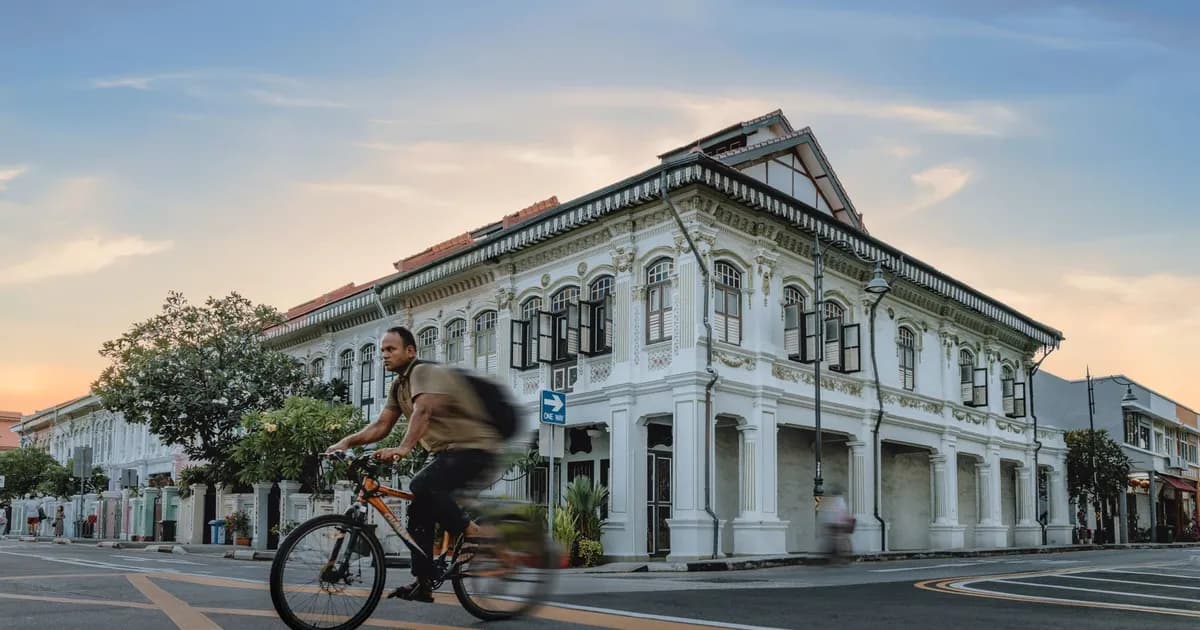


Some neighbourhoods ask to be rushed. Tiong Bahru asks for the opposite. Tucked between the Central Business District and the sea, a short walk from Chinatown yet a world away in tempo, this is one of the oldest housing estates in Singapore and, quietly, one of its most rewarding places to spend a slow morning. The name means "new cemetery" in a mix of Hokkien and Malay — the land was once burial ground before the Singapore Improvement Trust laid out its curving streets in the 1930s. Today those low walk-up flats, painted cream and terracotta, hold cafés, a much-loved wet market, hidden temples, painted walls, and a resident population that has never fully handed the place over to visitors.
We think Tiong Bahru is best understood on foot, over a single unhurried day, with nothing on the itinerary you cannot skip. This guide walks you through the estate the way a long-time resident might: a bowl of something warm to start, a wander past the streamline-moderne curves that make architects go misty-eyed, a coffee, a bookshop or two, and the small heritage details — a temple to the Monkey God, a corner where old men once hung their birdcages — that reveal themselves only if you are paying attention.
Why Tiong Bahru rewards a slow pace
Most first-time visitors to Singapore are steered towards the big set-pieces: Marina Bay, Gardens by the Bay, Sentosa. Those places are impressive, but they are engineered for volume and speed. Tiong Bahru is the antidote. It is compact — you can cross the historic core in fifteen minutes — but it does not want to be crossed. It wants to be lingered in.
The estate is small enough that you keep circling back to the same junctions, noticing something new each time: a spiral staircase you missed, a cat asleep on a motorcycle seat, a shop selling nothing but vinyl. There is no single must-see monument here, which is precisely the point. The reward is cumulative. An hour in, you stop checking your phone. Two hours in, you have a favourite bench. This is slow travel in its most honest form, and if you are still mapping your wider trip, our guide to where to go and when in Singapore can help you decide when to slot a morning here.
A word on timing. Tiong Bahru wakes early, like most of working Singapore. The market and hawker centre are busiest and best before ten in the morning; the cafés fill up mid-morning and stay full through a lazy weekend brunch. If you can, come on a weekday. The estate breathes differently when it is mostly locals running errands rather than a queue for the bakery.
One request. Up to five tailored proposals.
Skip contacting agencies one by one — share your trip once and let up to five trusted Singapore agencies come to you. Free, with no obligation.
Get my free quotesReading the architecture: SIT flats and streamline curves
The buildings are the reason Tiong Bahru looks like nowhere else in Singapore. Built by the Singapore Improvement Trust between the mid-1930s and the outbreak of war, they were among the first public housing in the country — and the SIT built them in the Art Deco and streamline-moderne styles then fashionable across the world. That means long horizontal lines, curved corners that wrap around junctions like the prow of a ship, flat roofs, porthole windows, and cantilevered "aeroplane" staircases spiralling up the rear of the blocks.
Walk along Guan Chuan Street, Moh Guan Terrace, and Tiong Poh Road and you will see the vocabulary repeat: rounded balconies, sun-shading fins, the occasional original spiral stair still in daily use. Around forty of these pre-war blocks survive, and the low-rise core is conserved, which is why it has never been redeveloped into towers. Look up as you walk — the best details are at first- and second-floor level, above the shopfronts. Some blocks still have their communal air-raid shelter, a reminder that this housing was built on the eve of a war that reached the island in 1942.
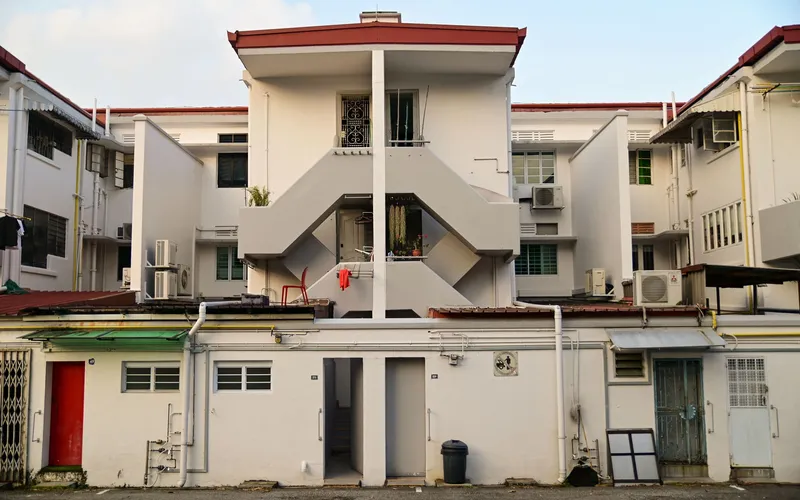
The scale is what makes it humane. Nothing here is tall enough to throw the street into shadow, and the setbacks and shared courtyards were designed for a slower, more communal way of living. You are walking through an idea about how cities could feel — an idea from the 1930s that, walking it today, still holds up.
Tiong Bahru Market: breakfast the local way
If you do one thing in Tiong Bahru, eat breakfast at the market. The building on Seng Poh Road holds a wet market on the ground floor and a hawker centre upstairs, and it reopened in mid-2025 after a refurbishment that spruced up the seating and facilities without evicting the old stalls — the ones that matter are still here.
Start with chwee kueh: small steamed rice cakes topped with a savoury mound of preserved radish (chai poh), fried until fragrant. Jian Bo Shui Kueh has been making them since 1958 and its stall inside the market is the one to seek out. For something heartier, join the queue for lor mee — thick yellow noodles in a dark, starchy, garlicky gravy, finished with fish, egg and a splash of vinegar and chilli. There is usually a wait, and the wait is part of it; nobody here is in a hurry, and neither should you be.
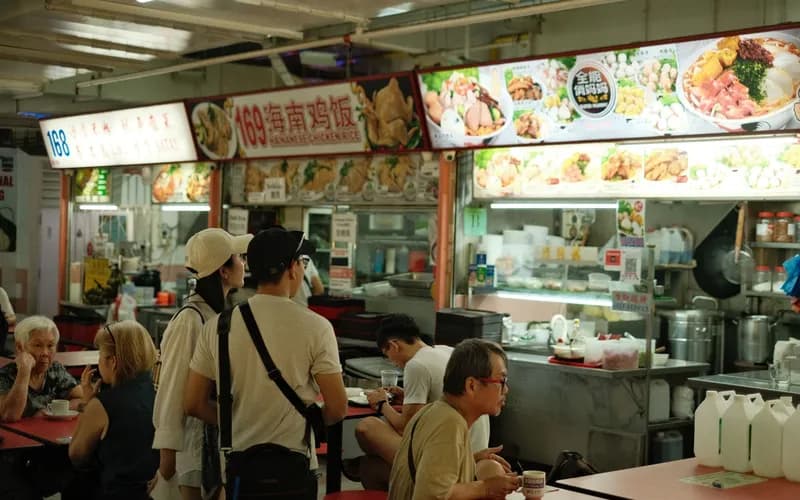
Beyond those two, the upstairs centre rewards grazing: chwee kueh for one, a plate of chicken rice for another, dragon-fruit cheong fun if it is on, a cup of thick local kopi to finish. Prices are gentle by Singapore standards. Bring cash, sit at a shared table, and do not be shy about "choping" a seat with a packet of tissues, the local custom. If you want the wider context on how hawker culture works and what else to eat across the island, our guide to Singapore food and what to eat sets the table.
Get matched with up to 5 trusted Singapore agencies
- Free
- No obligation
- Up to 5 agencies
The wet market downstairs
Do not skip the ground floor. The wet market is where the neighbourhood actually shops, and it is a quieter, more textured experience than the hawker bustle upstairs. Come before nine to see it at full tilt: fishmongers hosing down their slabs, vegetable sellers stacking bittergourd and long beans, a flower stall wrapping jasmine and marigold for temple offerings, an aunty deftly deboning a fish for a regular.
It is called a "wet" market because the floors are sluiced with water through the day, so wear shoes with grip. You are not obliged to buy anything — most visitors simply walk a slow loop and watch — but the stallholders are used to browsers, and a smile goes a long way. This is the beating heart of the estate's daily life, the reason Tiong Bahru still feels lived-in rather than curated. Spend ten unhurried minutes here and the rest of the morning makes more sense.
Cafés, the bakery, and the ghost of BooksActually
By late morning Tiong Bahru becomes café country. The estate helped kick off Singapore's independent-café wave, and the anchor is Tiong Bahru Bakery on Eng Hoon Street, which opened in 2012 and made the kouign-amann — a caramelised, laminated Breton pastry — a local obsession. Their croissants are the other reason for the queue. Grab one, find a stool, and watch the street.
From there, the small streets around Yong Siak Street and Seng Poh Road are dense with independents: specialty-coffee roasters, a homeware store or two, a record shop, design studios. It is walkable in the truest sense — you drift from door to door rather than plotting a route.
One landmark you will hear about is BooksActually, the beloved independent bookshop that occupied a shophouse on Yong Siak Street and became shorthand for literary Tiong Bahru. Be prepared: its physical store closed in 2021, and the business now operates online only. We mention it because its legacy still shapes the street and because visitors often arrive expecting to find it. The good news is that the bookish spirit has not left the estate entirely — independent shops and pop-ups still turn up here, and Woods in the Books, a children's picture-book shop nearby, has long been part of the same creative fabric. If you are hunting for corners like this across the city, our guide to off-the-beaten-path Singapore points to more.
Murals, the bird corner, and Qi Tian Gong
The details that make Tiong Bahru linger in the memory are the small heritage ones, and you find them by wandering rather than by ticking off a list.
Start with the murals by Yip Yew Chong, a local artist who grew up in the area and, around 2015, painted a series of large, warm-hearted scenes of old Singapore on the estate's walls. "Bird Singing Corner" shows men gathered beneath hanging cages; "Pasar and the Fortune Teller" recreates the old market; "Home" opens a window onto a 1970s living room. They are scattered around Eng Hoon Street, Seng Poh Lane and Tiong Poh Road — half the pleasure is stumbling on them.
The murals are not random. They memorialise a real tradition: the Tiong Bahru bird-singing corner, where, from the 1950s, men would gather in the morning to hang their prized songbirds in tall cages and let them sing together. The original corner stood by Block 53 on Tiong Bahru Road; when the old block was demolished in 2007, the structure was preserved and re-established near what is now the Link Hotel. Be honest with your expectations here: the tradition has faded, and the poles are often empty now, but on a quiet early morning you may still catch a few enthusiasts and their birds. Even empty, the corner is a poignant piece of the estate's story.
A few streets away, at 44 Eng Hoon Street, sits Qi Tian Gong — the Monkey God Temple. Founded in 1920 and settled at this shophouse in 1938, it is said to be the first temple in Singapore dedicated to the Monkey King, the shape-shifting hero of the classic novel "Journey to the West." It is small, working, and free to enter; step inside quietly, keep your voice low, and dress with a little modesty. Twice a year the temple marks the Monkey God's birthday with processions that spill onto the street.
How to spend a slow half-day or full day on foot
Here is the shape of an unhurried day, though you should feel free to unpick it.
For a half-day, arrive by 8am. Eat chwee kueh and lor mee at the market, then walk a slow loop of the wet market downstairs. Spend an hour among the SIT blocks on Guan Chuan Street and Moh Guan Terrace, looking up at the curves and spiral stairs. Coffee and a kouign-amann at Tiong Bahru Bakery. Find two or three of the Yip Yew Chong murals, look in at Qi Tian Gong, and you are done by lunch, having barely raised your heart rate.
For a full day, slow it all down further and add browsing time in the independent shops, a long second coffee, and a midday rest during the hottest hours — Singapore's heat is real, and the locals pace themselves accordingly. Drift back out in the late afternoon when the light softens and the estate cools, and let dinner be another market plate or a sit-down meal in one of the shophouse restaurants. The estate is walkable start to finish, flat, and shaded in parts, which makes it forgiving for all ages.
Getting here is simple. Tiong Bahru MRT station (East-West line) sits at the edge of the estate, a five-to-ten-minute walk from the market; the walk in, past ordinary blocks that slowly turn characterful, is a gentle overture. Wear light clothing, carry water, and give yourself permission to do less than you planned.
What to Do Next
- Pick a weekday morning and arrive at Tiong Bahru Market before 9am, hungry, with cash in your pocket.
- Walk one slow architectural loop — Guan Chuan Street, Moh Guan Terrace, Tiong Poh Road — looking up for the streamline curves and spiral staircases.
- Track down at least two Yip Yew Chong murals and step quietly into Qi Tian Gong on Eng Hoon Street.
- Build the visit into a wider, unhurried Singapore itinerary using our plan your journey page.
- If you would rather have the whole trip shaped around your own pace, read about our approach on the slow travel charter and let a specialist handle the logistics.
Frequently Asked Questions
How much time should I spend in Tiong Bahru?
A half-day, roughly four hours, covers the market, the architecture, a café, the murals and the temple at a genuinely relaxed pace. If you love wandering, browsing bookshops and lingering over coffee, a full day is easy to fill — the estate rewards slowness rather than a packed checklist.
When is the best time to visit Tiong Bahru?
Early morning on a weekday. The market and hawker centre are at their best and busiest before ten, the cafés are calmer than at weekend brunch, and the temperature is bearable. Weekends are livelier but more crowded, especially around the bakery.
Is BooksActually still open in Tiong Bahru?
No. The much-loved independent bookshop closed its physical store on Yong Siak Street in 2021 and now operates online only. Its legacy still shapes the neighbourhood's literary reputation, and other independent bookshops and pop-ups still appear in the area, but you will not find the original shop.
Can I still see the bird-singing corner?
The bird corner survives as a preserved structure near the Link Hotel on Tiong Bahru Road, but the daily tradition has largely faded and the poles are often empty. On a quiet early morning you may still see a handful of enthusiasts. The Yip Yew Chong mural nearby commemorates the custom in its heyday.
What should I eat at Tiong Bahru Market?
Start with chwee kueh — steamed rice cakes with preserved radish, best from Jian Bo Shui Kueh, making them here since 1958 — and lor mee, thick noodles in a dark starchy gravy. Beyond those, chicken rice, roasted meats and a cup of local kopi round out a classic hawker breakfast.
Is Tiong Bahru suitable for families and older travellers?
Yes. The estate is flat, compact and shaded in parts, with plenty of places to sit and eat. The market is stroller- and wheelchair-navigable on the whole, though the wet market floor can be slippery. Pace it gently and take a midday break during the hottest hours.
How do I get to Tiong Bahru?
Take the MRT to Tiong Bahru station on the East-West line; the market and historic core are a five-to-ten-minute walk away. Taxis and ride-hailing drop you right at the market on Seng Poh Road. The estate itself is best explored entirely on foot.