The Slow Traveler's Guide to Singapore Food: What to Eat in Singapore
There is a way to understand Singapore that no museum, skyline photograph or guided walk can match: you sit down at a hawker centre, order a plate of chicken rice, and watch the whole country pass through in an hour. Office workers in lanyards share a table with taxi drivers. A grandmother slurps laksa beside a teenager filming her bowl for social media. Four culinary traditions — Chinese, Malay, Indian and Peranakan — cook side by side under one metal roof, and nobody thinks this is remarkable, because in Singapore it is simply lunch.
Food here is not a garnish to the trip. It is the trip. Singapore is one of the great eating cities of the world, and unlike some of its rivals, it wears its greatness lightly. The best meal you eat may cost less than a coffee back home, served on a melamine plate by someone who has been perfecting that single dish for forty years. This is a place where a street stall can earn a Michelin star, where breakfast is a ritual with its own vocabulary, and where "have you eaten yet?" is less a question than a way of saying hello.
This guide is written for the slow traveller — the person who would rather eat one dish properly than photograph ten. We will walk through how a hawker centre actually works, the national icons you should not leave without trying, the four cuisines that shaped the plate, the famous Michelin hawker story, where to eat across the island, the breakfast culture, the desserts, the drinks, and how to eat well whether you keep halal, eat vegetarian, or simply want the real thing. Take your time. The city rewards patience, and so does its food.
The hawker centre: Singapore's UNESCO food heart
If you understand the hawker centre, you understand how Singaporeans eat. These are open-air complexes of dozens — sometimes over a hundred — individual food stalls, each specialising in one or two dishes, gathered around a shared seating area. They began in the 1960s and 70s as a way to move street hawkers off the roads and into hygienic, licensed premises, and they became something far larger: the shared dining rooms of the nation.
In December 2020, UNESCO inscribed Singapore's hawker culture on its Representative List of the Intangible Cultural Heritage of Humanity — the country's first entry on that list. The recognition was not for any single dish but for the culture itself: the way people from every background, income and religion gather at communal tables to eat, mingle and belong. That is worth pausing on. Hawker centres are one of the few genuinely democratic spaces left in a famously stratified city. A bank director and a bus driver queue at the same stall and pay the same three or four dollars.
Here is how to use one without looking lost. First, walk the whole centre before you commit. Look for the stalls with the longest queues of locals — that is the market voting with its feet, and it is almost never wrong. Second, "chope" your seat. To chope is to reserve a table, and the traditional tool is a humble packet of tissues left on a chair or table. A tissue packet on an empty seat means it is taken; leave one yourself before you queue, and the unwritten code will hold it for you. Third, order and pay at each individual stall — there is no central till and no table service. You carry your own food back, and at most centres you clear your own tray to the return points when you are done, a rule now enforced with small fines.
Payment is increasingly cashless — many stalls take QR-code apps — but keep small notes and coins, because plenty of veteran hawkers still prefer cash. Portions are single-serving and cheap, which is the secret to eating well here: you are not meant to order one big meal, you are meant to graze across several stalls, one dish at a time, sharing as you go. That is also, conveniently, exactly how a slow traveller should eat. If you are still planning the shape of your trip, our guide on where to go and when in Singapore will help you decide which neighbourhoods — and therefore which hawker centres — to base yourself near.
One request. Up to five tailored proposals.
Skip contacting agencies one by one — share your trip once and let up to five trusted Singapore agencies come to you. Free, with no obligation.
Get my free quotesThe national icons: the dishes that define Singapore
Some dishes are so bound up with Singaporean identity that trying them is less a meal than an introduction. Start with these.
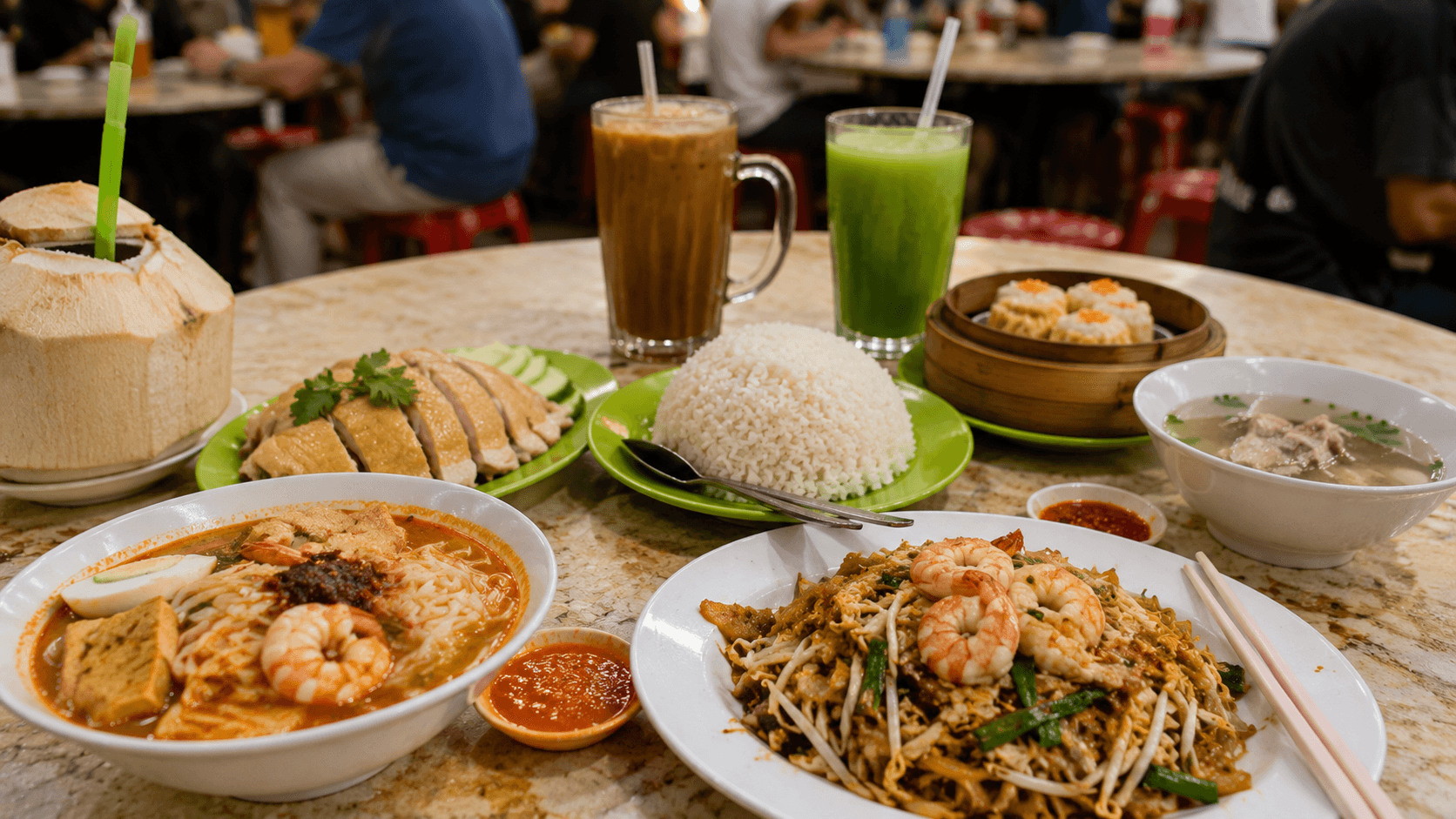
Hainanese chicken rice is the closest thing Singapore has to a national dish. It looks almost austere — poached chicken, sliced and laid over rice — but the craft is total. The rice is cooked in chicken stock with ginger, garlic and pandan until each grain is glossy and fragrant; the chicken is poached gently and often plunged into iced water to set a silky, gelatinous skin; and it arrives with a trio of condiments: a bright chilli-garlic sauce, grated ginger, and dark sweet soy. Brought to Singapore by immigrants from Hainan island in China, it has become the dish that Singaporeans abroad miss most.
Chilli crab is the boisterous opposite — messy, communal, unforgettable. A whole mud crab is stir-fried in a thick, tomato-and-chilli gravy loosened with egg, sweet and savoury and only gently spicy. You eat it with your hands, cracking shells and mopping up the sauce with soft fried or steamed buns called mantou. Its cousin, black pepper crab, swaps the sweetness for a dry, peppery, buttery heat that many locals quietly prefer. Neither is cheap — crab is the one splurge on most Singapore food itineraries — so factor it in when you read our Singapore trip cost and budget guide.
Laksa is where Chinese and Malay cooking melt into one bowl: thick rice noodles in a rich, coconut-and-dried-shrimp gravy, spiked with chilli and topped with prawns, cockles and fish cake. The celebrated local version is Katong laksa, named for the eastern neighbourhood, distinctive because the noodles are cut short so the whole bowl can be eaten with a spoon alone.
Char kway teow is flat rice noodles fried hard and fast over ferocious heat with dark soy, prawns, cockles, Chinese sausage, bean sprouts and egg. Its magic is wok hei — literally "the breath of the wok," the smoky, elusive char that only a screaming-hot pan and a practised hand can produce. Hokkien mee is another wok classic: yellow and rice noodles braised in a deep prawn-and-pork stock until they drink up the flavour, finished with a squeeze of lime and a spoon of chilli.
Bak kut teh — literally "meat bone tea" — is a peppery, garlicky pork-rib broth eaten for breakfast or supper, restorative and clean, usually with rice, dough fritters and a pot of Chinese tea. Satay, skewers of marinated meat grilled over charcoal and served with a thick peanut sauce, cucumber and rice cakes, is the smoke that drifts through every night market. And roti prata, a flaky, pan-fried Indian-Muslim flatbread served with curry for dipping, is the crisp, buttery workhorse of the late-night and early-morning table. Try them one at a time, on different days. There is no prize for rushing.
The four culinary streams: Chinese, Malay, Indian, Peranakan
To eat in Singapore is to eat across four great traditions at once, each brought by the communities who built the city, each fully at home.
Chinese cuisine is the largest stream, itself a mosaic of regional styles carried by immigrants from southern China — Hokkien, Teochew, Cantonese, Hainanese, Hakka and Cantonese roast-meat traditions among them. It gives Singapore its chicken rice, its char kway teow, its Hokkien mee, its bak kut teh, its wonton noodles and its congee.
Malay cuisine, the food of the region's indigenous heritage, is built on aromatic spice pastes (rempah), coconut milk, lemongrass, galangal and chilli. Its crown is nasi lemak — rice cooked in coconut milk and pandan, served with fried anchovies, peanuts, egg, cucumber and a dab of sweet-spicy sambal, a dish eaten from breakfast to midnight. Malay stalls also give you satay, mee rebus (noodles in a thick, sweet potato-based gravy), and sup tulang.
Indian cuisine arrived chiefly with Tamil and other South Indian communities, and it flavours the whole island. Fish head curry — a large fish head simmered in a tangy, spiced curry with okra and aubergine — is a genuinely Singaporean invention, born when South Indian cooks adapted their curries to a Chinese fondness for fish head. You will also find dosai, thosai, banana-leaf rice meals in Little India, and the Indian-Muslim (mamak) tradition that gives Singapore roti prata, murtabak and teh tarik.
Peranakan cuisine — the food of the Straits Chinese, or Nyonya cooking — is the fourth stream, and it deserves a section of its own.
Watching these four traditions share a single hawker roof is the clearest possible lesson in what Singapore is. If you want to go deeper than the famous centres and eat where locals actually queue, our off-the-beaten-path Singapore guide points to the quieter, older neighbourhoods where the cooking has changed least.
Get matched with up to 5 trusted Singapore agencies
- Free
- No obligation
- Up to 5 agencies
Peranakan cuisine: the flavour of the Straits
The Peranakans — also called Straits Chinese, Baba-Nyonya or simply Nyonya — are the descendants of early Chinese settlers who married into local Malay communities across the Straits of Malacca, centuries ago. Their culture is a genuine fusion, and their kitchen is one of Southeast Asia's most sophisticated: Chinese ingredients and techniques married to Malay spice pastes, herbs and coconut.
Nyonya food is labour-intensive in a way that fast-casual dining has almost erased elsewhere. A proper rempah is pounded by hand from a long list of aromatics. Dishes to seek out include ayam buah keluak, chicken braised with the black, earthy, almost chocolatey nuts of the kepayang tree — a dish so laborious it is a benchmark of a good Nyonya kitchen; babi pongteh, pork stewed with fermented bean paste; itek tim, a tangy duck and salted-vegetable soup; and laksa itself, which is Peranakan at heart. To finish, Nyonya kueh — jewel-bright, chewy little cakes of rice flour, coconut and palm sugar, often coloured with the blue of the butterfly-pea flower — are among the prettiest sweets in Asia.
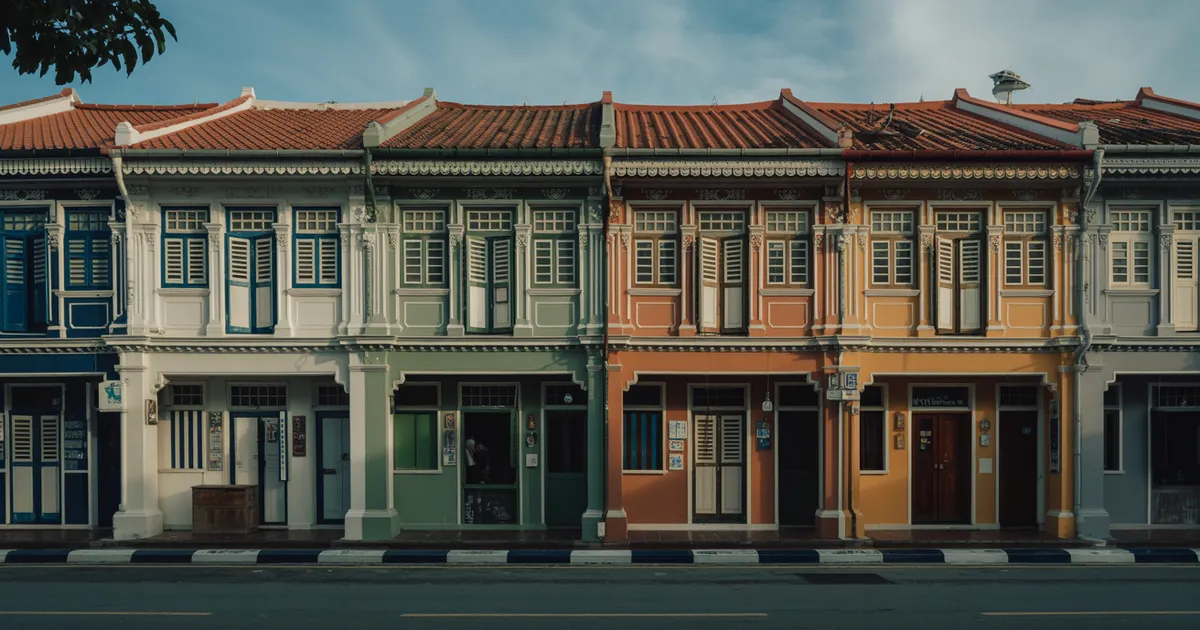
Peranakan food is harder to find in hawker centres than the other streams — much of it is home cooking, and the best is served in dedicated restaurants in the Katong and Joo Chiat neighbourhoods, themselves the historic heart of the community. Eating a slow Nyonya meal there, surrounded by the pastel shophouses the Peranakans built, is one of the most rewarding food experiences on the island.
The Michelin hawker story: great food, honest prices
In 2016, the Michelin Guide came to Singapore for the first time — and did something it had never done anywhere in the world. It awarded stars to street-food stalls.
Two hawkers earned that first star: Hill Street Tai Hwa Pork Noodle, a family stall serving bak chor mee (minced-pork noodles in a tangy vinegar sauce) founded in the 1930s; and Hawker Chan, then called Liao Fan Hong Kong Soya Sauce Chicken Rice & Noodle, whose owner became famous overnight as the man serving the world's cheapest Michelin-starred meal — a plate of soya-sauce chicken and rice for a couple of Singapore dollars. The story travelled around the world, because it upended the assumption that great food and fine dining are the same thing.
A little honesty is due here, because it matters for how you plan. Hawker Chan lost its star in 2021, though it still holds a Bib Gourmand — Michelin's mark for excellent value — and Hill Street Tai Hwa has kept its star. Dozens more stalls across the island carry the Bib Gourmand each year. So do not chase the star itself; chase the cooking. The deeper truth of the Michelin hawker story is not that a stall got a star — it is that Singapore's ordinary, everyday, three-dollar food is, at its best, world-class, and always was. The guide simply confirmed what the queues had been saying for decades.
Two practical notes. Michelin-listed stalls draw long queues and sometimes sell out by early afternoon, so go early. And a starred or Bib-listed stall is a wonderful benchmark, not the only good one — some of the finest plates you will eat in Singapore come from stalls no guide has ever noticed, chosen simply because the auntie next to you swore by them.
Where to eat: the hawker centres and neighbourhoods worth your time
You could eat somewhere different every meal for a month and not run out. A few centres, though, reward a slow traveller especially well.
Maxwell Food Centre, in Chinatown, is the classic first stop — home to the endlessly queued Tian Tian Hainanese Chicken Rice and dozens of other veterans, in a lively, central, easy-to-reach hall. Chinatown Complex Food Centre, nearby, is the largest hawker centre in Singapore, a sprawling maze of more than two hundred stalls where you can happily lose an afternoon; it houses several Michelin-recognised names and, crucially, retains a deeply local feel.
Lau Pa Sat, in the financial district, is worth visiting as much for its architecture — a beautiful Victorian cast-iron structure — as its food; at night the adjoining Boon Tat Street closes to traffic and becomes a smoky satay street. Old Airport Road Food Centre, east of the city, is a pilgrimage site for serious eaters, packed with long-established stalls and beloved by locals precisely because tourists rarely stray this far. Tiong Bahru Market, in one of Singapore's most characterful old neighbourhoods, pairs excellent hawker food downstairs with a wet market below and one of the city's most walkable heritage districts around it.
One honest warning: Newton Food Centre, made famous by a certain film, is the most tourist-oriented of the lot, more expensive and more aggressively touristed than the rest. It is fine, but it is not where locals go, and you can do far better a short ride away. For the eastern trail of laksa and Nyonya food, base yourself around Katong and Joo Chiat. Deciding where in the city to stay is half the battle; our plan your journey resources can help you build an itinerary that puts the best tables within walking distance of your bed.
Kopitiam breakfast: kaya toast, soft eggs and a cup of kopi
Before the hawker centre opens for lunch, Singapore wakes up in the kopitiam — the traditional coffee shop, its name a blend of the Malay word for coffee and the Hokkien word for shop. The classic breakfast is a small, perfect ritual, and learning it is one of the quiet joys of the city.
It comes in three parts. Kaya toast: thin, crisp-toasted or grilled bread spread with kaya — a fragrant jam of coconut, egg and sugar, perfumed with pandan leaf — and a cold slab of butter. Soft-boiled eggs, served barely set and slippery in a saucer; you crack them out, splash on dark soy sauce and white pepper, and either drink them or dip your toast into them. And a cup of kopi, strong local coffee brewed from beans roasted with sugar and often margarine, poured over condensed or evaporated milk.
Ordering that coffee is its own small language, and using it correctly earns a nod from the uncle behind the counter. Plain kopi is coffee with condensed milk and sugar. Kopi-O is black, with sugar but no milk. Kopi-C uses evaporated milk (the "C" comes from the Hainanese word for fresh) and is less sweet. Add kosong — "empty" — for no sugar at all: kopi-o kosong is black, unsweetened coffee. Peng means iced; siew dai means less sweet; gah dai means sweeter. The whole system works identically for teh (tea). And then there is teh tarik, "pulled tea," poured in long theatrical arcs between two vessels to aerate it into a thick froth — the signature drink of the Malay and mamak stalls, and a small performance worth watching. Sit, sip slowly, and let the morning start at its own pace. That, after all, is the whole point.
Desserts and durian: how Singapore ends a meal
Singapore's tropical heat has produced a whole genre of cooling desserts, most of them served over shaved ice. Chendol is the classic: shaved ice drenched in coconut milk and dark palm sugar (gula melaka), with green worm-shaped pandan jellies and red beans hiding at the bottom. Ice kachang is its taller, more flamboyant cousin — a mountain of shaved ice over red beans, jelly, sweet corn and attap seeds, doused in rainbow syrups and evaporated milk. Both are best eaten fast, in the shade, on a hot afternoon.
And then there is durian — the spiky, custard-fleshed fruit that Singaporeans revere and many visitors fear. Its smell is famously pungent, strong enough that it is banned on public transport, but its flesh is rich, sweet and complex, closer to a warm custard than anything you would call fruit. Durian season peaks around the middle of the year, when stalls pile up varieties like the prized Mao Shan Wang, and locals gather on plastic stools to eat it straight from the shell. You do not have to love it. But trying it, at least once, is part of understanding the place — and if you do fall for it, you will spend the rest of your life chasing that first taste.
Drinks, Tiger Beer and the alcohol note
Beyond kopi and teh, Singapore drinks generously and cheaply from its hawker stalls — fresh sugarcane juice pressed to order, kopi peng on a hot day, sweet iced bandung (rose syrup and milk, an alarming pink), milo dinosaur (iced chocolate malt buried under a heap of undissolved powder), fresh lime juice, and teh halia, ginger milk tea. All of them cost a couple of dollars and pair beautifully with the food.
Alcohol is the one place where Singapore is genuinely expensive, and it is worth knowing before the bill arrives. High excise taxes mean a beer at a bar can cost more than an entire hawker meal. Tiger Beer, brewed in Singapore since 1932, is the local lager and the natural companion to chilli crab or a plate of satay; you will find it everywhere. But budget accordingly: a night of drinking can quietly cost more than several days of eating. Many hawker centres and coffee shops sell large bottles of beer far more cheaply than bars do, which is how locals manage it. If you are mapping out costs, our budget guide breaks down where the money really goes.
Halal and vegetarian: eating well without compromise
Singapore is one of the easiest food cities in Asia for both halal and vegetarian travellers, precisely because its diversity is built into everyday life rather than bolted on for tourists.
For halal eating, the Malay and Indian-Muslim (mamak) traditions offer an enormous range: nasi lemak, satay, mee rebus, roti prata, murtabak, biryani, nasi padang and more, almost all of it halal by default at Malay and Muslim-run stalls. Look for the green MUIS halal certification displayed at stalls and restaurants, and note that many hawker centres have dedicated Malay-Muslim sections. Chinese pork-based stalls sit alongside them, so simply choose the stall, not the centre.
For vegetarians, there are three easy paths. Indian vegetarian food — dosai, idli, thali, banana-leaf meals — is abundant, especially in Little India, and much of South Indian cuisine is vegetarian by tradition. Chinese Buddhist vegetarian stalls, often marked with a swastika-like symbol denoting Buddhism, serve meat-free versions of noodle and rice dishes, including convincing mock meats. And many standard dishes can be adapted. A word of care: staples like laksa, char kway teow and even seemingly simple noodles are often cooked with dried shrimp, fish sauce, lard or pork stock, so if you are strict, ask — "no meat, no seafood" is understood — or head straight for the dedicated vegetarian and Indian stalls, where you can eat superbly without a single compromise.
Etiquette, value and eating slowly
A few habits will make you feel less like a visitor and more like a regular. Chope your seat with a tissue packet, but do not hover over someone else's choped table. Return your tray to the collection points when you finish — it is now the law, and it is simply good manners. Sharing a table with strangers is normal; a nod is all the conversation required. Queue patiently at the good stalls, because the queue is the whole point. And carry small cash even in an increasingly cashless city, for the veteran hawkers who never went digital.
On value: Singapore has a reputation as an expensive destination, and hotels and cocktails will earn it. But the food is the great exception. A hawker meal of three or four dollars, eaten twice a day, is one of the best-value pleasures in world travel — and it happens to be the best food, too. This is the rare city where eating cheaply and eating brilliantly are the same act. Spend your money on a crab feast or a Peranakan dinner as an occasional treat, and let the everyday hawker plate carry the trip.
Why food is the best way to understand Singapore
Singapore can be a difficult city to read at first. It is efficient, orderly, glassy and new, and a fast visitor can leave having admired it without ever quite touching it. Food is the way in. At a hawker table you meet the actual texture of the place: four cultures cooking in parallel and borrowing from one another; an immigrant history written in chicken rice and fish head curry; a fierce, unshowy pride in getting one simple dish exactly right, decade after decade.
Eat slowly here and the city opens. Go back to the same stall twice and the auntie remembers you. Order your kopi in the local shorthand and the morning belongs to you a little more. This is a country that put its street food, not its skyscrapers, forward for UNESCO recognition — a quiet statement about what it believes is worth preserving. Honour that. Skip a landmark if you must, but do not skip the meal. When you are ready to build a trip around the table rather than the checklist, a good local operator can shape the whole thing around how, and where, you want to eat — our Singapore travel agencies directory and the Unrush slow-travel charter are the places to start.
Frequently Asked Questions
What is the national dish of Singapore?
Hainanese chicken rice is the dish most often called Singapore's national dish — poached chicken served over rice cooked in chicken stock with ginger, garlic and pandan, alongside chilli, ginger paste and dark soy sauce. That said, Singaporeans are quick to point out that chilli crab, laksa, char kway teow and nasi lemak are all national favourites too. The truth is that Singapore is defined less by one dish than by the range of them, and by the four cuisines — Chinese, Malay, Indian and Peranakan — that produced them.
How does a hawker centre work?
A hawker centre is an open-air hall of dozens of independent food stalls around shared seating. Walk the whole centre first, then order and pay directly at each stall you want — there is no central till and no table service. Reserve a seat by "choping" it, traditionally with a packet of tissues left on the table, before you queue. Carry your food back yourself, and clear your tray to the return points when you finish, which is now required by law. Bring small cash, as some older stalls still prefer it, though many now accept cashless payment.
Are Singapore's hawker stalls really Michelin-starred?
Yes — Singapore made history in 2016 as the first place where the Michelin Guide awarded stars to street-food stalls. Hill Street Tai Hwa Pork Noodle, famous for its bak chor mee, still holds a Michelin star. Hawker Chan, once billed as the world's cheapest Michelin-starred meal for its soya-sauce chicken rice, lost its star in 2021 but retains a Bib Gourmand for excellent value. Dozens more stalls carry the Bib Gourmand. The larger point is that outstanding, inexpensive hawker food is the everyday norm here, guide or no guide.
How do I order kopi like a local?
Kopi is coffee with condensed milk and sugar. Kopi-O is black with sugar and no milk; kopi-C uses evaporated milk and is less sweet. Add "kosong" for no sugar, "peng" for iced, and "siew dai" for less sweet — so a kopi-o kosong is black unsweetened coffee, and a kopi-c peng is iced coffee with evaporated milk. The same modifiers work for teh (tea). Teh tarik, or "pulled tea," is poured dramatically between two cups to build a frothy top, and is a speciality of Malay and mamak stalls.
Is it easy to eat vegetarian or halal in Singapore?
Very. For halal eating, Malay and Indian-Muslim stalls offer nasi lemak, satay, roti prata, biryani and much more, most of it halal by default — look for the green MUIS certification. For vegetarians, Indian vegetarian food is abundant in Little India, Chinese Buddhist vegetarian stalls serve meat-free noodle and rice dishes, and many places will adapt. Do ask, though, since dishes like laksa and char kway teow often contain dried shrimp, fish sauce or pork stock even when they look simple.
What should I know about durian?
Durian is a large, spiky tropical fruit with rich, custard-like flesh and a famously strong smell — so strong it is banned on public transport and in many hotels. Locals adore it, and season peaks around the middle of the year, when prized varieties like Mao Shan Wang appear. It is a genuine acquired taste: sweet, creamy and complex if you take to it, overwhelming if you do not. Trying it once, ideally fresh from a street stall where you can pick a good one, is part of understanding Singapore's food culture, even if you decide once is enough.
Is food in Singapore expensive?
Not the food that matters most. Hawker meals are one of the best values in world travel — a superb plate of chicken rice, laksa or char kway teow typically costs only a few Singapore dollars, and you can eat brilliantly for very little by grazing across stalls. The expensive exceptions are alcohol, which carries high taxes, and speciality dishes like chilli crab, which are priced as treats. Hotels and cocktails give Singapore its costly reputation, but everyday eating is affordable, which is exactly why food is the smartest thing to build a slow trip around.