

A silent retreat in a Thai monastery is one of the few travel experiences that genuinely cannot be bought. There is no upgrade, no skip-the-queue, no way to make the third morning easier by spending more. You get a mat, a schedule, a bell, and a great deal of your own company. Thailand has offered this to foreigners for decades, quietly and cheaply, and it remains one of the most valuable things the country gives visitors. It is also frequently misunderstood, badly prepared for, and abandoned on day two. Here is how to do it properly.
Be Honest About Why You Are Going
There is a real difference between a meditation retreat and a wellness holiday, and conflating them is the most common mistake. A wellness resort is designed to make you feel better. A monastery retreat is designed to show you your own mind, which for the first several days usually feels considerably worse.
Thailand now has an enormous and growing market in the first category, as we covered in our piece on the country's wellness and longevity tourism boom. Those places have their merits. They are not what this article is about.
If you want rest, book a quiet island and sleep. If you want a beautiful photograph in white clothes, be aware that most serious centres forbid cameras entirely. If you are curious about what happens when you stop distracting yourself for ten days, and you are willing to be uncomfortable in service of that, a monastery retreat will deliver more than you expect.
One request. Up to five tailored proposals.
Skip contacting agencies one by one — share your trip once and let up to five trusted Thailand agencies come to you. Free, with no obligation.
Get my free quotesThe Three Kinds of Place, and Which One You Want
Thai options fall into three broad categories, and choosing the wrong one is the second most common mistake.
Structured retreat centres attached to monasteries. These run fixed-length courses on a published schedule, with instruction in English, dormitory or cell accommodation, and a clear beginning and end. They are the right choice for a first retreat.
Working monasteries that accept lay guests. These are not retreat centres. You join the community's routine, which was not designed around you, and you are expected to arrive with prior practice. They are extraordinary and entirely unsuitable as a first experience.
Commercial retreats at resorts and yoga schools. Comfortable, expensive, often excellent teaching, and a substantially softer version of the thing. Legitimate, but understand what you are buying.
The Traditions: Three Different Rooms in the Same House
You will meet three main lineages, and the practice differs enough that it is worth knowing which you are signing up for.
Anapanasati, the mindfulness of breathing, is taught in the tradition of Buddhadasa Bhikkhu and is the method used at Suan Mokkh. It is calm, breath-centred and relatively gentle in framing, though the schedule around it is not.
Mahasi-style vipassana is the noting practice most common in the Chiang Mai centres. You alternate sitting and slow walking meditation in lengthening intervals, mentally noting each sensation. It is systematic, sometimes gruelling, and produces very clear results for people who like structure.
The Thai Forest tradition, associated with Ajahn Chah, places less emphasis on formal technique and more on monastic discipline, simplicity and the ordinary work of the day. It is the least programmatic and the most demanding in a different way.
Get matched with up to 5 trusted Thailand agencies
- Free
- No obligation
- Up to 5 agencies
Named Places That Actually Take Foreigners
Wat Suan Mokkh, Chaiya, Surat Thani. The best-known entry point. The associated International Dhamma Hermitage runs a ten-day silent retreat beginning on the first of each month, with registration in person the day before. There is no advance booking and no reservation system, which means you must plan your travel around arriving in Chaiya at the right time. Expect a wooden bed, a wooden pillow, a four-o'clock bell and two meals a day. Well over a thousand foreigners pass through each year.
Wat Ram Poeng, Chiang Mai. Formally the Northern Insight Meditation Center, this is the most established Mahasi-tradition option for international practitioners in the north. The full basic course runs twenty-six days; shorter stays of ten days upward are possible, up to around six weeks. Practitioners wear white, keep silence, and receive individual interviews with a teacher.
Wat Phra That Doi Suthep, Chiang Mai. The international meditation centre on the mountain runs Satipatthana vipassana courses of varying length and is used to first-timers. Its monk chat sessions are also the easiest low-commitment way to talk to a monk before deciding whether a retreat is for you.
Dipabhavan, Koh Samui. A hillside centre in the Suan Mokkh style running shorter retreats of around a week. Useful if ten days is more than your itinerary allows.
Wat Pah Nanachat, Ubon Ratchathani. The international forest monastery founded so that Western students could train under Ajahn Chah, and the only monastery in Thailand using English as its primary language. It does not run retreats. Lay guests may stay, but you must write well in advance, you are expected to have completed a retreat elsewhere first, and you will keep the monastic routine, including a single meal a day. Treat it as a destination for your third retreat, not your first.
Schedules, prices and application processes at all of these change. Confirm directly with the centre before booking flights around a date.
What It Costs, and Why Free Is Misleading
Most monastery retreats are donation-based. Some ask a modest fixed contribution toward food and utilities, historically in the low thousands of baht for ten days, which is a fraction of what any commercial equivalent charges. Others take nothing at the door and rely entirely on what you leave.
This is not a bargain to be exploited. The correct mental model is that lay supporters have been feeding and housing practitioners in Thailand for centuries, and by attending you are joining that arrangement from both sides. Work out what an equivalent ten days of accommodation, food and teaching would cost you commercially, and give what you honestly can against that number. If you are travelling on very little, give less and give it gladly; nobody is checking. If you are not, do not pretend you are.
Budget separately for the practical items: white or plain modest clothing, a light blanket in the cool season, insect repellent, and any medication you take, because you will not be leaving to buy it.
The Rules You Will Actually Have to Keep
Nearly all Thai retreats ask you to observe the eight precepts for the duration. In practice that means no killing, no stealing, no sexual activity, no false speech, no intoxicants, no eating after midday, no entertainment or personal adornment, and no high or luxurious beds.
Alongside that, expect:
- Noble silence. No speaking to other participants at all, and often no eye contact. Questions go to the teacher at designated times.
- No phone. Devices are usually surrendered at registration and returned at the end.
- No reading or writing. This surprises people more than the silence does, and it is deliberate.
- Gender separation. Accommodation, and often the meditation hall itself, is divided.
- Two meals, both before noon. Breakfast early, lunch around eleven, nothing solid afterwards.
The broader question of how to behave in and around Thai religious space applies here in a concentrated form, and our guide to cultural etiquette in Thailand is worth reading before you arrive rather than after you have offended someone.
What the Days Actually Feel Like
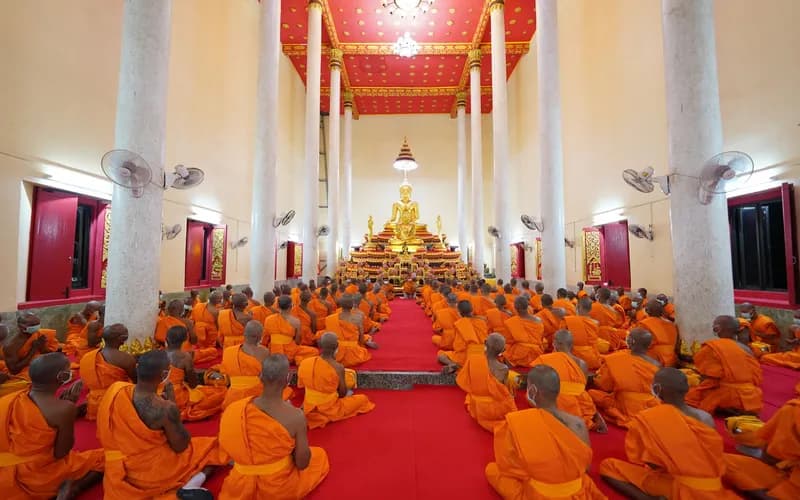
The shape is consistent across centres. A bell somewhere between four and four thirty. Sitting, walking, sitting. A talk. Chores. Two meals. Sitting, walking, sitting. Lights out at nine or ten. Ten to twelve hours of formal practice, split into blocks.
The emotional arc is also consistent, and knowing it in advance helps enormously. Days one and two are mostly logistical discomfort: the bed, the heat, the bell. Days three and four are the hard part, when the mind, deprived of input, produces every unfinished conversation of the past decade in high definition. Most people who quit, quit here. Days five through seven usually settle. By the end something has changed, and it is rarely the thing you expected.
The food is vegetarian, simple, and served in quantity twice a day. It is genuinely good. If you have dietary restrictions beyond that, say so at registration and understand that a monastery kitchen has limited flexibility; our guide to eating vegetarian and vegan in Thailand explains the wider context, including the difference between vegetarian and strictly vegan in a Thai setting.
Timing, Visas and Logistics
The cool season, November to February, is the most comfortable time for a retreat almost anywhere in Thailand. Sitting still for ten hours a day in April heat is a meaningfully harder version of the same exercise.
If you are considering a northern centre, factor in the air. February through April brings serious haze to Chiang Mai and the surrounding provinces, and a retreat is not an activity you can relocate halfway through. Our analysis of the northern smoke season sets out the pattern; the short version is to put a Chiang Mai retreat in December or January, or in the green season.
On paperwork, a standard tourist entry is sufficient for a ten-day or twenty-six-day retreat, provided the rest of your itinerary fits inside it. Do not arrive with three days of permitted stay remaining. Longer monastic stays require proper long-stay arrangements, and you should discuss them with the monastery well in advance.
Build a buffer day at each end. Arriving from an overnight bus straight into registration, and flying out the morning after a ten-day silence, are both worse ideas than they sound.
Choosing Well: Questions to Ask Before You Commit
- Is teaching given in English, and by whom?
- What is the daily schedule, hour by hour?
- What are the sleeping arrangements, and is there any privacy?
- What is the policy if I need to leave early, and will that disturb others?
- Is there a teacher interview process, or only group instruction?
- What is expected by way of donation, and when is it given?
- Are there any health conditions that would exclude me?
A centre that answers these plainly is a centre worth attending. Vagueness about money or schedule is a reason to look elsewhere. The same principle of asking direct questions before committing runs through our approach to slow travel, and it applies to monasteries exactly as it does to tour operators.
What to Do Next
- Decide honestly whether you want rest or practice. They are different trips.
- Choose a tradition. Breath-focused at Suan Mokkh or Dipabhavan; noting practice at Wat Ram Poeng or Doi Suthep.
- Contact the centre directly and confirm the current schedule, application method and any fixed contribution.
- Book your dates in the cool season if you can, and avoid the northern haze months for northern centres.
- Sit for twenty minutes a day for the month before you go. Untrained, the first sitting is brutal.
- Pack white or plain modest clothes, a light layer, repellent, and any medication. Leave the camera and the books.
- Add a buffer day at each end, and tell people at home that you will be unreachable.
- Decide your donation before you arrive, so the decision is not made while you are tired and emotional at the end.
Frequently Asked Questions
Do I need to be a Buddhist?
No. Every centre listed here accepts practitioners of any faith or none, and none of them will ask you to convert. You will be asked to observe the forms while you are there, including bowing to the Buddha image as a gesture of respect, which most non-Buddhists find straightforward once framed as courtesy rather than worship.
Can I do a retreat if I have never meditated before?
Yes, at a structured retreat centre. Suan Mokkh, Doi Suthep and Dipabhavan all routinely take complete beginners. Working monasteries such as Wat Pah Nanachat expect prior experience and will say so. A month of short daily sittings beforehand makes an enormous difference.
How much should I donate?
Consider what ten days of accommodation, three meals a day and daily instruction would cost commercially, and give what you can reasonably afford against that. Where a fixed contribution is requested it is usually modest, in the low thousands of baht for a ten-day stay, and it is a contribution rather than a price.
What if I cannot handle it and want to leave?
You can leave. Nobody is locked in, and staff are used to it. Most centres will ask you to speak to a teacher first, partly because the urge to leave peaks on day three and passes for most people who wait it out. If you do leave, do it quietly and at a break, so you do not disrupt everyone else's practice.
Is a retreat compatible with a normal two-week Thailand trip?
A ten-day retreat plus travel days consumes almost all of it, so be realistic. A seven-day option, or a two or three-day introductory course, fits a shorter trip much better. Many people find it works best as the anchor of a longer, slower stay.
Do I need a special visa?
Not for a standard retreat within your permitted stay. Longer periods of monastic residence need proper arrangements, and anyone planning several months in Thailand should look at the long-stay routes, including the Destination Thailand Visa, well ahead of departure.
Are retreats open to women on equal terms?
Yes, at all the centres described here, though accommodation and often seating are segregated by gender, and the monastic hierarchy you observe will be male in most Thai settings. Some centres have significant numbers of maechi, white-robed female renunciants, on staff. If this matters to you, ask about it directly when you enquire.