

How to Learn Enough Thai to Travel Better: Tones, Politeness and Twenty Useful Phrases
You can travel Thailand for a month without speaking a word of Thai. Menus have pictures, signs are often in English, and hospitality workers are patient and practical. But you will be travelling on the surface of the place, and the surface is where the tourist prices, the tourist menus and the tourist conversations live. Twenty minutes a day for a few weeks before you fly, and a handful of habits once you land, will change that more than almost any upgrade you could buy.
This guide is deliberately modest. It will not make you fluent. It aims to give you enough Thai to be polite, to order what you actually want, to ask the price, and to enjoy the smile you get when a stranger realises you tried.
Why a little Thai goes a long way
In Thailand, effort is read as respect. A traveller who opens with a clumsy sawasdee and a small bow of the head is treated differently from one who opens with a loud English question, and the difference compounds across a trip. Taxi drivers explain things, market sellers offer the better fruit, and guesthouse owners start telling you where they actually eat.
There is also a practical gain. Outside Bangkok, Chiang Mai and the big islands, English is patchy. In provincial towns, on local buses and in village homestays, a few phrases and the confidence to point and smile turn a stressful moment into a pleasant one. That matters for slow travel in particular, because you will spend far more time in these places than a two-week visitor would.
Finally, it makes you a better guest. Speaking even basic Thai signals that you are not treating the country as a backdrop. That is the spirit of travelling slowly: the more you give to a place, the more it gives back.
One request. Up to five tailored proposals.
Skip contacting agencies one by one — share your trip once and let up to five trusted Thailand agencies come to you. Free, with no obligation.
Get my free quotesTones without tears
Thai is a tonal language with five tones: mid, low, falling, high and rising. The same syllable can mean different things depending on the tone, which is why the language sounds musical and why learners fear it. The good news is that you do not need to master all five to be understood.
Context does most of the work. If you say a word in roughly the right tone while pointing at a mango, nobody will think you are talking about anything else. The tones that matter most for a beginner are the falling tone, which is common on words like mai (no, not), and the rising tone, used in questions like sabai dee mai (how are you?).
A practical approach is to learn each phrase as a whole melody rather than as separate words. Listen to a native speaker saying it, repeat it aloud, and copy the rise and fall as if you were learning a short song. Do not try to analyse tones before you have a feel for the sound. Short audio lessons on your phone, repeated daily, work far better than a grammar chapter.
[ ]
]
The politeness particles that do the heavy lifting
If you learn only one thing, learn this: Thai speakers end polite sentences with a particle that shows respect. Men say khrap and women say kha. This is not a word with meaning on its own; it is the sound of courtesy. Adding it to a sentence turns a blunt phrase into a gracious one, and leaving it out can come across as abrupt.
So you say sawasdee khrap if you are a man and sawasdee kha if you are a woman. Thank you is khop khun khrap or khop khun kha. Both men and women can use these particles in almost any situation, and nobody will mind a slightly wrong tone. The particle also works as a gentle yes: khrap or kha alone often means yes, I understand, or please go on.
Add the wai, the palms-together gesture, when greeting people, particularly elders, and you will be well ahead of most visitors. For the finer points of when to bow, what to do at temples and how to behave around the monarchy, read our guide to cultural etiquette in Thailand. The language and the manners belong together.
Get matched with up to 5 trusted Thailand agencies
- Free
- No obligation
- Up to 5 agencies
Twenty phrases worth learning
Romanisation in Thailand is inconsistent; you will see the same word spelled several ways. The spellings below are approximations to help you say them aloud. Add khrap or kha at the end of each.
- Sawasdee: hello and goodbye
- Khop khun: thank you
- Khor thot: sorry, excuse me
- Mai pen rai: no problem, never mind
- Chai: yes
- Mai chai: no, that is not right
- Tao rai: how much?
- Phaeng: expensive
- Lot noi dai mai: can you reduce it a little?
- Yu tee nai: where is it?
- Hong nam yu tee nai: where is the toilet?
- Sai / kwa / trong pai: left / right / straight on
- Mai phet: not spicy
- Phet nit noi: a little spicy
- Aroi: delicious
- Nam plao: plain water
- Check bin: the bill, please
- Chuay duay: help
- Mai khao jai: I do not understand
- Phut cha-cha dai mai: could you speak slowly?
You do not need to memorise all of them at once. Pick five for arrival (hello, thank you, sorry, how much, where is), five for eating, and five for getting around. The rest will come with use.
Numbers and bargaining
Numbers are among the most useful things you can learn, and they are easier than the tones. From one to ten: nueng, song, sam, si, ha, hok, chet, paet, kao, sip. Twenty is yi-sip, one hundred is roi and one thousand is phan. With these you can understand prices, bus fares, room rates and times.
Bargaining exists in Thailand but within limits. At a night market, asking lot noi dai mai with a smile can shave a little off a price; at a fixed-price shop, a restaurant or a guesthouse, it is not appropriate. Start with a light touch, never haggle over tiny sums with someone who is clearly working hard for a small margin, and accept the first decent price. If you need help managing cash, cards and mobile data on the move, our guide to money and connectivity in Thailand covers the practical side.
Ordering food in Thai
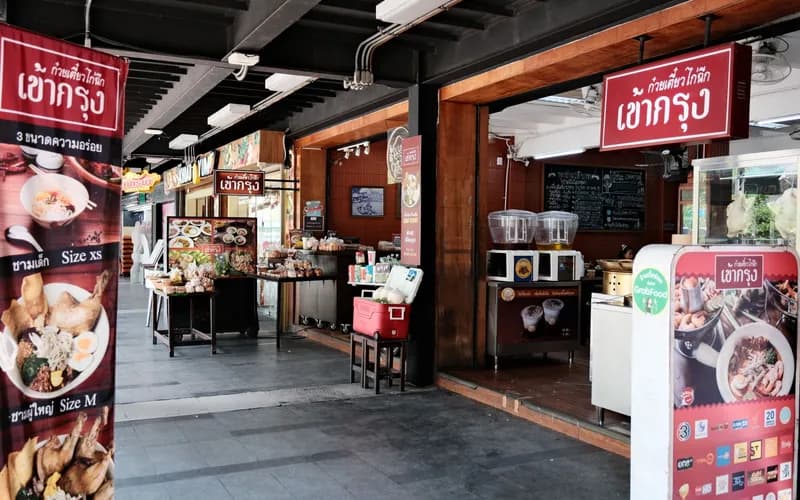
This is where a few words pay for themselves immediately. Spice levels are the classic example. If you do not say anything, dishes may arrive hotter than you expected. Saying mai phet (not spicy) or phet nit noi (a little spicy) gives you control. If you want it properly hot, phet mak means very spicy, and you should be prepared to mean it.
Dietary needs can be explained in simple words, but need care. Vegetarian food is often described as jay or gin jay; fish sauce and shrimp paste appear in many dishes, so ask clearly about each ingredient. Our practical guide to eating vegetarian and vegan in Thailand goes through phrases and traps in more detail.
[ ]
]
Reading signs and using your phone
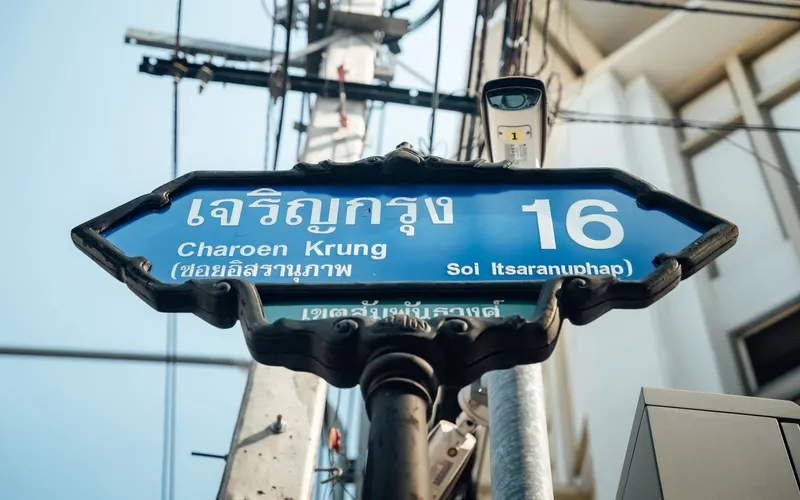
Thai script has 44 consonants and a number of vowel marks, and it is not realistic to learn it before a short trip. For a longer stay, learning to read basic signs and menus is a satisfying project that pays off quickly, especially numerals on street stalls.
Technology fills the gaps. A translation app with an offline Thai pack and a camera mode that reads menus and signs is the single most useful tool. Use it as a bridge rather than a replacement: say your phrase first, and use the app if you are not understood. Speaking aloud into the phone and then handing it to the other person works well, but a smile and a phrase learned by heart will often get further.
Keep addresses and hotel names in Thai script on your phone for taxi drivers, and save key places in your maps app. English-only directions are often hard for drivers to match, while Thai text works instantly.
Regional speech and what to expect
Thai is not spoken the same way everywhere. In the northeast, Isan speech is close to Lao and has its own vocabulary. In the north, the northern dialect has a softer rhythm and its own words. In the south, speech can sound very fast and clipped, and visitors who understood Bangkok Thai may struggle.
Do not worry. Standard Thai is understood nationwide because it is the language of schools, television and government. But expect to hear different words in markets and villages, and take it as a pleasure rather than a problem. Dish names change from region to region too, which our guide to Thai food explores in depth. Listening for the differences is one of the quiet delights of slow travel.
How to practise before and during your trip
Aim for short, regular sessions rather than long, rare ones. Ten to twenty minutes a day for four to six weeks is enough to learn the particles, the numbers and a core set of phrases. Use audio first, because pronunciation and tones are heard before they are read. Repeat aloud, record yourself if you wish, and test yourself with a friend or tutor.
Once you arrive, make use of every day. Greet people in Thai, ask for the price in Thai, order in Thai even when the menu is in English. Keep a small notebook, write down words you hear, and ask a friendly guesthouse host to correct you. Most people are delighted to help. A cooking class is one of the best language classrooms in the country: you hear ingredient names, handle them and repeat them in a low-stakes setting, and our advice on choosing a Thai cooking class explains what to look for.
If you are staying a month or more in one place, consider a few lessons with a local teacher; many towns have language schools or private tutors. It is a good use of a slow-travel budget, and it gives you a regular structure to your week.
What to Do Next
- Start four weeks before you fly: ten to twenty minutes a day of audio practice.
- Learn the politeness particles first, then numbers, then the twenty phrases above.
- Download an offline translation app with camera mode before you leave.
- Save your hotel and key destinations in Thai script on your phone.
- On arrival, use one new phrase every day, and ask a local to correct you.
Frequently Asked Questions
Do I need to speak Thai to travel in Thailand?
No. You can travel without it, especially in tourist areas. But even a few phrases improve interactions, help in less touristy towns, and show respect that is noticed and appreciated.
Is Thai really that difficult because of the tones?
Tones make Thai harder than many languages, but travellers do not need to master them. Context carries most meaning, and people are used to hearing foreigners speak imperfectly. Learn phrases as whole melodies and focus on being clear and polite.
What is the difference between khrap and kha?
Khrap is the polite particle used by men, and kha is used by women. They are added to the end of sentences to show courtesy. Using the wrong one is a small error that people will forgive, but using the right one earns warmth.
How do I say that I want food not spicy?
Say mai phet, adding khrap or kha. For a little spice, say phet nit noi. If you want it properly hot, say phet mak, but only if you are confident.
Should I learn to read Thai script?
For a short trip, no. For a long stay, learning basic characters and numerals is rewarding and practical. A translation app with a camera mode covers most needs in the meantime.
Will a translation app be enough?
An app is a useful bridge, but it works best alongside a few spoken phrases. Offline packs help where signal is weak. Use the app when you are stuck, and your own words the rest of the time.
Do people in different regions speak differently?
Yes. Isan in the northeast, northern Thai and southern Thai each have their own words and rhythms. Standard Thai is understood everywhere, so you will be fine, but you may hear unfamiliar words in local markets.