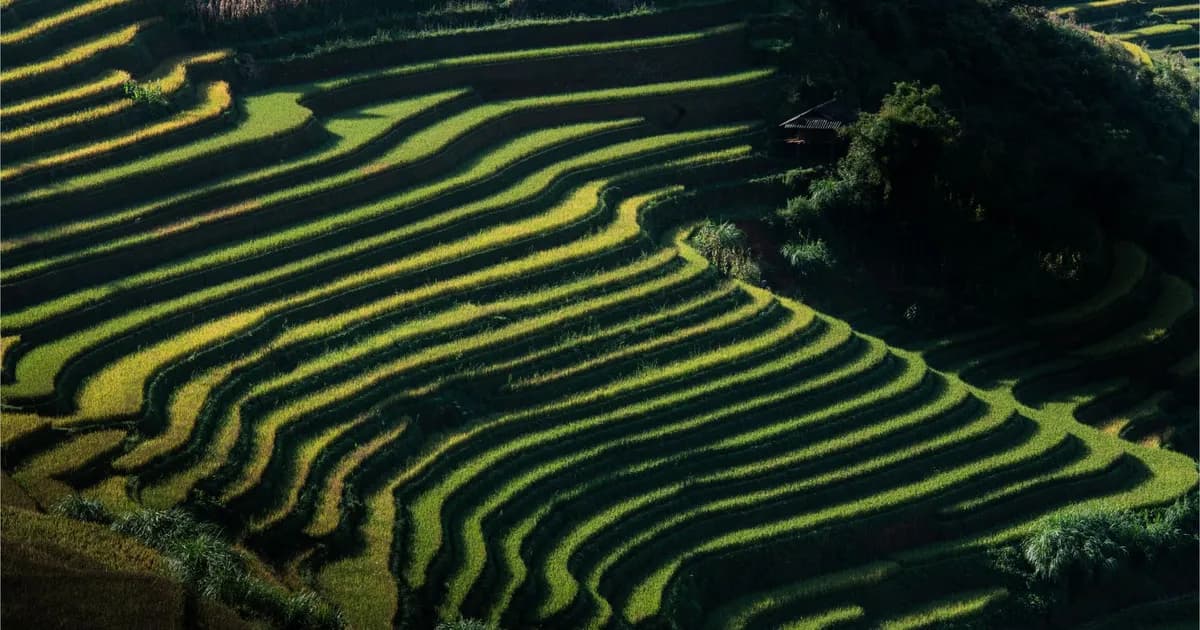

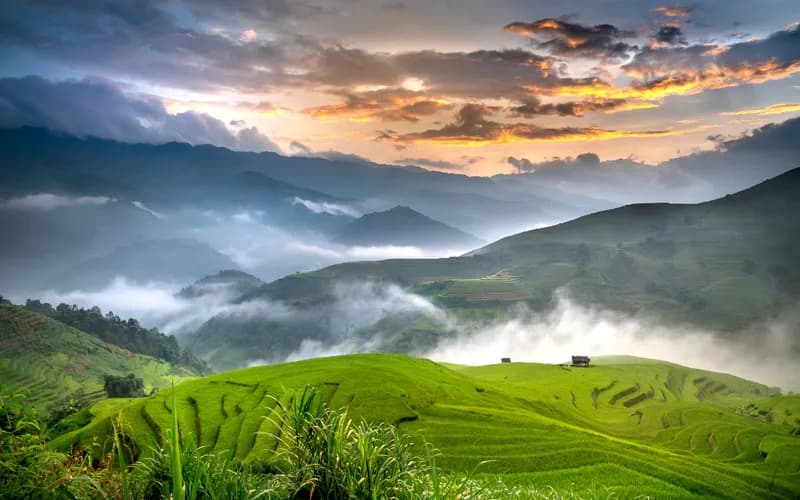
The rice terraces of Muong Hoa Valley do not announce themselves. They emerge gradually — tier by tier, pale gold or deep green depending on the season — as the road drops southeast from Sa Pa town and the noise of the market district falls away. At this distance, roughly eight to ten kilometres from the centre, the landscape stops performing and starts simply existing.
Most visitors to Sa Pa never quite reach that feeling. They arrive by overnight train, photograph the terraces from a viewpoint, and leave before the afternoon cloud rolls in. The valley becomes a backdrop rather than a place. What this piece is about is the other version: staying long enough, and slowly enough, that Muong Hoa becomes somewhere you actually know.
The Valley as Landscape, Not Lookout
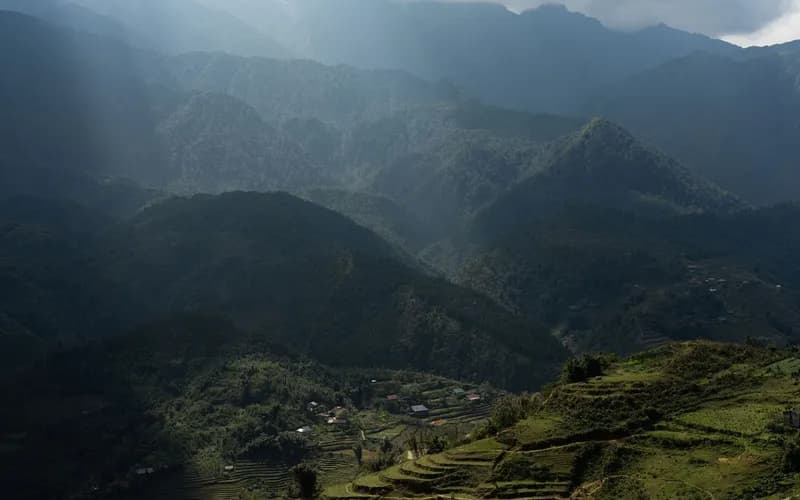
Muong Hoa sits in Lao Cai province, in the shadow of the Hoang Lien Son range. The valley floor holds the Muong Hoa stream, and the slopes above it are carved into some of the most intricate agricultural terracing in the north. This is not ornamental. The terraces are working fields, maintained by Black Hmong and Red Dao farming families whose villages — Ta Van, Lao Chai, and others — are scattered along the valley corridor.
The distinction between viewpoint and landscape matters here. A viewpoint is consumed in minutes. A landscape takes days to read. The trails that thread through Ta Van and down toward the stream are uneven, sometimes steep, and occasionally demanding — one traveller described a four-hour guided hike through the villages as "a bit demanding" with paths that were "sometimes very steep." That is not a warning against going. It is a description of terrain that has not been flattened for convenience, which is precisely its value.
The valley rewards a particular kind of attention. Walk slowly enough and you begin to notice the irrigation channels cut into the hillside, the way a farmer adjusts the water flow with a single stone, the sound the terraces make after rain. These are not details that appear in photographs.
One request. Up to five tailored proposals.
Skip contacting agencies one by one — share your trip once and let up to five trusted Vietnam agencies come to you. Free, with no obligation.
Get my free quotesLodge-Anchored Slow Travel
The most coherent way to experience Muong Hoa is to base yourself in the hills rather than in Sa Pa town. Properties like Topas Ecolodge, positioned on a ridge above the valley, are built around exactly this logic: the accommodation is not a place to sleep between activities, it is the frame through which the landscape is experienced.
From a ridge-line lodge, the rhythm of the day changes. You wake to cloud moving through the valley below. You walk in the morning, when the light is low and the trails are quiet. You return in the afternoon, when the mist comes in and the terraces disappear into grey. That cycle — walk, return, observe, repeat — is the actual product. It cannot be replicated on a day trip from town.
This approach also changes the nature of village encounters. Guided walks through Ta Van and Lao Chai are not performances arranged for visitors. They are routes through communities that have their own pace and purpose. A guide who knows the valley adds route certainty on steep terrain, but more importantly adds cultural context — the difference between walking past a Red Dao household and understanding something of what you are seeing.
Weather, Expectations, and Honest Preparation
Muong Hoa is not a guaranteed experience. One travel account described the valley as a low point of a Vietnam trip, shaped by poor weather and unmet expectations. That account is worth taking seriously, not as a deterrent but as a calibration.
The northern highlands operate on their own meteorological schedule. Cloud can settle for days. Rain turns the trails to mud. The terraces that look luminous in dry-season photographs can disappear entirely behind fog. None of this makes the valley less interesting — fog has its own atmosphere — but it does mean that travellers who arrive expecting instant visual payoff are likely to be disappointed.
The better frame is flexibility. Build in enough days that one grey morning does not define the stay. Accept that the valley in mist is a different experience from the valley in sun, and that both are real. Bring footwear that handles uneven ground. Treat the weather as part of the landscape rather than an obstacle to it.
The best time to visit is generally September to November, when the harvest terraces are at their most vivid and the weather is more stable. March and April offer a second window, with the fields flooded and reflecting the sky before planting begins. The summer months bring heavy rain and reduced visibility on the trails.
Get matched with up to 5 trusted Vietnam agencies
- Free
- No obligation
- Up to 5 agencies
Getting There and Settling In
Muong Hoa Valley is accessible from Sa Pa town via Highway 4D. The journey takes roughly twenty to thirty minutes by car or motorbike taxi. Organised tours from Sa Pa also run into the valley, though these tend toward the day-trip format that this piece argues against.
For a lodge-anchored stay, the practical sequence is straightforward: arrive in Sa Pa by overnight train from Hanoi, transfer directly to your accommodation in the hills, and let the town remain a supply point rather than a base. Sa Pa's market is worth a morning — the produce, the textiles, the density of it — but the valley is where the time should go.
Independent access to the trails is possible, but a local guide adds genuine value on longer routes. The terrain is not always clearly marked, and the cultural dimension of village walking is significantly richer with someone who can translate not just language but context. Guide rates and lodge packages vary; confirm current pricing directly with your accommodation before arrival, as costs in this region shift with the season and the operator.
Who This Journey Suits
Muong Hoa is not for every traveller, and it does not try to be. It suits people who are comfortable with physical walking, who find meaning in landscape that requires some effort to read, and who prefer depth over coverage. It is a place for those who would rather spend three days in one valley than three days crossing four destinations.
It also suits travellers who are willing to let the place set the pace. The terraces do not hurry. The villages do not perform. The ridge-line view at dawn is available to anyone who wakes early enough and walks to it. That is the quiet offer Muong Hoa makes — not spectacle, but presence.
For the right traveller, that is more than enough.
Frequently Asked Questions
When is the best time to visit Muong Hoa Valley?
September to November is the most reliable window. The rice harvest turns the terraces gold, the weather is more settled, and the trails are at their most walkable. March and April offer a second season, when the flooded paddies reflect the sky before planting. Avoid the peak summer months if possible — heavy rain reduces visibility and makes steep trails significantly harder.
How do you get from Sa Pa town to Muong Hoa Valley?
The valley is roughly eight to ten kilometres southeast of Sa Pa town centre, accessible via Highway 4D. Motorbike taxis and private cars are the standard options; the journey takes around twenty to thirty minutes. Organised day tours also run from town, though a lodge-based stay in the hills is a more immersive approach than a return transfer.
How difficult are the walking trails?
Expect uneven ground and sections that are genuinely steep. A guided four-hour hike through Ta Van and the surrounding rice fields is a reasonable benchmark for the effort involved. The trails are not technical, but they are not flat park paths either. Sturdy footwear with grip is important. Fitness levels that are comfortable with a half-day hill walk will manage well.
Do you need a guide?
Not strictly, but a guide adds real value. Route-finding on longer village walks is not always straightforward, and a knowledgeable local guide provides cultural context that transforms a walk through a village into something more than a transit. Most lodges and tour operators in the area can arrange guides; confirm availability and rates when you book your accommodation.
What are the common pitfalls for first-time visitors?
The two most common are weather disappointment and checklist thinking. Travellers who arrive expecting guaranteed clear skies and a quick visual reward often leave frustrated. The valley is best approached with flexible days, realistic expectations about mountain weather, and a genuine interest in the landscape as a lived place rather than a scenic backdrop. Arriving with those conditions in place, the experience tends to be quietly absorbing.