

Vietnam is one country with three distinct climates that frequently run in opposite directions. While Hanoi shivers under winter drizzle, Hoi An's beaches can be warm and dry. While the central coast floods under typhoon rains, Ho Chi Minh City enters its most pleasant season. Generic advice — "go between November and April" — is not wrong exactly, but it is incomplete enough to ruin a trip. This guide maps Vietnam's weather region by region, flags the windows that matter most for planning, and gives you a sequencing logic for multi-region itineraries. It will not tell you there is a perfect month. It will help you understand the trade-offs so you can make an informed choice — and build a trip that works with the weather rather than against it.
How Vietnam's Three Climate Zones Work
Vietnam's narrow, elongated shape means its regions sit under different monsoon systems at the same time. Two main monsoons drive the country's weather: the southwest monsoon (roughly May–September), which brings humid, rainy conditions to the south and parts of the north; and the northeast monsoon (roughly November–March), which pushes cooler, drier air into the north and drives central Vietnam's winter rains. Vietnam's national tourism authority outlines this two-monsoon structure as the foundation for all regional variation.
Think in three bands:
- North: Cool, dry winters; hot, wet summers
- Centre: Long dry summers; late-year typhoon and rain season
- South: Consistent heat year-round; a clean wet/dry split
Within each band, altitude adds another layer. Mountain areas in the north — Sapa, Ha Giang, Cao Bang — run significantly colder than Hanoi's lowlands, with winter nights near or below 0°C and occasional frost.
One request. Up to five tailored proposals.
Skip contacting agencies one by one — share your trip once and let up to five trusted Vietnam agencies come to you. Free, with no obligation.
Get my free quotesNorthern Vietnam: Month-by-Month Conditions
Hanoi, Ninh Binh, Ha Long Bay
- November–April: Cool and mostly dry. December–February brings the coldest days, often 10–15°C, sometimes lower during cold snaps. Expect grey skies and occasional drizzle rather than sunshine.
- May–October: Hot, humid, and wet. June–August sees the heaviest rainfall. Hanoi receives roughly 1,600–1,800 mm of rain annually, most of it concentrated in these months.
Best for cultural touring: November–March, if you accept cool, overcast conditions. Best for lush landscapes: June–September, with the trade-off of heat and frequent showers.
Northern Mountains: Sapa, Ha Giang, Mu Cang Chai
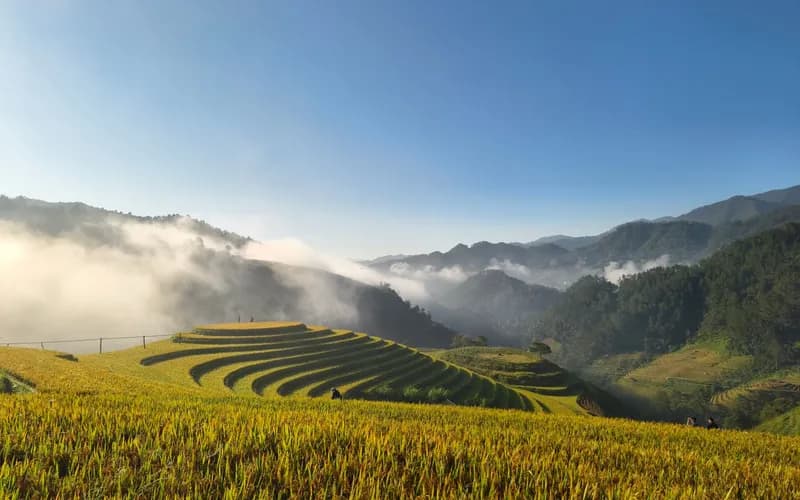
- September–November: Generally the clearest window after summer rains. Late September to early October is when rice terraces turn golden before harvest — the timing varies by altitude and farming schedule, so treat this as a range, not a fixed date.
- March–April: Mild temperatures, greening hills, manageable crowds.
- December–February: Atmospheric and quiet, but fog can obscure mountain views entirely. Paths can be frozen or muddy. Gear matters: thermal layers and waterproof footwear are not optional.
Ha Long Bay cruise operators sometimes suspend sailings during storms or high winds, even when skies over the bay look clear. Build flexibility into any Ha Long itinerary, particularly from June through September.
Central Vietnam: The Region Where Planning Errors Hurt Most
Central Vietnam — Hue, Danang, Hoi An, Quy Nhon, Nha Trang — has the most counterintuitive seasonal pattern in the country. Selective Asia's Vietnam weather guide describes the split clearly: a long dry season running roughly January through August, followed by a rainy and typhoon-prone period from September through December.
The Dry Season (January–August)
- Temperatures range from around 21°C in January to 35°C or higher by late spring and early summer.
- June–August is hot — often intensely so — but generally dry and swimmable along the coast.
- Nha Trang and Phan Thiet (Mui Ne) are particularly reliable during this window.
The Rainy and Typhoon Season (September–December)
This is where simplified advice causes real damage to real trips.
- Heavy rains typically peak in October–November across the Hue–Hoi An corridor.
- Typhoons and tropical storms in the South China Sea affect central coastal provinces — Thua Thien–Hue, Danang, Quang Nam, Quang Ngai, Binh Dinh, Khanh Hoa — primarily from August through November, peaking in August–October.
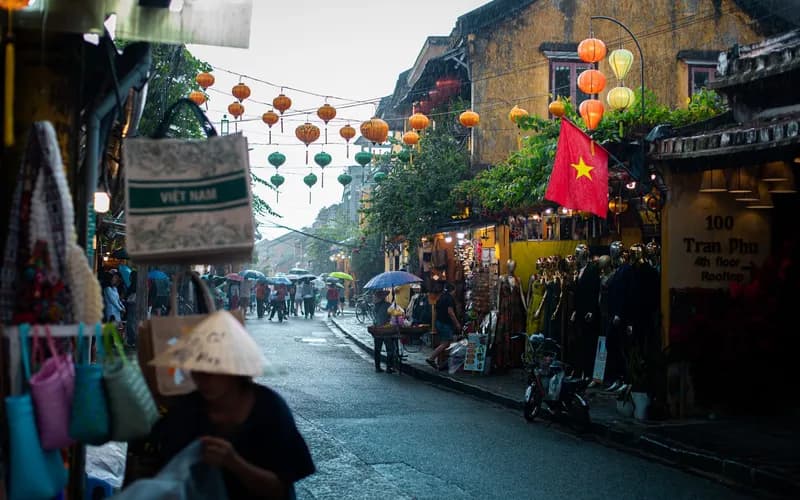
- Flooding in Hoi An's Old Town is not a rare edge case. Travelers in October and November regularly report flooded streets, cancelled boat trips, and closed beach facilities. Some years are worse than others, but the risk is meaningfully elevated compared to March.
One useful micro-detail: The Hai Van Pass marks a rough weather divide. Hue, north of the pass, tends to be wetter and cooler in winter than Danang and Hoi An to the south. Nha Trang's rainy peak often runs slightly later — October through December — making it more reliable in July and August than in November.
Get matched with up to 5 trusted Vietnam agencies
- Free
- No obligation
- Up to 5 agencies
Southern Vietnam: The Simplest Pattern
- Dry season: November through April or early May. Late February through May grows hotter and more humid.
- Wet season: May through early November. Heaviest rainfall falls in June–August.
- Temperatures stay broadly consistent year-round: 25–32°C.
The south's wet season behaves differently from the north's. Rain typically arrives as intense, short mid-afternoon downpours rather than all-day events. Mornings are often clear. For urban and cultural travel — Ho Chi Minh City's food scene, Mekong Delta boat trips, Hue's citadels — wet season is entirely manageable if you plan your days accordingly.
Islands:
- Phu Quoc: Drier November–April; rougher seas and occasional boat cancellations May–October.
- Con Dao: Similar monsoonal pattern; divers often target March–July for better underwater visibility.
Sequencing a Multi-Region Itinerary
The goal is to follow the good weather south or north rather than fight it.
The Most Forgiving Window: Late November–March
For a north–central–south trip covering Hanoi, Hue or Hoi An, and Ho Chi Minh City:
- North: Cool and mostly dry. Expect grey skies in December–January, not tropical sunshine.
- Centre: Past peak typhoon season by December; drier from January onward. Central beaches can be cool and cloudy in January–February.
- South: Firmly in dry season.
This window has the fewest serious weather risks across all three regions. It is not perfect everywhere simultaneously — it rarely is.
The Spring Sweet Spot: March–April
- Northern temperatures warm up and skies improve.
- Central beaches are entering their best months.
- The south is still dry or only just beginning to transition.
March–April is often cited by experienced travelers and regional specialists as the most balanced window for a full-country trip. Monsoon onset varies by year, so watch forecasts as you approach.
The Riskier Window: August–October
- North: hot and wet, improving gradually by late September.
- Centre: highest typhoon and flood risk, especially October–November.
- South: wet season with heavy afternoon downpours.
Travel in this period is possible. It requires cancellable bookings, buffer days, and a willingness to reroute if a storm targets the central coast. Do not plan a beach-heavy central Vietnam trip in October without contingency options.
Wet Season Strategy
If your dates are fixed in monsoon months, design around the conditions rather than against them:
- Prioritize cities and culture over beaches and mountain viewpoints.
- Schedule sightseeing in the mornings in the south, where afternoon storms are most predictable.
- Keep central Vietnam bookings cancellable during September–December.
- Build buffer days into northern mountain itineraries — landslides and road closures after heavy rain are not uncommon on Ha Giang loop roads or passes in the Hoang Lien Son range.
- Monitor local advisories in the days before each regional move, not just at the time of booking.

What to Do Next
- Identify your non-negotiables first. Beach days, mountain trekking, and city culture each have different optimal windows. Start with your priorities, not a calendar.
- Map your itinerary against the three regional bands. North, centre, and south. Then refine by altitude and activity type.
- Flag October–November as a high-risk window for central Vietnam. If your dates fall there, either skip the central coast or book fully refundable accommodation.
- For a full north-to-south trip, target late November–March or March–April. Accept the trade-offs: cool north in December–January, or a slightly earlier monsoon risk in April.
- Book flexible fares and accommodation for any trip touching the central coast between August and December. This is not excessive caution — it is standard practice among travelers who know the region.
- Check Vietnam's national meteorological service forecasts in the week before each regional leg, particularly if you are traveling between July and November.
Four Principles for Weather-Aware Trip Design
- Choose your anchor region before your dates. Decide which part of Vietnam matters most to you, northern trekking, central beaches or southern food and waterways, find that region's optimal window, and build the dates around it.
- Sequence your direction with the seasonal shift. From February to April, a south-to-north progression follows improving northern conditions. From September to November, moving north to south lets you catch the northern harvest before settling into the southern dry season.
- Spend more time where conditions are reliable, less where they are not. If Hoi An in November is unavoidable, keep it to two or three nights with flexible bookings, and put the bulk of the trip where the weather is working in your favour.
- Wet season is not a reason to stay home. In the south, and across much of the north in summer, rain arrives in the afternoon and clears by evening. A trip built around morning activity, a midday pause and evening exploration stays genuinely comfortable.
Applied to a real route, this is what our two-to-four-week itinerary guide is built on, and it is why the Mu Cang Chai harvest only works within a narrow window each September and October.
Frequently Asked Questions
Is there a single best month to visit all of Vietnam?
No. Vietnam's three climate zones are frequently out of sync. A month that is ideal for Hanoi may coincide with typhoon season on the central coast, or with the wet season in the south. The most broadly manageable window for a full north-to-south trip is late November through March, but even then you are trading off cool, grey weather in the north against only-adequate beach conditions in the centre.
When is the typhoon season in Vietnam, and which areas are affected?
Typhoons and tropical storms in the South China Sea affect Vietnam primarily from June through November, peaking between August and October. The central coastal provinces — from Quang Binh down through Khanh Hoa — are the most exposed. The north and south are less directly affected, though severe storms can disrupt transport across the country.
Is October a bad time to visit Hoi An?
October carries meaningfully elevated flood and storm risk for Hoi An and the surrounding central coast. Some years see only a few rainy days; others bring flooded streets, cancelled boat trips, and closed beach facilities for days at a time. If you travel in October, keep bookings cancellable and have a contingency plan. It is not impossible — but it is not the low-risk shoulder season some sources suggest.
Can I trek in Sapa or Ha Giang in December?
Yes, but with adjusted expectations. December in the northern mountains can be atmospheric and quiet, with fewer crowds. It can also mean fog that obscures views entirely, frozen or muddy paths, and cold nights near or below 0°C. Thermal layers, waterproof footwear, and a flexible attitude toward viewpoints are essential. If clear mountain panoramas are your primary goal, September–November or March–April are more reliable.
Is wet season travel in southern Vietnam worth avoiding?
Not necessarily. The south's wet season — roughly May through October — brings intense but short afternoon downpours rather than all-day rain. Mornings are often clear. Ho Chi Minh City's food scene, the Mekong Delta, and cultural sites remain fully accessible. The trade-off is choppy seas and reduced visibility for island and snorkeling trips. Wet season also brings lower prices and fewer crowds at many properties.
Why do Ha Long Bay cruises sometimes get cancelled even when the weather looks fine?
Harbor authorities in Ha Long Bay err on the side of caution. They can suspend sailings based on forecast wind speeds or distant storm systems, even when skies over the bay appear clear. This is a safety protocol, not an anomaly. If your itinerary depends on a Ha Long overnight cruise, build in a buffer day and check cancellation and rescheduling policies before booking.
What is the best time to visit Vietnam for beaches specifically?
It depends on which coast. For central Vietnam — Danang, Hoi An, Quy Nhon, Nha Trang — the most reliable beach window is March through August, with June–August being hot but generally dry. Avoid October–November for beach-focused trips. For southern islands — Phu Quoc, Con Dao, Mui Ne — December through March offers the calmest seas and most consistent sunshine.