
Vietnam's railways get the romantic coverage, and deservedly so. But the change that will actually reshape how most people move around the country over the next two years is happening in the air. A third significant airline has entered the market, new routes are connecting second cities directly rather than funnelling everyone through Hanoi and Ho Chi Minh City, and on 1 December 2026 a brand-new international airport takes over long-haul traffic for the south. None of this is obviously good news for slow travel. Used carelessly, cheaper flights produce faster, shallower trips. Used deliberately, the same network lets you cut backtracking, spend more nights in fewer places, and reach regions that used to cost you a full travel day.
What actually changed in the last twelve months
Three things, in rough order of importance. First, Long Thanh International Airport moved from construction story to firm date. Second, Sun PhuQuoc Airways went from paperwork to a real fleet flying real schedules. Third, both the established carriers and the newcomer kept adding direct routes between cities that previously had no useful connection to each other.
The cumulative effect is a network that looks less like a barbell and more like a web. For two decades, Vietnamese domestic aviation was essentially a shuttle between two megacities with spurs to holiday islands. Getting from, say, the central highlands to the northern mountains meant flying south or north to a hub and out again, or accepting a very long night on the road. That is steadily becoming less true.
It is worth keeping perspective. Vietnam still has only a handful of carriers, domestic fares rise steeply around Tet and the summer holidays, and schedule reliability in the typhoon months is what it has always been. This is an incremental improvement, not a transformation.
One request. Up to five tailored proposals.
Skip contacting agencies one by one — share your trip once and let up to five trusted Vietnam agencies come to you. Free, with no obligation.
Get my free quotesLong Thanh: the big one, and it lands in December
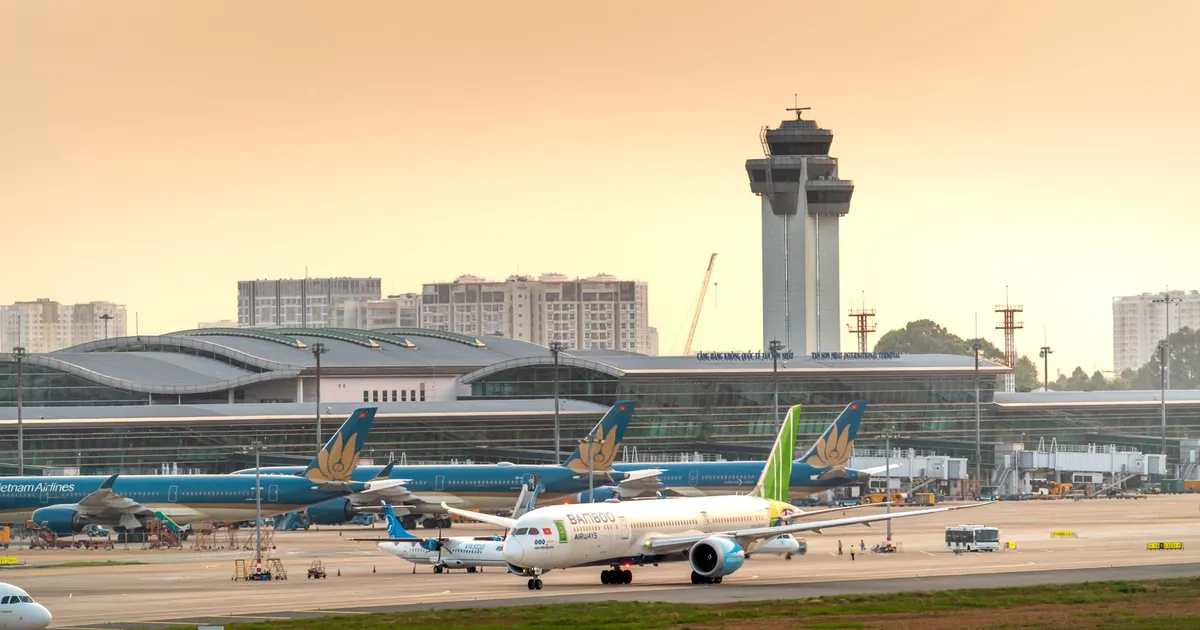
Long Thanh, roughly 40 kilometres east of Ho Chi Minh City in the Dong Nai area, held a ceremonial technical opening on 19 December 2025 and is scheduled for commercial launch on 1 December 2026. The plan is a clean split of duties rather than a gradual migration: Long Thanh takes long-haul international flights, cargo and new international routes, beginning with services from Europe, India, the Middle East and North America, with Northeast Asia following in 2027. Tan Son Nhat keeps regional Southeast Asian flying and the bulk of domestic traffic.
The opening capacity is modest by design, around 2.6 million passengers, expanding toward 15 million by the end of 2027. Only a small share of movements, in the region of five to ten percent, will be domestic feeder flights.
For travellers, the practical consequence is a question you will have to answer from December: which airport does my connection actually use? A long-haul arrival at Long Thanh followed by a domestic departure from Tan Son Nhat is a transfer across a congested metropolitan area, not a walk between terminals. If your trip starts after 1 December, read our Long Thanh arrival guide before you book anything with a tight connection.
Our honest advice for the first months: avoid same-day domestic connections through Ho Chi Minh City altogether. Build in a night in the city, or fly into Da Nang or Hanoi instead. New airports have teething problems everywhere, and this one is opening in phases with a new expressway and rail link still maturing around it.
A third national airline, and what it is really for
Sun PhuQuoc Airways, backed by the Sun Group, flew its first commercial service on 1 November 2025, from Hanoi's Noi Bai to Phu Quoc with 220 passengers aboard an Airbus A321. It launched with three domestic routes, Phu Quoc to Hanoi, Phu Quoc to Ho Chi Minh City, and the Hanoi to Ho Chi Minh City trunk, and had built a fleet of around ten aircraft by mid-2026.
Through 2026 it added Da Nang and Nha Trang connections to Phu Quoc, began flying Hanoi and Ho Chi Minh City to Da Nang from late February, and opened its first international route to Taipei on 29 March, with Busan, Singapore, Bangkok and Hong Kong following.
Be clear-eyed about the strategy. This is an airline built to feed an island resort economy, and Phu Quoc's build-out ahead of hosting APEC in 2027 is the context for all of it. That is not a slow-travel proposition. What it does give the rest of us is a third bidder on domestic trunk routes, which tends to keep fares honest, and better mid-week availability on the Hanoi and Ho Chi Minh City corridors at exactly the times independent travellers prefer to move.
Get matched with up to 5 trusted Vietnam agencies
- Free
- No obligation
- Up to 5 agencies
The rise of point-to-point routes between second cities
The quieter and more useful development is the steady thickening of routes that bypass the two big hubs entirely. Da Nang has been the main beneficiary, gaining direct services in several directions, but the pattern extends to Hai Phong, Vinh, Quy Nhon, Hue, Buon Ma Thuot, Can Tho and Con Dao. Domestic route announcements clustered again around the Lunar New Year period in 2026, which is when Vietnamese carriers typically add capacity.
What this changes on the ground is the shape of an itinerary. The old default was a spine: arrive Hanoi, work south, depart Ho Chi Minh City, with an internal flight or two to skip the dull bits. The emerging alternative is a loop with an open jaw, where you fly into one regional airport and out of another without paying for a hub transfer in either direction.
A concrete example. A central-coast trip that once began and ended in Da Nang can now plausibly enter at Hue or Da Nang and exit at Quy Nhon or Buon Ma Thuot, which means an island like Ly Son off the Quang Ngai coast stops being a detour and becomes a natural stop on the line. That is the kind of change that adds days to a region rather than removing them.
Why this matters for slow travel, and where it does not
Slow travel is not anti-transport. It is anti-backtracking, anti-rushing and anti-treating a country as a list. Judged that way, a denser route map helps in three specific ways.
- It removes wasted days. A four-hour hub transfer that exists only because of network design is a day you do not spend anywhere.
- It makes open-jaw itineraries cheap. Entering and leaving through different regions is the single easiest way to stop doubling back.
- It opens up regions with weak road links, particularly the central highlands and the far south, where the alternative is a ten-hour bus.
Where it does not help: anything under about 500 kilometres. Hanoi to Ninh Binh, Hue to Da Nang, Ho Chi Minh City to the Mekong Delta are all better by train, car or bus, and flying them costs you time once you count the airport. We work through the trade-offs in detail in our guide to choosing between trains, flights and sleeper buses.
The honest downside: cheap seats make for fast trips
There is a reason this article is not simply cheerleading. Every new domestic route makes it easier to compress Vietnam into a highlights reel. Three cities in nine days becomes five cities in nine days, and the traveller arrives home having seen a great deal and understood very little. Airports are also where the environmental cost of a trip concentrates. A short domestic hop carries a disproportionate emissions penalty because take-off and climb dominate the fuel burn.
The discipline we would suggest is simple and unfashionable: cap yourself at two domestic flights for a three-week trip, and make each one buy you at least three extra nights in a place. If a flight exists only to let you add another destination, skip it. Our ultimate slow travel guide to Vietnam sets out the same principle for the rest of an itinerary.
There is also a resilience argument. Flights are the first thing to fail when weather turns, and Vietnam's central coast has a real typhoon season. The train and the road keep running through a great deal of weather that grounds an A321.
How to use the new map without wrecking your trip
Start from where you want to spend time, not from where flights are cheap. Choose two or three regions for a two-week trip, pick the airport nearest the first and the airport nearest the last, and then look for the international fares. Vietnamese carriers and the major Asian hubs now make Da Nang, Hai Phong, Hue, Nha Trang and Phu Quoc realistic entry points, and an open-jaw international ticket usually costs little more than a return.
Book domestic legs directly with the airline rather than through aggregators; changes are far simpler when something moves, and something usually does. Keep at least three hours between a domestic arrival and an international departure, more from December if Ho Chi Minh City is involved. Travel mid-week where you can, since domestic fares and airports both spike at weekends and collapse into chaos around Tet and the end-of-April holiday.
Finally, resist the temptation to book the flight first. The itinerary should decide the route map, not the other way round.
What to Do Next
- Sketch your regions before your flights. Write down the three or four places you want to spend real time in, in geographical order, and only then look at which airports bracket them.
- Check whether your travel dates fall after 1 December 2026. If they do and you are transiting Ho Chi Minh City, confirm which airport each leg uses before you pay for anything.
- Price an open-jaw international ticket alongside a standard return. Entering at one regional airport and leaving from another often costs the same and saves two travel days.
- Limit yourself to two domestic flights, and hold each one to a test: does it buy at least three more nights somewhere worthwhile?
- Compare each flight against the train or a private car for journeys under 500 kilometres. Below that distance, the ground option usually wins on time as well as on experience.
- Sanity-check the whole plan against seasonal weather and holiday peaks using our plan your journey tools before you commit to dates.
Frequently Asked Questions
When does Long Thanh airport actually open to passengers?
Commercial operations are scheduled to begin on 1 December 2026, following the ceremonial technical opening in December 2025. It starts with long-haul international flights, cargo and new international routes, with an initial capacity of roughly 2.6 million passengers a year, scaling toward 15 million by the end of 2027.
Will my flight leave from Long Thanh or Tan Son Nhat?
From December 2026, long-haul international services to Europe, North America, India and the Middle East move to Long Thanh, while Southeast Asian regional flights and most domestic services stay at Tan Son Nhat. Always confirm the airport code on your booking, because the two are about 40 kilometres and a serious traffic corridor apart.
Is Sun PhuQuoc Airways a reasonable choice for foreign travellers?
It is a conventional A321 operator flying mainstream domestic and regional routes, and it has expanded quickly since its first flight in November 2025. As with any young airline, the sensible caution is schedule stability rather than safety: book direct, avoid tight connections, and do not put a new carrier's flight on the day of your international departure.
Do more flights mean cheaper domestic fares in Vietnam?
Competition on the main trunk routes has increased, which helps, but the bigger price drivers remain seasonal. Fares around Tet, the end-of-April holiday and the July to August domestic peak can be several times the shoulder-season level. Travelling mid-week and outside national holidays saves far more than choosing between airlines.
Should I fly or take the train between Hanoi and Hue or Da Nang?
For that specific corridor, the train is usually the better slow-travel choice: you see the Hai Van pass, you arrive in the centre of town, and the overnight sleeper saves a hotel night. Flying wins only when your dates are tight or when you are continuing straight to a third region.
How many domestic flights is too many?
As a working rule, more than two in three weeks suggests the itinerary is too broad. Each flight typically consumes half a day door to door once you count transfers and check-in, so three flights can quietly cost you the equivalent of two full days of your trip.
Are new routes making Vietnam more crowded?
In specific places, yes. Direct international access concentrates visitors on a handful of destinations, particularly islands and beach cities, during a short season. The same network also makes lesser-visited provinces reachable, so the crowding effect depends heavily on where you choose to go rather than on the route map itself.