

Most travellers meet the Mekong twice in Cambodia. Once in Phnom Penh, where it swallows the Tonle Sap in front of the Royal Palace, and once in Kratie, where they go looking for dolphins. Between those two points lies Kampong Cham, a broad, low-slung provincial capital that almost everybody drives past. That is exactly what makes it worth stopping in. Here the Mekong is not scenery. It is infrastructure, livelihood and calendar all at once.
The Town the Highway Forgot
Kampong Cham sits roughly 120 kilometres northeast of Phnom Penh, close enough to reach in two to three hours and far enough that the capital's noise does not follow you. For much of the twentieth century it was one of Cambodia's most important provincial centres, the administrative and commercial heart of a rubber-growing region. The town still carries that weight in its fabric: wide boulevards, shuttered colonial-era shophouses, a riverside promenade that is genuinely used by residents rather than staged for visitors.
In 2013 the old province was split, and its eastern districts became the separate province of Tboung Khmum. Kampong Cham kept the river, the bridges and the name, but shed some of its administrative bulk. Add the road upgrades that now let long-distance buses run north without pausing, and you get a town that is quietly under-visited relative to what it holds.
For slow travellers this is close to ideal. There is enough here to fill two or three days without any single sight demanding to be ticked off, and prices remain modest. If you are working out where a stop like this fits into a wider route, the Cambodia off the beaten path guide covers how the country's second-tier towns string together.
One request. Up to five tailored proposals.
Skip contacting agencies one by one — share your trip once and let up to five trusted Cambodia agencies come to you. Free, with no obligation.
Get my free quotesThe River, the Bridge and the Working Bank
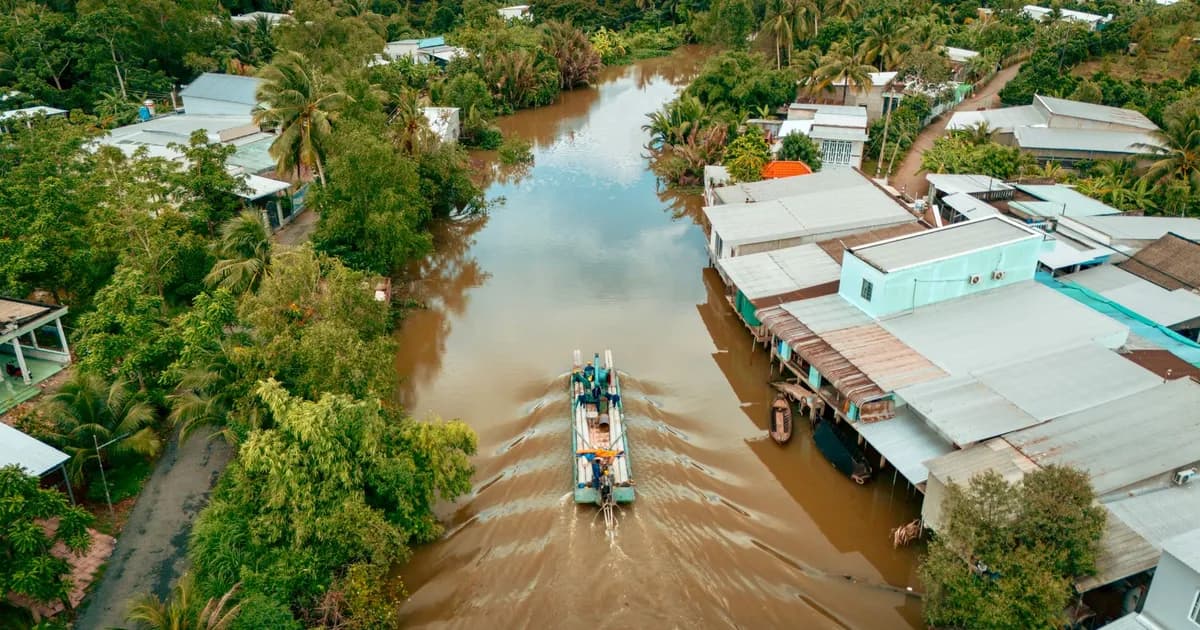
Start where the town starts: on the water. Kampong Cham's riverfront is a long, unhurried strip of concrete and shade trees where the whole social life of the place plays out between five and seven in the evening. Families walk. Vendors set up grills and drinks carts. Teenagers race scooters slowly enough to be seen. The river itself is enormous here, several hundred metres wide in the wet months, and it moves with a heavy, unshowy authority that photographs poorly and stays with you anyway.
The Kizuna Bridge, opened in 2001 with Japanese funding, was the first bridge to span the Mekong inside Cambodia and remains the town's defining structure. Before it existed, everything crossing between the eastern and western halves of the country queued for a ferry. Walking or cycling out onto it at dusk gives you the clearest sense of the river's scale, and of how much of Cambodia's daily economy still moves along and across this single channel.
Below the bridge, the bank is a working one. Fishermen mend nets. Sand barges load. In the dry months, market gardeners plant vegetables directly into the exposed riverbed, a crop cycle that exists only because the water withdraws and returns on schedule.
Koh Paen, the Island That Moves
Directly opposite the town sits Koh Paen, a long sandy island in the middle of the Mekong. It is farmland, mostly: sesame, corn, tobacco, vegetables, with villages strung along dirt tracks and pagodas marking the higher ground. Nothing about it is engineered for visitors, which is the point. A slow cycle or moto loop around the island takes two to three hours and passes almost nothing you would call an attraction, and a great deal you would call life.
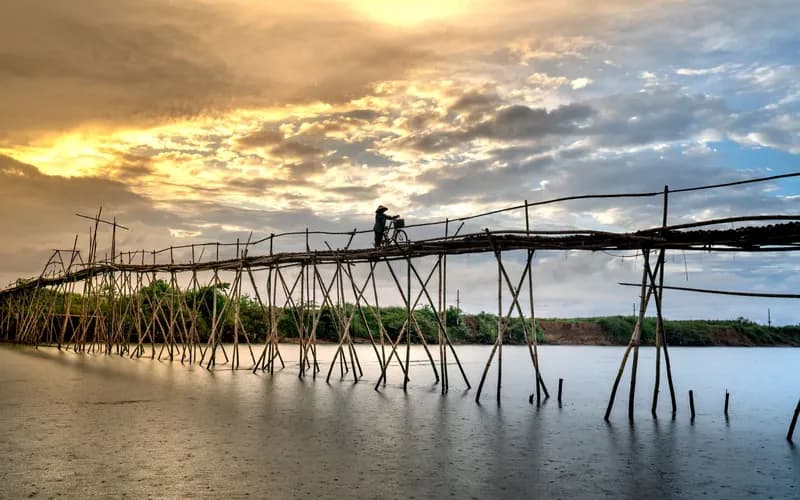
Koh Paen is famous for its seasonal bamboo bridge, traditionally rebuilt by hand each dry season and dismantled or washed out when the water rises. Reports of its length vary between roughly 800 metres and a kilometre. It is a genuine feat of vernacular engineering, and crossing it on foot is one of the more memorable things you can do in eastern Cambodia. It is also not guaranteed. Construction depends on water levels, funding and local decisions, and a concrete crossing has in recent years taken over much of the vehicle traffic. Ask at your guesthouse before building a day around it, and treat a working bamboo bridge as a bonus rather than a promise. When it is absent, a small ferry or the permanent crossing does the job.
Expect a token toll if the bamboo bridge is running, typically a few thousand riel per person. Go early or late; the island has almost no shade on its tracks.
Get matched with up to 5 trusted Cambodia agencies
- Free
- No obligation
- Up to 5 agencies
Wat Nokor Bachey: A Temple Inside a Temple
Two kilometres out of town along National Road 7 stands Wat Nokor Bachey, and it is the single most interesting thing in the district. The core is an eleventh-century Angkorian sanctuary of dark laterite and sandstone. Inside and around it, a modern Buddhist pagoda has been built, painted, and put to daily use, so that monks walk between ancient doorframes and contemporary murals sit against thousand-year-old stone.
Elsewhere this layering would be treated as a conservation problem. Here it reads as continuity: a sacred site that was never abandoned long enough to become a ruin. Come in the late afternoon when school groups and worshippers thin out. There is usually a small entrance fee, and it is worth walking the full circuit of the outer gallery rather than heading straight for the central shrine.
Phnom Pros and Phnom Srei: Two Hills and an Argument
About seven kilometres from town, two low hills rise from the flat: Phnom Pros, Man Hill, and Phnom Srei, Woman Hill. The story attached to them is a building contest between men and women, settled by a trick involving a lantern raised in the night to imitate the morning star. Which side won depends on who is telling it.
Phnom Pros is the easier climb, with a pagoda, food stalls and a resident macaque troop that has learned exactly how tourists behave around plastic bags. Keep food out of sight and do not feed them. Phnom Srei demands a longer stairway and pays it back with a genuine view over the plain: rice, sugar palms, and the distant line of the river. Between the two hills is a memorial to those killed here during the Khmer Rouge period, quietly maintained and worth the few minutes it asks.
Han Chey and the Upstream Road
Twenty kilometres upstream, on a bluff above the Mekong, sits Han Chey. The climb is a long flight of steps to a hilltop compound where a modern pagoda shares the ground with a small pre-Angkorian brick sanctuary, a survivor from the Chenla period well before Angkor Wat was conceived. Stone is not the main event; the view is. From the top you look straight down the river as it bends away, and on a clear afternoon you can see how completely the settlement pattern below is dictated by water.
The road out follows the bank through villages that see very few foreign faces. Hire a moto driver for a half day, or cycle it if you are comfortable with heat and dust. This is the same slow river geography that continues north to Kratie, and if you are heading that way the Kratie and the Mekong article picks up the thread.
Rubber, Rice and the Working Countryside
Kampong Cham's modern history is a rubber story. Plantations established during the colonial period, most famously around Chup to the east, made this one of the wealthiest agricultural regions in French Indochina, and rubber remains a major regional employer. The plantations are strange and beautiful places: rank after rank of identical trees, each with a spiral cut and a collection cup, the light falling in stripes.
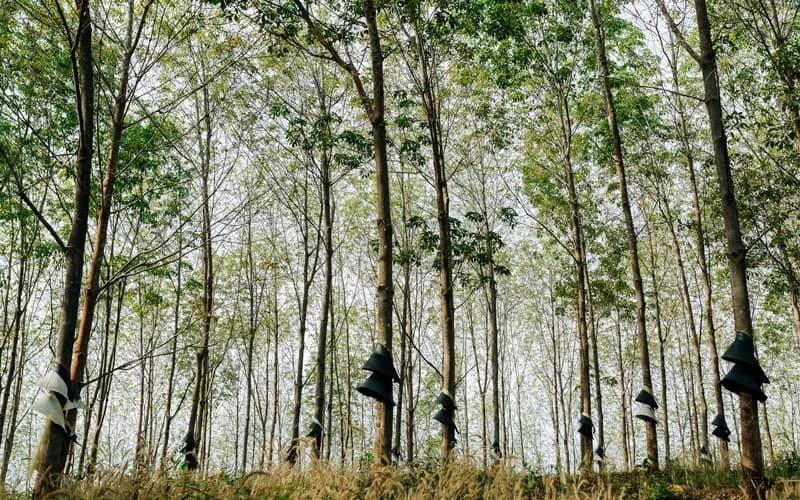
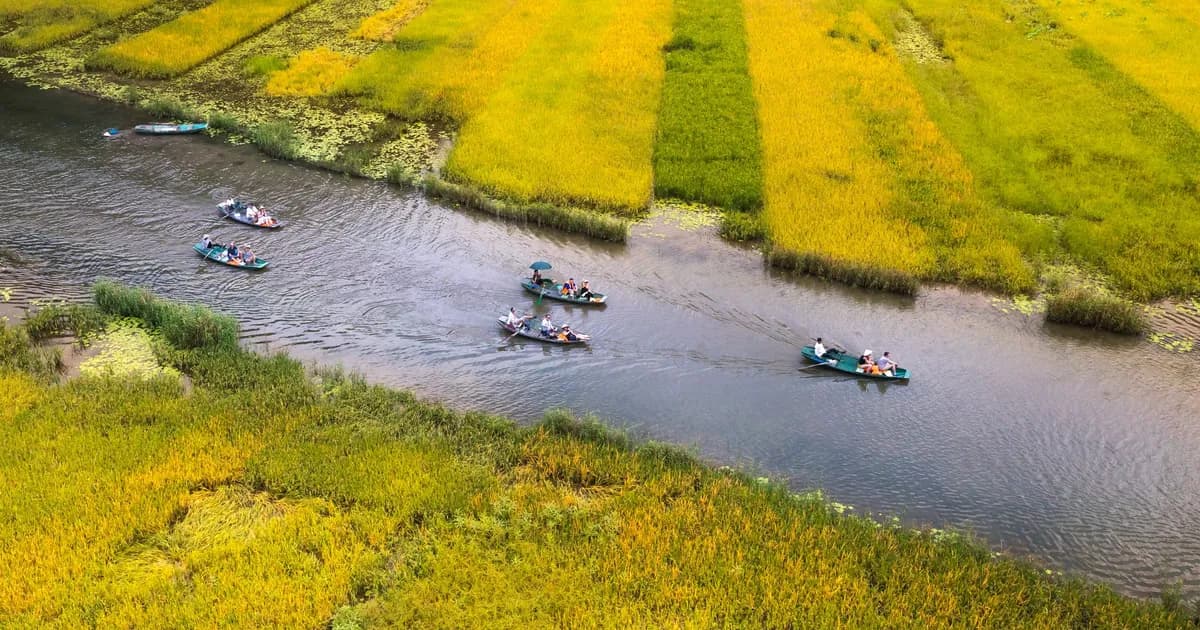
You can drive through plantation roads freely, though the estates themselves are working operations rather than attractions and deserve to be treated as such. Ask before wandering into a tapping area. Between the rubber and the river lies ordinary Cambodian countryside at its most legible: rice in the lowlands, sugar palms marking field boundaries, oxcarts still in occasional use, and a rhythm set entirely by the wet and dry seasons.
Eating and Sleeping at River Pace
Accommodation is limited but adequate, and that is a fair trade. A handful of riverfront guesthouses and small hotels offer rooms in the modest range, several with balconies facing the water. There are no resorts and no serious nightlife, which filters the visitor mix in a useful way.
Eat where the town eats. The market delivers breakfast rice porridge and noodle soup from early morning; the riverside stalls handle the evening. Grilled river fish, beef skewers, and the fried noodle plates that show up wherever Cambodian and Chinese cooking have been in conversation for a century are all reliable here. Prices are noticeably lower than in Siem Reap or the coast. For a broader sense of what to order and why, the guide to Cambodian food is a useful companion.
Wet-season visitors should note that the river frontage is at its most dramatic between roughly July and October, when the water is high and the island shrinks. Our practical notes on travelling in the rains are in the green season guide.
Getting There, Moving On
Buses and minivans run frequently from Phnom Penh, typically two to three hours depending on the operator and the number of stops. From the north, Kampong Cham is a natural break on the road between the capital and Kratie or Stung Treng. Shared taxis fill the gaps. Local transport within town is by moto or tuk-tuk, and a half-day hire to cover Wat Nokor, the two hills and Han Chey is straightforward to arrange at any guesthouse.
Bicycles are the right tool for Koh Paen and the near riverbank. Several guesthouses rent them cheaply. If you want the mechanics of moving around the country by road, rail and river, see how to travel Cambodia overland.
What to Do Next
- Give Kampong Cham two nights minimum. One night reduces it to a bus break; two lets you cycle the island and still see the temples without rushing.
- Check the bamboo bridge status locally before you arrive, and have a plan that works without it.
- Book a riverfront room. The evening promenade is the town's best hour, and being able to step straight into it matters.
- Arrange a half-day moto or tuk-tuk circuit covering Wat Nokor Bachey, Phnom Pros and Phnom Srei, and Han Chey, ideally starting early.
- Pair the stop with Kratie rather than treating it as a standalone destination, so the middle Mekong reads as one continuous journey.
- Use plan your journey to slot the middle Mekong into a wider Cambodian route with realistic travel times.
Frequently Asked Questions
How many days do I need in Kampong Cham?
Two nights is the sensible minimum and three is comfortable. That gives you one day for the island and riverfront and one for the temples and hills outside town, with room to lose an afternoon to the heat without feeling behind.
Is the bamboo bridge to Koh Paen always there?
No. It is a seasonal, hand-built structure traditionally raised in the dry months and lost when the river rises, and its construction in any given year depends on local circumstances. A permanent crossing and a ferry mean you can always reach the island, but confirm the bamboo bridge locally rather than assuming it.
Is Kampong Cham safe and easy for independent travellers?
Yes. It is a calm provincial town with normal small-city precautions, well away from the sensitive Cambodia-Thailand border areas in the northwest. English is less widely spoken than in Siem Reap, so a translation app and patience help.
When is the best time to visit?
November to February is the most comfortable, with cooler air and a falling river. March to May is very hot. The green season from roughly June to October brings a high, powerful river and vivid countryside, along with occasional road disruption.
Can I visit Kampong Cham as a day trip from Phnom Penh?
You can, and it is better than nothing, but you will spend four to six hours in transit for a few hours on the ground. The town's appeal is atmospheric rather than sight-driven, and atmosphere needs an overnight.
Is there much to do for children?
The island cycle, the macaques at Phnom Pros and the riverfront in the evening all work well for families. There are no formal attractions, playgrounds or activity operators, so plan for unstructured time rather than a schedule.
How does Kampong Cham compare to Kratie or Battambang?
Kratie is smaller and organised around the river and its dolphins. Battambang is larger, with a stronger arts and colonial-architecture draw. Kampong Cham sits between them: more urban than Kratie, less curated than Battambang, and the least visited of the three.