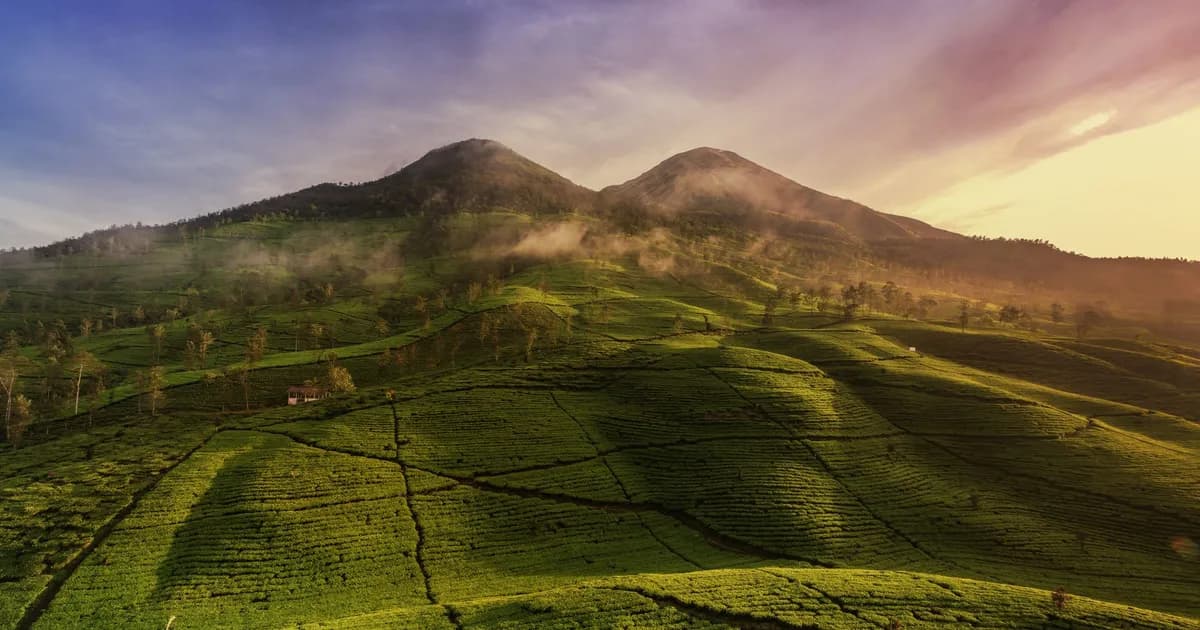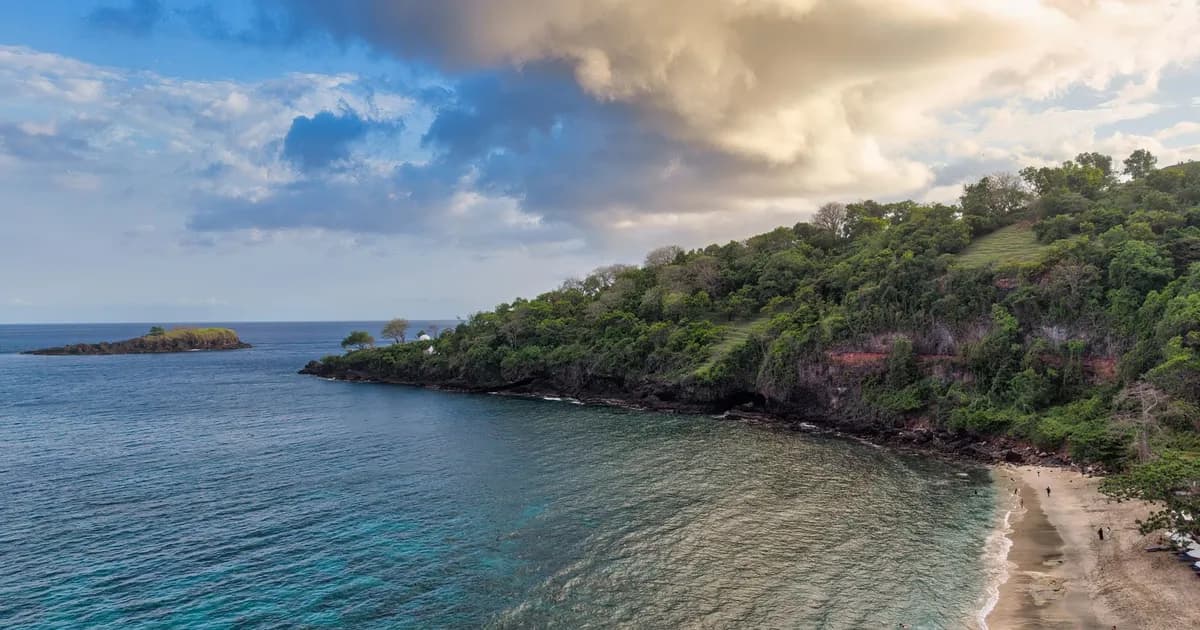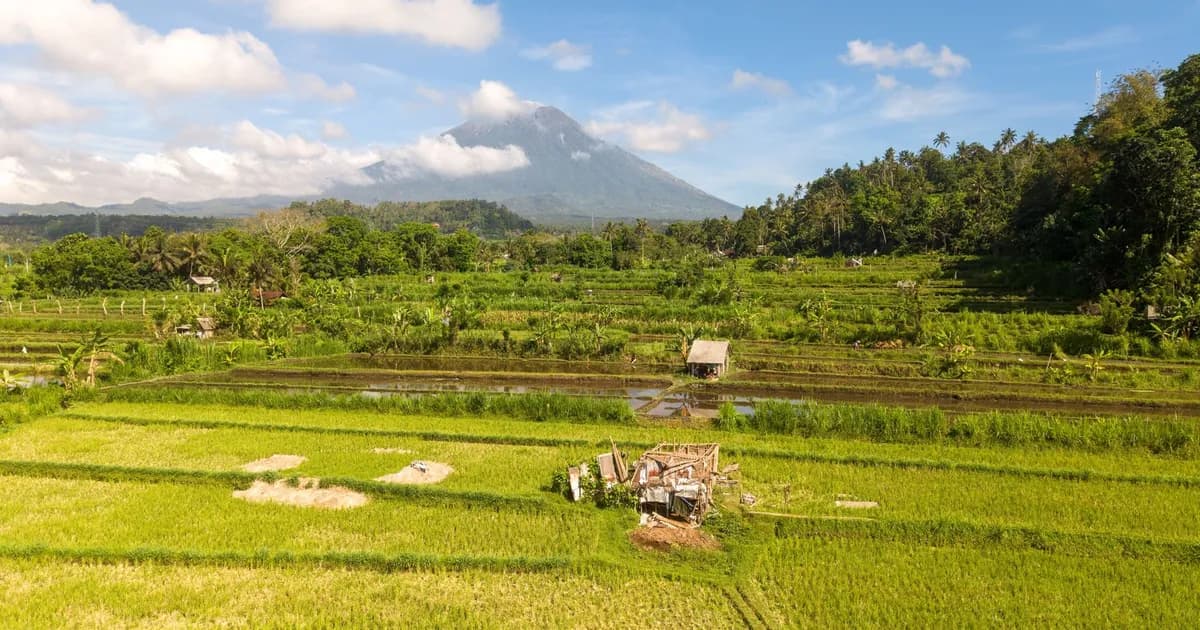


Most first-time Indonesia itineraries arrive pre-cooked: Bali, perhaps Java, perhaps Flores. North Sulawesi almost never appears on them. That is a loss, and also the reason the province still works. Here a coral wall drops into deep blue water within sight of a provincial capital, the world's smallest primate wakes at dusk in a coastal forest an hour up the road, and a highland market town smells of cloves, wet volcanic soil and frying chilli. It is a region built for two weeks, not two days.
Where North Sulawesi Sits, and Why It Stays Quiet
Sulawesi sprawls across the centre of the archipelago in four long arms, and North Sulawesi occupies the tip of the northern one. Manado, the provincial capital, is geographically closer to Davao in the southern Philippines than it is to Jakarta. That position keeps it off the well-worn corridor that runs Bali to Lombok to Komodo to Flores, and the isolation has protected it. Most foreign visitors who do come are divers who fly in, transfer straight to a resort, dive for ten days and fly out again without ever seeing the interior.
The result is a strange and useful imbalance: reefs of genuine international quality with modest crowds, and a hinterland that receives almost no foreign visitors at all. If you have already worked through the obvious islands and want somewhere that has not yet been reshaped around tourism, this is a serious candidate. Our wider survey of places Indonesia is deliberately steering travellers towards explains why regions like this are suddenly being pushed, and why arriving before the infrastructure does is both the pleasure and the difficulty.
North Sulawesi is also culturally distinct from most of the country. The Minahasa people of the highlands are majority Christian, and the landscape reflects it: church spires rather than minarets, Sunday mornings when the roads empty and the markets close, a colonial layering of Portuguese, Spanish and Dutch contact that shows up in surnames, in the architecture and in the food. Planning around that weekly rhythm matters more here than in Java or Bali.
One request. Up to five tailored proposals.
Skip contacting agencies one by one — share your trip once and let up to five trusted Indonesia agencies come to you. Free, with no obligation.
Get my free quotesManado: A Gateway Worth More Than One Night
Sam Ratulangi International Airport sits about 30 minutes north of central Manado, and nearly everyone treats the city as a transit point between the runway and a dive boat. Give it a day at each end instead.
Manado is not a pretty city. It is hot, traffic-heavy, and much of its waterfront is reclaimed land occupied by malls. But it has an old Chinese quarter with the Ban Hin Kiong temple, one of the oldest Chinese temples in Indonesia and still busy with daily worship. It has Pasar Bersehati, a chaotic riverside market where the fish arrive before dawn. And it has the practical function that matters most on a long trip: it is where you resupply, do laundry, fix a booking, eat well and adjust.
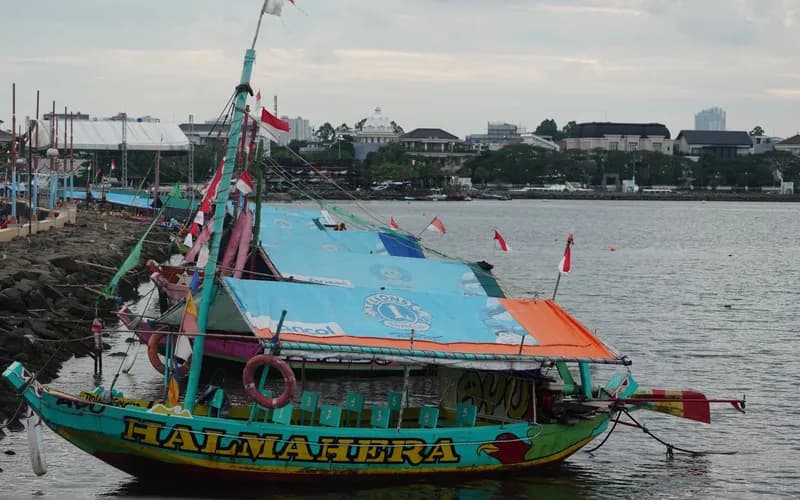
Manado also functions as a hinge in a longer archipelago route. Flights connect it to Makassar, Sorong and Ternate, which means North Sulawesi can be strung onto a wider eastern-Indonesia journey rather than treated as a dead end. If you are assembling that kind of route, our guide to moving between Indonesian islands without losing days to logistics covers the ferry-versus-flight arithmetic and the buffer days that make it survivable.
Bunaken: The Wall That Made the Region Famous
Bunaken National Marine Park protects roughly 890 square kilometres of sea around five main islands: Bunaken itself, the volcanic cone of Manado Tua, tiny Siladen, and the larger Montehage and Nain. Its signature is the drop-off. The reef flat runs out from the shore and then simply ends, falling away in a near-vertical wall covered in sponges, gorgonians and soft coral. You swim along it with turtles below you and schools of fusiliers streaming past at eye level.
The park charges an entrance fee of around IDR 150,000 for foreign visitors, against a token domestic rate, usually collected as a tag or card that your operator arranges. The crossing from Manado takes roughly 40 to 50 minutes by boat.
Two honest caveats. First, Bunaken has a history of damage, from dynamite fishing decades ago to more recent bleaching events, and some sites are visibly less rich than the marketing photographs suggest. Second, during the wettest months the rivers of Manado push plastic and debris into the bay, and on a bad day you will swim through it. The reef is still excellent. It is not pristine, and anyone selling it as untouched is not being straight with you. Reading our notes on diving and snorkelling without adding to the damage before you get in the water is worth the ten minutes.
Stay on the island rather than day-tripping. Simple homestays line Liang and Pangalisang beaches, meals are usually included, and three nights is the realistic minimum to dive or snorkel properly and still have an evening on the sand.
Get matched with up to 5 trusted Indonesia agencies
- Free
- No obligation
- Up to 5 agencies
Lembeh Strait: The Art of Looking Down
Across the peninsula from Manado, about 90 minutes to two hours by road, the port city of Bitung faces the narrow channel between the mainland and Lembeh island. The seabed here is black volcanic sand, nutrient-rich and, to the untrained eye, dull. It is also one of the most celebrated dive sites on earth.
Lembeh is the global capital of muck diving: hunting for tiny, bizarre, superbly camouflaged creatures on an apparently empty bottom. Hairy frogfish, mimic and blue-ringed octopus, flamboyant cuttlefish, pygmy seahorses, nudibranchs in absurd colours. If you want sweeping reefscapes, you will be bored. If you want to hover in one square metre for twenty minutes while a guide points at something that turns out to be alive, you will not want to leave.
Costs are higher than the Indonesian average. Seven-night packages at established dive resorts, including all meals, three boat dives a day and transfers, commonly run from around USD 1,800 to USD 3,500 per diver depending on the tier of the property, with separate strait fees of roughly USD 30 to 50. Budget dive lodges exist and cost considerably less. The strait is sheltered enough to dive year-round, with the clearest water generally from July to October.
Tangkoko: Tarsiers, Macaques and an Honest Reckoning
Tangkoko Batuangus Nature Reserve sits on the coast beyond Bitung, about 90 minutes from Manado, which makes it a natural pairing with Lembeh. The reserve protects lowland forest running down to a black-sand shore beneath a volcanic cone, and it holds two animals people travel a long way to see.
The first is the crested black macaque, a critically endangered species found nowhere else, instantly recognisable from the famous self-portrait photograph taken with a wildlife photographer's camera. The second is the spectral tarsier, among the smallest primates alive, which roosts by day inside hollow strangler figs and emerges at dusk with eyes that seem far too large for its body.
Entry costs around IDR 100,000 per foreign visitor, with guide and ranger fees of roughly IDR 100,000 to 200,000 per person depending on the walk. A guide is compulsory, and that is the right rule. Because tarsiers emerge at last light, the walk that matters is the late-afternoon one, which means sleeping in Batuputih village at the reserve gate rather than returning to the city.
The honest reckoning: tarsier trees can attract a scrum of visitors and camera flashes at exactly the moment the animals are most vulnerable, and macaques have learned to associate people with food. Go in a small group, refuse flash photography, keep a real distance from the macaques rather than a photogenic one, and never feed anything. Distance is also a health question, since primate bites and scratches are a rabies concern anywhere in Indonesia, as our guide to staying well across the archipelago sets out in detail.
The Minahasa Highlands: Volcanoes, Lakes and Market Day
Drive inland and up from Manado and within an hour the air changes. Tomohon sits at around 800 metres between two volcanoes, Lokon and Mahawu, in a landscape of flower nurseries, clove trees and vegetable terraces. Nights are genuinely cool.
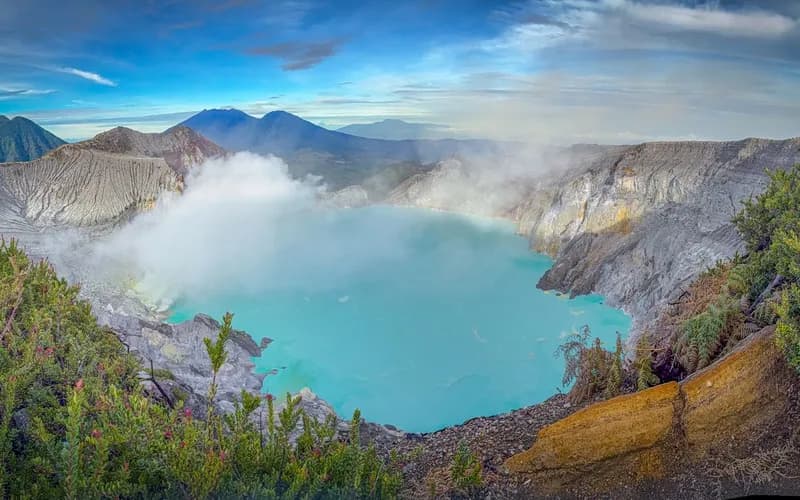
Mahawu is the accessible volcano: a road takes you near the rim, a staircase does the rest, and the crater and its views over the highlands are yours in under an hour. Lokon is more serious and periodically restricted depending on its alert status, which is checked and enforced. Below them, Lake Linow shifts colour through green, blue and amber as sulphur and light interact, and Lake Tondano, the province's largest, spreads out in rice fields and floating fish farms with lakeside restaurants along its edge.
The highlands also hold the region's deepest history. At Sawangan, rows of waruga, pre-Christian Minahasa stone burial sarcophagi carved with faces and animals, stand in a field like a small stone city. At Kanonang, Bukit Kasih is a sulphurous hill built as a shared spiritual site, with places of worship from five faiths on one slope. In Woloan, workshops build traditional wooden houses in kit form and ship them across Indonesia.
One place requires a decision rather than a recommendation. Tomohon's traditional market has an international reputation for the sale of bushmeat and, historically, dog and cat meat. The city announced a ban on that trade in 2023, and enforcement has been reported as partial and inconsistent. You should know what you may encounter, and you should be honest with yourself about your reason for going. Curiosity about a working local market is one thing. Going to photograph animal suffering is another.
Eating in Minahasa
Minahasan cooking is among the spiciest in Indonesia and it does not adjust for visitors. Rica-rica is the base idea: a chilli and shallot paste applied to chicken, fish or pork. Woku is its aromatic cousin, loaded with lemongrass, turmeric leaf and basil. Dabu-dabu, a raw chilli, tomato and lime relish, arrives with grilled fish and is not optional.
Breakfast is tinutuan, a pumpkin, sweetcorn and greens porridge eaten with salted fish and sambal, and cakalang fufu, smoked skipjack tuna, appears in some form at most meals. Sweet things run to klappertaart, a Dutch-descended coconut custard. Local palm wine, saguer, and its distilled form, cap tikus, are offered generously and should be treated with respect. Our survey of what to eat across the country puts these regional dishes in context.
Pacing Two Weeks, Honestly
Fourteen nights is the sweet spot. A workable frame: two nights in Manado on arrival, three or four on Bunaken, three around Bitung for Lembeh and Tangkoko, three or four in the Tomohon highlands, and a final night back in Manado before flying. Nothing in that plan involves more than two hours of road at a time, which is unusual for Indonesia and one of the region's real advantages.
Resist compressing it. The temptation is to add Sangihe or the Togean Islands, but both are separate journeys with their own ferry rhythms, and stapling them on turns a calm fortnight into a transport schedule.
Getting There, Costs and Seasons
Manado connects domestically through Jakarta, Surabaya and Makassar, with onward links east to Ternate and Sorong. International connections are limited and change often, so check current schedules rather than trusting an old itinerary.
Costs sit slightly above the Indonesian average because of the dive economy but well below Bali for anything outside it. Highland guesthouses and Bunaken homestays remain modest; Lembeh dive resorts are the outlier. The drier months run roughly April to October, with the clearest underwater visibility from July to October, while November to March brings heavier rain and more debris in the bay. If you want help turning this into a shaped itinerary with the right internal flights, our journey planning page is the place to start.
What to Do Next
- Fix your dates against the season first: aim for the April to October window, and prioritise July to October if diving is the point of the trip.
- Book Bunaken or Lembeh accommodation before anything else. Dive resorts are small, fill early, and dictate the rest of the schedule.
- Confirm your flights into Manado and out again with at least one buffer night at each end, since regional connections here are prone to reshuffling.
- Decide your Tangkoko plan in advance: a dusk walk means a night in Batuputih, not a day trip.
- Block three nights minimum for the highlands so that a rained-out volcano day does not cost you the whole region.
Frequently Asked Questions
Is North Sulawesi worth visiting if I do not dive?
Yes, though you will want to snorkel. Bunaken's drop-offs begin close enough to the surface that snorkellers see much of what divers do, and the highlands, Tangkoko and the Minahasa cultural sites easily fill a week on their own. If you have no interest in the water at all, the region is still rewarding but you would be skipping its strongest asset.
How many days do I need for North Sulawesi?
Ten days is workable, fourteen is comfortable, and anything under a week forces you to choose between the reefs and the interior. The distances are short, but ferry crossings, dusk wildlife walks and weather all reward slack in the schedule.
When is the best time to go?
Roughly April to October, with July to October offering the most reliable underwater visibility. November to March is wetter, and river run-off can bring debris into the bay around Manado. Lembeh Strait is sheltered and diveable year-round, which makes it the safer bet in shoulder months.
Is it safe to see the tarsiers and macaques at Tangkoko?
Yes, with a licensed guide and sensible behaviour. Keep well back from the macaques, do not feed any animal, and avoid flash photography around tarsiers. Bites and scratches from primates carry a rabies risk in Indonesia and should always be treated as a medical matter, not a travel anecdote.
How does North Sulawesi compare with Raja Ampat?
Raja Ampat has greater biodiversity and far more dramatic seascapes, but it is more expensive, harder to reach and increasingly regulated. North Sulawesi is cheaper, far easier logistically, and combines its reefs with a genuinely interesting land-based region. They serve different trips rather than competing directly.
Do I need to book dives in advance?
For Lembeh, yes, often months ahead in high season, because the good resorts are small and repeat guests fill them. On Bunaken, homestays and dive shops are more flexible outside July and August, though booking your first two or three nights removes the risk of arriving on a full island.