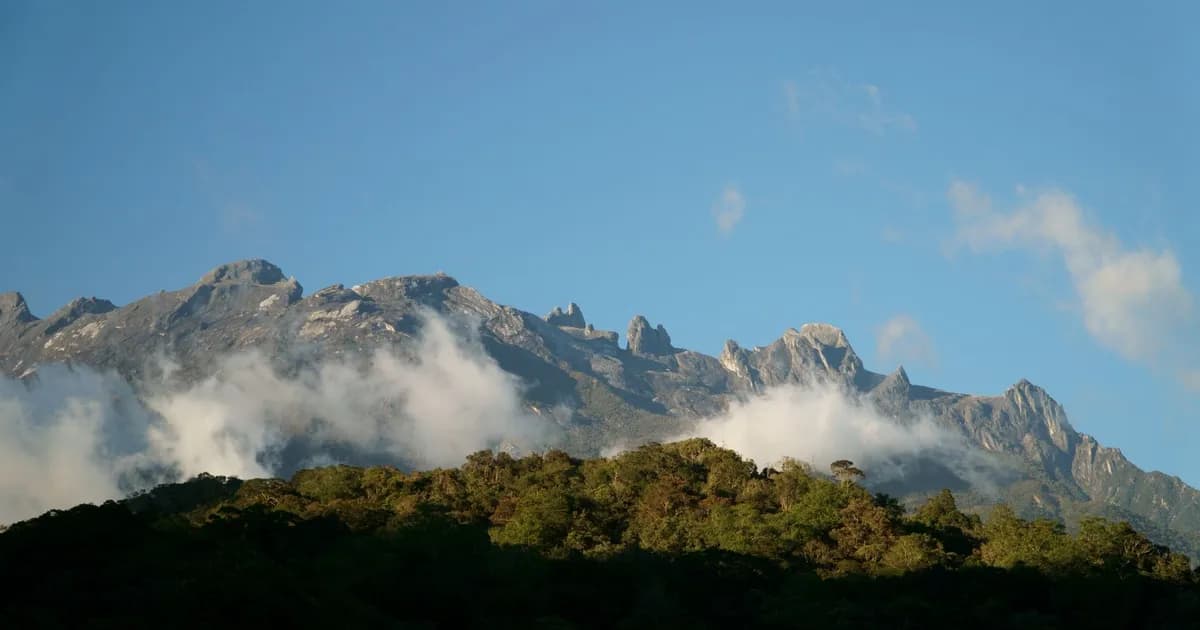

Mount Kinabalu is the one thing in Malaysia you cannot decide to do next week. At 4,095 metres, Low's Peak is the highest point between the Himalaya and New Guinea, and it sits inside a UNESCO World Heritage site administered with a hard daily cap on climbers. If you are reading this in late 2026 and hoping to climb in 2027, the date that matters is 1 December 2026, when the following year's permits are released. Almost everything else in this article is a consequence of that single constraint.
Why the mountain is rationed
Kinabalu Park is not a wilderness where numbers self-regulate. Every climber uses the same summit trail, sleeps at the same high camp, and depends on the same guides, porters and shuttle vehicles. The bottleneck is physical: there are only so many beds at 3,270 metres, and only so many people who can be safely moved up a granite slab in the dark.
Sabah Parks responded by capping permits rather than expanding infrastructure, which is the right call ecologically and an inconvenient one logistically. Since 25 January 2023 the limit has stood at 163 climb permits per day, reduced from the pre-pandemic figure of 185. Nobody passes Timpohon Gate without one.
The result is a mountain that behaves like a ticketed event rather than a hike. That is not unique in Malaysia right now: several parts of the country are seeing demand run ahead of capacity in 2026, a pattern we traced in our analysis of what Malaysia's cruise boom means on the ground. Kinabalu is simply the most formalised version of it.
One request. Up to five tailored proposals.
Skip contacting agencies one by one — share your trip once and let up to five trusted Malaysia agencies come to you. Free, with no obligation.
Get my free quotesThe 163-permit quota, in practice
At a glance
- Permit
- climbing permit required
- Daily quota
- 163 climbers
- Duration
- 2 days / 1 night
- High camp
- Panalaban, 3,270 m
- Summit
- 4,095 m
A daily cap of 163 sounds generous until you break it down. That number covers everyone: independent climbers, package clients, via ferrata participants and, in high season, a significant domestic contingent. Malaysian school holidays, Sabah public holidays and the weeks around major festivals disappear first.
Some practical consequences:
- Peak months, broadly February to April and July to September, sell out earliest.
- Weekend dates go before midweek dates, often by months.
- Solo travellers have a marginal advantage, because single remaining slots exist where a pair of slots does not.
- Via ferrata allocations, which sit within the overall cap, tend to persist longer than standard climb slots.
The 1 December booking rush
Sabah Parks releases the whole of the following year in one batch. Bookings for the next calendar year open on 1 December at 01:00 Malaysian time, online only, through the parks reservation portal at sabapakeco.com. For a 2027 climb, that means 1 December 2026.
Popular dates go within hours. If you have a fixed travel window, treat the release like a concert on-sale: be at the screen, know your dates and your fallback dates, have passport details for every climber typed out in advance, and be ready to pay immediately.
If you miss the release, you have two realistic options. The first is to watch for cancellations, which do appear, though the non-refundable policy means fewer than you would expect. The second is to book through an established Sabah operator: agencies hold allocations and will often have inventory when the public portal shows nothing. You pay a margin for that, and for most travellers it is money well spent.
Get matched with up to 5 trusted Malaysia agencies
- Free
- No obligation
- Up to 5 agencies
What a permit costs in 2026 and 2027
Sabah Parks charges separately for the climb permit and park entry, with different rates for Malaysians and international visitors. As indicative 2026 figures:
- Climb permit, international adult: around RM400
- Climb permit, Malaysian adult: around RM100
- Kinabalu Park entrance, international: around RM50
- Kinabalu Park entrance, Malaysian: around RM10
- Climber insurance: a small mandatory charge, usually bundled
Treat these as the starting line rather than the price. The permit is a fraction of what the climb actually costs, and Sabah Parks revises its rates periodically. Tiered pricing of this kind is standard across Malaysian protected areas; we covered the equivalent structure for the coast in our briefing on marine park fees and rules.
Panalaban: the real bottleneck
Every standard ascent involves one night at Panalaban, the high camp at roughly 3,270 metres, 2.7 kilometres and some 800 vertical metres below the summit. You cannot climb Kinabalu in a day as a visitor, and you cannot camp. You sleep in the accommodation Sabah Parks and its concessionaire provide, and that accommodation is the true scarce resource.
Indicative 2026 rates, per person, generally inclusive of permit, insurance and meals:
- Panalaban hostel dormitories, Kinotoki and Mokodou: around RM578 for Malaysians, around RM899 for international climbers
- Laban Rata Resthouse, the more comfortable heated option: around RM1,015 for Malaysians, around RM1,455 for international climbers
The gap between those two lines explains most of the price variation you will see quoted online. Booking the hostel directly, when you can get it, is the cheapest legitimate route up the mountain.
Guides, shuttles and the fees nobody quotes
A licensed mountain guide is compulsory. This is not a recommendation or an upsell; the gate staff enforce it, and the requirement exists because people have died on this mountain in bad weather and after earthquakes. Guide fees are charged per group rather than per person, so a party of four splits the cost four ways while a solo climber carries it alone.
Then there are the smaller items that are absent from most quoted prices:
- Shuttle from park headquarters to Timpohon Gate: roughly RM34 for a solo traveller, or about RM9 to RM10 per person in a group of five or more
- Porter fees, charged by weight, if you want your pack carried to Panalaban
- A certificate fee, if you want the official summit certificate
- Transport between Kota Kinabalu and the park, roughly two hours each way
- A night in Kota Kinabalu or Kundasang before the climb, because the check-in time at park headquarters is early
Total realistic cost
For an international climber in 2026 and 2027, the honest ranges are these. Booking the Panalaban hostel directly and arranging your own transport, the minimum realistic outlay is somewhere around RM1,550 all in. A standard two-day, one-night package through an operator, including transfers from Kota Kinabalu, guide, accommodation, meals and all park fees, typically lands between about RM2,700 and RM2,900.
Via ferrata packages sit higher again. Current 2026 pricing for non-Malaysians runs roughly RM3,190 to RM3,790 for the shorter Walk the Torq route and about RM3,490 to RM4,140 for the longer Low's Peak Circuit, varying with group size.
These are indicative and move with exchange rates, fuel costs and Sabah Parks revisions. Budget an additional RM300 to RM500 for gear you may not own: a headtorch, gloves, a warm layer and waterproofs. It is genuinely cold above 3,000 metres before dawn, and the summit plateau in rain is a serious place.
Getting to the mountain
Kinabalu Park sits about two hours by road from Kota Kinabalu, which has direct flights from Kuala Lumpur, Singapore and several regional hubs. Shared vans run from the city, operators provide transfers, and the drive up through Tamparuli and the Crocker Range is pleasant in itself.
One administrative point that catches first-time visitors: Sabah operates its own immigration controls, and travellers arriving from Peninsular Malaysia pass through an immigration check on landing even though it is a domestic flight. You will be issued a permitted stay for Sabah specifically. We explain the mechanics in our note on Sabah and Sarawak internal immigration rules, and it is worth reading if your itinerary crosses between the peninsula and Borneo more than once.
Cancellations, name changes and weather
The terms are strict and worth understanding before you pay.
Bookings are non-refundable. Climber names cannot be exchanged, so you cannot pass your slot to a friend. A date change is generally permitted once within the same calendar year, subject to a penalty, and not across years.
Weather is the risk nobody can transfer. The summit push can be halted at the guides' discretion for storms, lightning or trail conditions, and in past years the mountain has closed for longer periods after seismic events. If that happens you will usually still have climbed to Panalaban, and you will usually not be refunded. Travel insurance that covers trip interruption for high-altitude trekking is the sensible hedge; check that your policy does not exclude activity above 4,000 metres.
The practical planning implication: do not schedule your climb for the last two days of your trip. Leave a buffer.
If you do not get a permit
A refused permit is not the end of a Sabah itinerary, and some of the alternatives are better slow travel than the summit.
Kinabalu Park's day trails need only the park entrance fee and give you the mountain's extraordinary flora, including pitcher plants and orchids, without any of the logistics. The Mesilau side, the Poring hot springs and canopy walkway, and the Kundasang farm valleys fill several unhurried days. Further afield, the Kinabatangan River, the Danum Valley and the Maliau Basin offer wildlife that the summit trail does not.
Sarawak is the other answer. Gunung Mulu's pinnacles, the Bako headlands and a slow few days on the Sarawak River are a different Borneo entirely, and our portrait of Kuching as a river city is a good place to start rethinking the trip.
Via ferrata, and going slower
The Kinabalu via ferrata is the highest in the world, a system of cables and rungs across the summit plateau above Panalaban. It requires the same permit and accommodation as the standard climb, plus its own fee and a briefing. Slots within the daily cap tend to remain available longer than standard ones, so it is worth checking if your preferred dates look closed.
A final honest note. Kinabalu is a genuinely worthwhile climb, but it is also the most scheduled, most rationed and most expensive single activity in Malaysian travel, and a 2am start in a line of headtorches is not everyone's idea of a mountain. If what you want is time in old forest rather than a summit photograph, the peninsula offers a completely different proposition; our guide to a slow week in Taman Negara sets out what that looks like.
What to Do Next
- Fix your climbing dates first, then build the rest of your Borneo itinerary around them, not the other way round.
- Put 1 December 2026, 01:00 Malaysian time, in your calendar if you are aiming at 2027, and be online when the portal opens.
- Have passport details for every climber ready to paste, plus two fallback date pairs.
- Decide between Panalaban hostel and Laban Rata Resthouse before you book; the price difference is several hundred ringgit per person.
- If the portal shows nothing, contact two or three established Sabah operators, who often hold allocations.
- Add a night in Kota Kinabalu or Kundasang before the climb, and leave at least two spare days afterwards in case of weather.
- Check your travel insurance covers trekking above 4,000 metres before you pay for anything.
Frequently Asked Questions
How many people can climb Mount Kinabalu each day?
Sabah Parks issues 163 climb permits per day, a limit in place since 25 January 2023 and reduced from 185 before the pandemic. The cap covers everyone on the summit trail, including via ferrata participants, and it is enforced at Timpohon Gate.
When do permits for the following year go on sale?
Bookings open on 1 December at 01:00 Malaysian time for the whole of the following calendar year, online only through the Sabah Parks reservation portal. For a 2027 climb, that is 1 December 2026. Popular dates sell out within hours.
What does it cost to climb Mount Kinabalu?
For international climbers, the minimum realistic all-in cost booking the Panalaban hostel directly is around RM1,550. A standard operator package covering transfers, guide, accommodation, meals and park fees generally runs from about RM2,700 to RM2,900. Via ferrata routes cost more, roughly RM3,190 to RM4,140 depending on the route and group size. Figures are indicative and revised periodically.
Is a guide compulsory?
Yes. Every climber must be accompanied by a licensed mountain guide, and nobody is permitted past Timpohon Gate without one. Guide fees are charged per group, so climbing as a small group reduces the per-person cost considerably.
Can I cancel or change my booking?
Bookings are non-refundable and climber names cannot be transferred to another person. A date change is usually permitted once within the same calendar year and attracts a penalty. This is why leaving a buffer of spare days at the end of your trip matters more than usual here.
Do I need to be very fit?
You need to be reasonably fit rather than athletic. The climb is a long, relentless staircase of roughly 6 kilometres from Timpohon Gate to Panalaban, followed by a pre-dawn summit push on granite. Altitude affects people unpredictably above 3,000 metres, and headaches at the high camp are common. Train with stairs and long descents, and take the second day seriously; most injuries happen coming down.
What happens if the weather closes the summit?
Guides can and do turn groups around for storms, lightning or poor trail conditions, and the mountain has closed for extended periods after seismic events. You will normally have climbed to Panalaban regardless, and refunds are not given. Travel insurance covering trip interruption and high-altitude trekking is the only real protection.