
Taman Negara Slowly: Seven Days in Malaysia's Oldest Rainforest
Taman Negara does not perform. There is no guaranteed animal on the third morning, no viewpoint that arranges itself for your camera, no single sight that justifies the journey on its own. What it offers instead is one of the oldest continuously forested landscapes on earth, roughly 130 million years of it, and the slow pleasure of learning to read it. Rushed, Malaysia's oldest national park is a canopy walkway, a boat ride and a night safari sold from a floating restaurant. Given a week, it becomes something else entirely: a place where you begin to hear the difference between rain arriving and rain leaving.
Why Taman Negara rewards the unhurried
The park covers about 4,343 square kilometres across three states, Pahang, Kelantan and Terengganu. That is larger than many small countries and far larger than anything you can meaningfully absorb in forty-eight hours. Most visitors enter through Kuala Tahan in Pahang, a village on the Tembeling River that faces the park headquarters across the water. Two other gateways exist and see a fraction of the traffic: Merapoh, also called Sungai Relau, on the Pahang side closer to the Gunung Tahan trailhead, and Kuala Koh in Kelantan, which receives very few foreign visitors at all.
The standard package sold in Kuala Lumpur compresses the whole park into two nights. You arrive mid-afternoon, queue for the canopy bridge, take a rapids-shooting boat trip that soaks you on purpose, join a night walk behind thirty other torches, and leave after breakfast. Nothing about that itinerary is dishonest. It is simply the wrong shape for a forest that only opens up when you stop moving through it.
Four to seven nights changes the arithmetic. You get spare days for weather, time to repeat a trail in different light, and the confidence to spend an entire morning sitting still in a hide without feeling that you are wasting money. If you are still working out where the park fits into a longer route, our slow traveller's guide to where to go and when lays out how the peninsula's seasons and regions fit together.
One request. Up to five tailored proposals.
Skip contacting agencies one by one — share your trip once and let up to five trusted Malaysia agencies come to you. Free, with no obligation.
Get my free quotesGetting there: Jerantut, Kuala Tembeling and the river
Jerantut is the hinge. Almost every route to Kuala Tahan passes through this unremarkable Pahang town, and it is worth planning a night there rather than sprinting through it. Buses run from Kuala Lumpur's TBS terminal and take roughly four to five hours for something in the region of RM40, with onward minivans and taxis covering the last stretch to Kuala Tahan. There is also a rail connection into Jerantut on the interior line, which is slower, prettier and far more in keeping with the pace of the place.
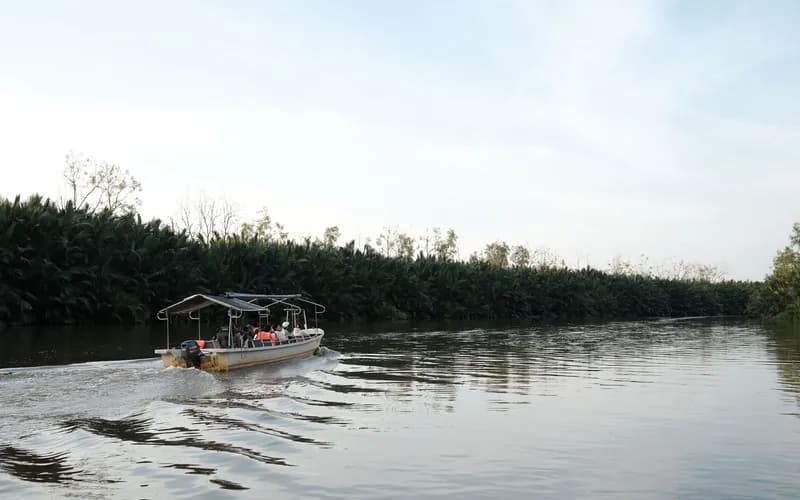
The romantic approach is the river. From Kuala Tembeling jetty, about 16 kilometres outside Jerantut, longboats run downstream to Kuala Tahan in roughly two to three hours depending on water levels. It costs more than the road and takes longer, and in low water it can be cancelled outright. It is also the only arrival that gives you the forest gradually, wall of green on both banks, kingfishers breaking cover, water buffalo standing in the shallows. If you have the time, take it in one direction and the road in the other.
Once you are in Kuala Tahan, you will not need a vehicle again. Everything moves by foot or by boat, and the RM1 crossing between the village and the park headquarters becomes the rhythm of your days. For the wider question of stitching Malaysia together without renting anything, see our notes on getting around Malaysia without a car.
Permits, fees and the paperwork nobody mentions
Taman Negara is administered by PERHILITAN, the Department of Wildlife and National Parks, and its official fees are almost comically modest compared with national parks elsewhere in Southeast Asia. The entry permit is RM1 per person. A camera licence is RM5 per device and, importantly, that includes smartphones. Permits are issued at the wildlife department counters at Kuala Tahan and at the Kuala Tembeling jetty, and are typically valid for 30 days.
A few other charges stack on top:
- Canopy walkway: around RM5 for adults, RM3 for children
- Fishing licence: around RM10 per rod
- River crossing between Kuala Tahan village and park headquarters: RM1 each way
- Guide fees for specific trails, hides and night walks, quoted per group
Two honest caveats. First, these are the government fees, not the price of a trip: guides, boats, accommodation and food are where your money actually goes. Second, rates are periodically revised and some counters keep shorter hours than the trails do, so buy your permit and camera licence on arrival rather than assuming you can do it at seven in the morning on your way to a trailhead.
Get matched with up to 5 trusted Malaysia agencies
- Free
- No obligation
- Up to 5 agencies
Where to sleep in and around Kuala Tahan
Inside the park boundary there is one resort, Mutiara Taman Negara, occupying the headquarters side of the river with chalets, a restaurant and direct access to the main trail network. It is the most expensive option and the only one where you can step from your door onto a forest path without crossing water.
Across the river, Kuala Tahan village has a spread of guesthouses, hostels and mid-range lodges, most of them family-run, plus the famous floating restaurants moored along the bank. They are noisier and cheaper, and they put you among the boatmen and guides, which has its own value. A third option, and the one we would push slow travellers towards, is to add nights in a village homestay in the surrounding kampungs on the Jerantut side, where the forest is a backdrop to ordinary rural life rather than the whole show. Our guide to staying in a Malaysian kampung homestay covers how the programme works and what to expect of an evening in someone's family home.
Book ahead for Malaysian school holidays and long weekends. Kuala Tahan is a domestic destination first, and the village fills up in ways that have nothing to do with the international season.
The walks: from half-day boardwalks to seven-day traverses
The trail network fans out from park headquarters and scales neatly from an hour to a week.
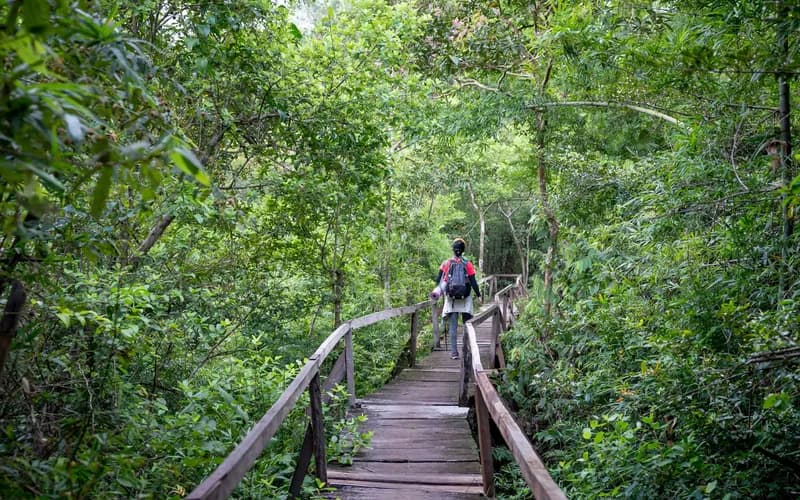
Bukit Teresek is the sensible first walk. It is only 334 metres high, much of the route is boardwalk, and the last section is steep enough to remind you what the humidity is doing to you. From the top you get the view that explains the park: unbroken canopy folding away into ridgelines with no road, no roof, no clearing in sight.
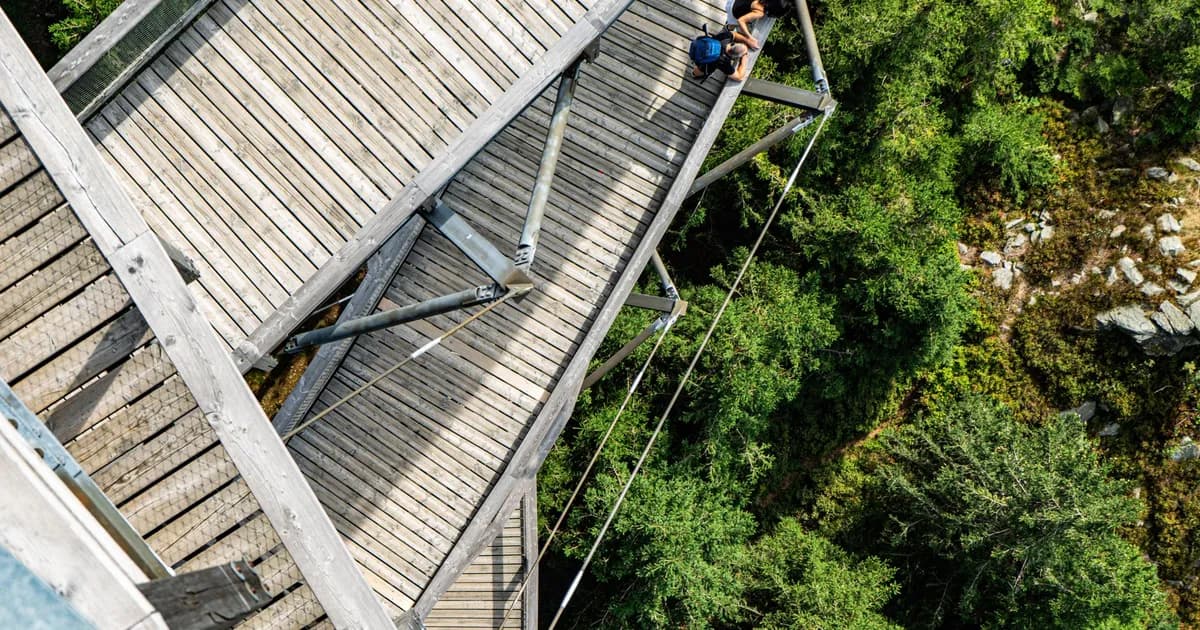
The canopy walkway near headquarters is the park's signature, a strung sequence of bridges 40-odd metres above the forest floor. It queues badly in the middle of the day and is transformed at opening time. A second structure, the Seberang Ara canopy walkway, opened to the public on 22 June 2026 and has begun to spread the crowds.
Lata Berkoh, a cascade on the Tahan River, is the classic half-day: roughly 8.5 kilometres of trail each way, or a one-hour longboat ride if the water is high enough. Gua Telinga, a limestone cave about three kilometres from headquarters, has been closed to visitors at various points in recent years, so confirm locally before building a day around it.
Beyond that, the park gets serious. The Keniam trail, starting from Kuala Keniam some 25 kilometres upriver, is a two-day walk usually done with a guide and a boat transfer. And the Gunung Tahan traverse, to the highest point in Peninsular Malaysia around 53 kilometres from headquarters, is a genuine expedition of roughly seven days and six nights, carrying everything, with river crossings that depend entirely on rainfall. If you want a big mountain but not a week of leeches, the more structured alternative is in Borneo, and our practical briefing on permits and costs for Mount Kinabalu explains what that involves.
Wildlife, hides and honest expectations
Taman Negara contains tigers, Malayan elephants, tapirs, gaur, sun bears and clouded leopards. You will almost certainly see none of them. This is dense lowland rainforest with low visibility and genuinely low densities of large mammals, and any operator promising sightings is selling you a feeling rather than an animal.
What you can realistically expect, with patience, is the layer below the headline species: gibbons calling at dawn, hornbills crossing a river gap, macaques, monitor lizards, flying squirrels at dusk, cicadas that reset the volume of the whole forest at exactly the same moment each evening. Tracks and droppings tell you what walked past while you slept.
The hides, known locally as bumbun, are simple raised shelters overlooking salt licks and clearings, some within a short walk of headquarters, others a boat ride away. Booking one for an overnight stay is the single best thing a slow traveller can do here. You take a sleeping bag, a torch with a red filter, water and no expectations, and you sit. Most nights nothing large appears. Occasionally something does, and the reason it matters is that you earned it.
Practical honesty: leeches are constant in wet months and harmless, long socks and repellent help, and the forest is hot in a way that reading about it does not convey. Mobile coverage is patchy at best in Kuala Tahan and absent on the trails, which is either the problem or the point depending on your mood; if you need to plan around connectivity, our guide to staying connected in Malaysia sets out what works and where signal simply stops.
The Orang Asli question
Most day tours out of Kuala Tahan include a stop at a Batek settlement. The Batek are one of the Orang Asli peoples of the peninsula, semi-nomadic forest dwellers whose relationship with this landscape long predates the park, the permits and the boats.
These visits range from respectful to extractive. At their worst they are a fifteen-minute stop where visitors photograph people at close range, watch a blowpipe demonstration and leave. At their best, with a guide who knows the families, speaks the language and has a standing arrangement, they are a genuine exchange.
The slow-travel position is not to boycott but to be deliberate. Ask your operator how the community is compensated and whether the visit was agreed with them. Ask before photographing anyone, and accept a no. Keep the group small. If a guide cannot answer those questions clearly, decline the stop and spend the time on the river instead. Agencies that work this park properly will have a straight answer ready; you can see how we assess operators on our Malaysia travel agencies page.
When to go, and what the rain does
The drier stretch runs roughly from mid-February to September, with April to August generally the most reliable window for trails and river levels. This is a rainforest, so "dry" means afternoon downpours rather than blue skies, and you should plan around a soaking every couple of days.
The northeast monsoon brings the real disruption. From around November to January, river levels rise, some boat services stop, trails flood and parts of the park close. Kuala Tahan does not shut down entirely, but a monsoon visit is a gamble and the classic riverine approach from Kuala Tembeling is the first thing to be cancelled.
The counter-argument for shoulder season is real, though. Late February and September have thinner crowds, cheaper rooms and a forest that feels closer to itself. If you have spare days built into your route, those are the months where patience is rewarded twice over.
What to Do Next
- Block out a minimum of four nights in Kuala Tahan, and ideally six or seven, before you start filling in the rest of your peninsular route.
- Decide your arrival: bus or train to Jerantut, then either the road to Kuala Tahan or the longboat from Kuala Tembeling. Take the river in at least one direction if water levels allow.
- Buy your RM1 entry permit and RM5 camera licence at the PERHILITAN counter on arrival, not on the morning you plan to walk.
- Book one overnight hide stay early in your visit, so you can repeat it later in the week if the first night is quiet.
- Line up a guide for one longer walk, Lata Berkoh or a night trail, and ask directly how any Orang Asli visit is arranged.
- Leave two unscheduled days at the end. In this park, the empty days are usually the ones you remember.
Frequently Asked Questions
How many days do you really need in Taman Negara?
Two nights is enough to see the canopy walkway and take a boat trip, which is what most packages deliver. Four nights lets you add a hide stay and a longer trail. Six or seven nights gives you room for bad weather, a repeat visit to a trail that impressed you, and the slow mornings that are the actual point of coming.
What does it cost to enter the park?
The official PERHILITAN fees are small: RM1 for the entry permit and RM5 for a camera licence per device, including smartphones, usually valid for 30 days. The canopy walkway is charged separately at around RM5, a fishing licence is around RM10 per rod, and the river crossing to headquarters is RM1. Guides, boats, rooms and food are where a realistic budget is spent. Fees are revised from time to time, so treat these as indicative.
Will I see a tiger or an elephant?
Almost certainly not. Large mammals here exist at low density in very dense forest, and sightings are rare even for guides who work the park daily. Come for hornbills, gibbon calls, tracks at a salt lick and the forest itself. Anyone guaranteeing big-mammal sightings is overselling.
Do I need a guide?
Not for the boardwalk circuits, the canopy walkway or Bukit Teresek, which are well marked and busy enough to be safe. Yes for night walks, the hides, Lata Berkoh by trail, the Keniam route and anything approaching Gunung Tahan. A good local guide also changes what you notice on even the easy trails.
When is the worst time to go?
Roughly November to January, during the northeast monsoon, when river levels rise, boats are cancelled and some trails and park sections close. The park does not fully shut, but your itinerary becomes weather-dependent in a way that is hard to plan around.
Is Kuala Tahan the only way in?
No. Merapoh, also known as Sungai Relau, on the Pahang side is quieter and sits closer to the Gunung Tahan approach, and Kuala Koh in Kelantan sees very few international visitors. Both have far less infrastructure, which is exactly why some travellers prefer them.
Are leeches really a problem?
They are constant in wet months and completely harmless. Long socks, closed shoes, trousers tucked in and insect repellent around ankles reduce the nuisance considerably. Do not pull them off mid-feed; let them finish or use salt or repellent, and the bite will stop bleeding within an hour or two.