
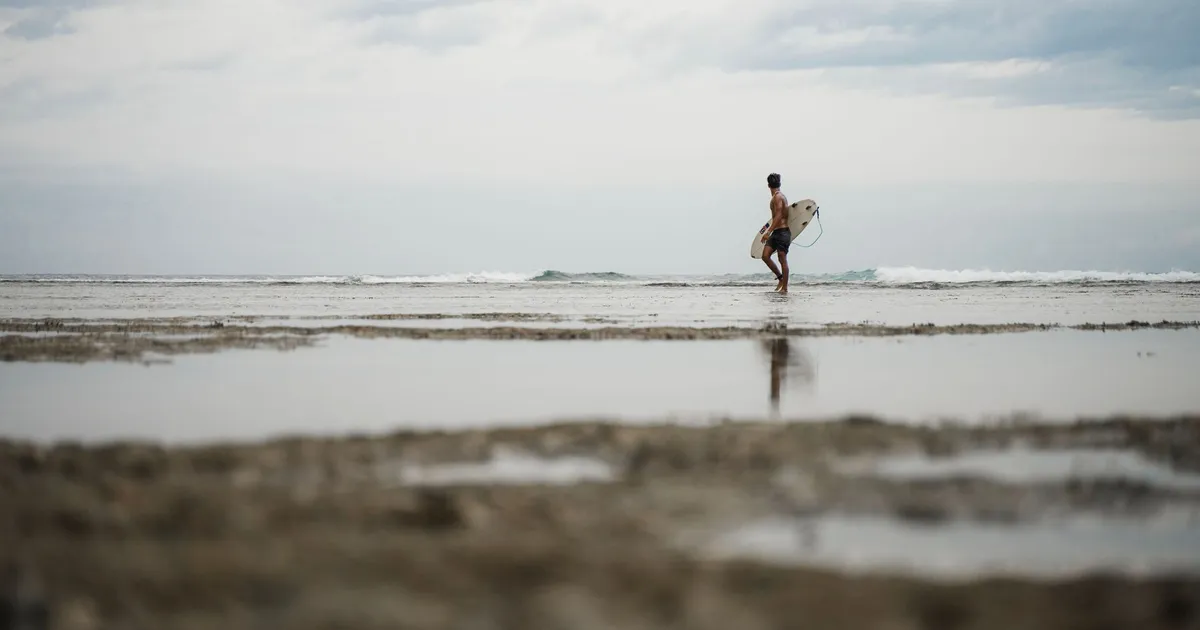

January is the month most Siargao guides skip over. The surf posters show glassy barrels in October, the island-hopping photos show flat turquoise water in April, and the weather pages put January at the bottom of their rankings. On the long-term numbers that is fair: January is the wettest month of the year on Siargao, and February is the third wettest after December.
Plenty of people still go, because Christmas holidays and European winter breaks fall exactly then. This page sets out what January and February on Siargao are actually like, what still works, what tends to be cancelled, how to get there now that the direct Manila flights are gone, and when it makes more sense to wait until March.
How wet January really is on Siargao
Siargao sits on the Pacific side of northeastern Mindanao, in what the Philippine weather bureau PAGASA classes as a Type II climate: no dry season at all, with a pronounced rainy peak from November to February. The northeast monsoon, the amihan, pushes moist Pacific air straight onto this coast for months.
The closest official record is PAGASA's station for Surigao del Norte, in Surigao City across the strait from Siargao. Its 30-year averages put January at about 609 mm of rain, more than four times the 134 mm of a typical August. February drops to about 446 mm and March to 326 mm.
Climate datasets for the island itself, out in the open Pacific, put January even higher, around 800 mm with rain on about 24 days. The exact total varies by source, but every dataset agrees on the shape of the year: wet from November to February, drying through March and April, driest from May to September. A little further south, Hinatuan in Surigao del Sur is the wettest PAGASA station in the whole country, so this is the rainiest corner of the Philippines.
Most January days still mix heavy showers with sunny spells. The air stays around 28 to 29°C and the sea is about 28°C. What changes is reliability: you cannot count on any given morning being dry. For how Siargao fits into the rest of the country month by month, our Philippines by month guide compares the islands that work in amihan season.
One request. Up to five tailored proposals.
Skip contacting agencies one by one — share your trip once and let up to five trusted Philippines agencies come to you. Free, with no obligation.
Get my free quotesWhy the east coast catches the worst of it
Most of the country that visitors know, from Palawan to Boracay, has its dry season from December to April. The eastern seaboard runs on a different calendar. In January the trade winds blow from the northeast across thousands of kilometres of open ocean and reach Siargao, Surigao and Samar first, while the western islands sit in the lee of the mountains and stay much drier.
This is why a January trip that combines El Nido with Siargao can feel like two different countries, and why the "dry season" advice in general Philippines guides does not apply here.
Typhoons are a smaller worry than the rain. Long-term averages give less than one day per January affected by a tropical storm passing near Siargao, but the island has been hit late in the year before: Typhoon Odette (Rai) made landfall here in December 2021 and flattened much of General Luna. Late-season storms are rare, so plan for them as a possibility. Our guide to travelling during typhoon season explains how to read PAGASA warnings and what a signal number means for ferries and flights.
What still works in January
If you accept that rain will shape some of your days, January on Siargao has real advantages. The heat is softer, rivers and fields are full and green, and once the New Year holidays are over the island is usually less busy than in the peak surf months.
Surfing carries on. Cloud 9's best months are roughly late August to November, when southwest winds blow offshore there; in January the northeast winds tend to blow across the reef and the wave gets messier. Other breaks on the island face different directions and can work well on the same days, and surf schools move lessons to whichever spot is sheltered. Beginners often find the softer beach breaks of winter easier than the hollow reef sets of October.
Del Carmen, on the western side, is the best rainy-season base for a slow day. Its mangrove forest covers about 4,871 hectares, the largest continuous stand in the Philippines, and it was listed as a Ramsar wetland of international importance in December 2024. The boardwalk through the forest is about 1.8 km long and free to walk, a paddle with a local boat guide works in light rain, and the boat ride to Sugba Lagoon takes 30 to 45 minutes through sheltered channels.
The interior is the other January pleasure. Rides between coconut palms, coffee in Dapa or Pilar while a squall passes and an afternoon at the General Luna market are the kind of days this month rewards. A week of them gives you a better sense of the island than a rushed tour list in the sun.
Get matched with up to 5 trusted Philippines agencies
- Free
- No obligation
- Up to 5 agencies
What suffers: boats, islands and Sohoton
The trips most visitors come for are the ones January puts at risk. Boat tours need Coast Guard clearance before leaving, and when the amihan swell is up, clearance is refused or boats turn back. That affects the tri-island tour to Naked, Daku and Guyam islands, the longer trip to Sohoton Cove on Bucas Grande and anything else that crosses open water.
Sohoton is the hardest to plan. Bucas Grande is a 1 to 1.5 hour boat ride from Siargao, tours inside the cove are run only by licensed operators from Socorro, and the stingless jellyfish people come to see are most numerous from April to July. In January you may get a clear day, or you may lose the day entirely.
Watch out
Do not leave a boat trip you care about for your last full day. Keep at least two flexible days at the end of a January stay so a cancelled tour can move, and check the Coast Guard decision with your operator the evening before.
Magpupungko rock pools in Pilar depend on both tide and weather. The pools only appear at low tide, entrance is around ₱50, and in rough conditions the sea washes over the rocks. Unpaved roads to the east coast also turn to mud after heavy rain, which matters if you ride a scooter. For a calmer way to string several islands together with buffer days, see our guide on how to island-hop the Philippines slowly.
Getting to Siargao in 2026-27
There is no direct flight from Manila's NAIA to Siargao any more. Cebu Pacific moved its Siargao service from Manila to Clark on 30 March 2025, turboprop flights left NAIA for Clark on 29 March 2026, and Philippine Airlines suspended its Clark to Siargao route on 4 May 2026 with no restart announced.
Flights to Sayak Airport (IAO), late 2026
- From Cebu
- Cebgo, PAL Express, Sunlight Air; about 1 hour; most frequent
- From Clark
- Cebgo and Sunlight Air; about 2.5 hours
- From Davao
- Cebgo
- From Manila
- No direct flight; connect via Cebu or travel by road to Clark
- By sea
- Ferry Surigao City to Dapa, about 1.5 to 2 hours
Fares are the sore point. Only turboprops can use Sayak's runway, so seats are few and prices high. In September 2025 the transport department said Philippine Airlines had agreed to cap one-way Siargao fares at about ₱11,000 to ₱11,500, down from peaks near ₱17,500, and in January 2026 the presidential palace said the main carriers had agreed to lower Siargao fares further. A cap is a ceiling rather than a typical price, and holiday dates still sell out early.
The sea route is slower and cheaper. Fast craft and roll-on ferries cross daily from Surigao City to Dapa in about 1.5 to 2 hours, with regular fares of roughly ₱430 to ₱560, and operators have warned that fuel costs can push these higher. In January the crossing can be rough and some sailings are cancelled. Our piece on the Manila airport changes and the turboprop move to Clark explains why the Manila flights disappeared.
Sayak handles flights in daylight only, so a long-haul arrival in Manila in the afternoon usually means a night in Cebu or Clark first. Build that night into the plan rather than chasing a tight connection in the wettest month.
Behaving well on a crowded small island
Siargao's popularity has come with friction. After a bar fight between foreign tourists in General Luna in April 2026, the municipal government warned visitors that breaking national laws or local ordinances, from disorderly conduct to environmental damage, would bring fines, legal action or deportation. The Bureau of Immigration also sent more officers to the island to check on overstays and illegal work.
For a respectful slow traveller this changes little, though it helps to know the island is paying attention. Take your rubbish with you, keep noise down in residential barangays and treat surf lineups as someone else's home break.
Scooters cause more harm to visitors than anything else here, and wet roads in January make that worse. Wear a helmet, avoid riding at night or after drinking, and read our guide to driving in the Philippines as a tourist for the licence rules before you rent.
February, March and the drying trend
February is a little kinder than January, with roughly a quarter less rain on the PAGASA record, but it still belongs to the wet peak. The clear change comes in March, and April and May are the island's calmest stretch for boats and beaches.
Going in January or February
- Usually quieter once the New Year rush ends
- Softer heat and green, full rivers
- Surf schools still running on sheltered breaks
- Good for slow days in Del Carmen and the interior
What you give up
- Rain on most days and no reliable dry mornings
- Island-hopping and Sohoton trips often cancelled
- Rough ferry crossings and muddy back roads
- Higher prices over the Christmas and New Year holidays
If your dates are fixed in January, go for longer rather than shorter, base yourself where you can enjoy a rainy afternoon and treat any calm sea day as a bonus. If your dates are flexible, March to May gives you the same island with far better odds.
What to Do Next
- Decide whether your trip is about the island itself or about boat trips; if it is the second, move it to March to May.
- Book Cebu to Siargao flights early, and add a night in Cebu or Clark if your international flight lands in the afternoon.
- Choose a base in General Luna for surf and food, or in Del Carmen or Pilar for quieter days, and plan at least a week.
- Keep two flexible days for weather and agree a rebooking rule with your tour operator.
- Pack for rain with a light shell, quick-dry clothes and a dry bag, and use our page on how to plan your journey in the Philippines to fit Siargao into a longer route.
Frequently Asked Questions
Is January a good time to visit Siargao?
It depends on what you want. January is the wettest month on the long-term record and boat trips are often cancelled, but the island is warm and green, and usually quieter after New Year. It suits a slow stay of a week or more, and it is a poor choice for a short trip built around island-hopping.
What is the rainiest month in Siargao?
January. PAGASA's Surigao del Norte station averages about 609 mm in January, ahead of December at 585 mm and February at 446 mm. The driest months are May to September.
Can you still surf in Siargao in January?
Yes. Cloud 9 is at its best from about late August to November, and in January the northeast winds usually make it messier, but other breaks around the island can work and surf schools keep running lessons. The water is around 28°C, so no wetsuit is needed.
Are there direct flights from Manila to Siargao?
No. There is no direct flight from Manila's NAIA any more. You can fly to Sayak from Cebu, Clark or Davao, or reach Surigao City and take the ferry to Dapa.
When is the best time to visit Siargao instead?
March to May is the best compromise, with much less rain and calmer seas for island-hopping. Surfers who want Cloud 9 at its best usually aim for September to November and accept more rain in the later weeks.