Getting Into and Around Singapore in 2026: SG Arrival Card, SimplyGo and the MRT
Singapore is one of the easiest places in Asia to arrive in and move around, and that is precisely why it rewards a little advance reading. The steps are simple, but a few of them changed recently, and the internet is full of stale advice and, worse, official-looking websites that want to charge you for things that are free. This guide walks calmly through the whole sequence: the digital arrival card you must submit before you fly, the entry rules for most visitors, what actually happens when you land at Changi, how to get into the city, and how to pay for a week of trains and buses without ever queuing at a ticket machine.
None of this needs to be stressful. Singapore has spent years automating the friction out of travel, and for a slow traveller the payoff is real: less time spent on logistics, more time spent walking a neighbourhood at your own pace. Read this once before you go, do the two things that need doing in advance, and you can more or less forget about transport for the rest of your trip.
The SG Arrival Card: Free, and How to Avoid Fake Sites
Almost every visitor to Singapore must submit an SG Arrival Card (SGAC) before arriving. It is an electronic declaration, combined with a short health declaration, that is linked to your passport number. There is no paper form and nothing to print.
The single most important fact: the SG Arrival Card is completely free. The only official channels are the Immigration and Checkpoints Authority (ICA) e-Service and the MyICA mobile app. Unfortunately, a whole industry of lookalike websites has grown up around it, charging anywhere from roughly twenty to eighty dollars to "process" a form that the government provides at no cost. These sites often rank high in search results and use official-sounding names. If you are being asked to pay, you are on the wrong site. Go directly to the ICA website (ica.gov.sg) or download the MyICA app from the official App Store or Google Play listing.
Timing matters. You can only submit the SGAC within three days before your arrival, and that window includes your day of arrival. Try to file it a week ahead and the system simply will not accept it. The form takes most people five to ten minutes. Once submitted, you receive an electronic acknowledgement; there is nothing to carry beyond your passport, because the record is tied to it.
One more recent change worth knowing: from early 2026, ICA can issue what are called No-Boarding Directives to airlines for travellers who plainly do not meet entry requirements, for example someone missing a required visa or holding a passport with less than six months of validity. In practice this means a problem can now stop you at check-in abroad rather than only at the Singapore border. The fix is the same as it has always been: sort your documents before you leave home.
One request. Up to five tailored proposals.
Skip contacting agencies one by one — share your trip once and let up to five trusted Singapore agencies come to you. Free, with no obligation.
Get my free quotesVisa-Free Entry and Passport Rules
For a large number of nationalities, Singapore does not require a visa for tourism. Citizens of countries such as the United States, the United Kingdom, Australia, Canada, Germany, Japan and South Korea are typically granted stays of up to 90 days on arrival, while some other nationalities receive 30 days. The exact figure depends on your passport and is determined by ICA at the point of entry, so treat any number you read online, including this one, as a guide rather than a guarantee.
Passport validity is the rule that trips up more travellers than any visa question. With the exception of Singapore passport holders, your passport must be valid for at least six months from your date of entry. It is also sensible to have at least two blank pages. If your passport is edging toward its expiry, renew it before you travel; this is exactly the kind of detail the new No-Boarding Directive is designed to catch.
Visa-exempt does not mean declaration-exempt. You still need to submit the SG Arrival Card described above, even if you need no visa. The two things are separate: one is permission to enter, the other is the pre-arrival declaration almost everyone files. If your nationality does require a visa, apply through the official ICA channels in good time, and never through a third-party site promising to speed things along for a fee.

Arriving at Changi and Automated Clearance
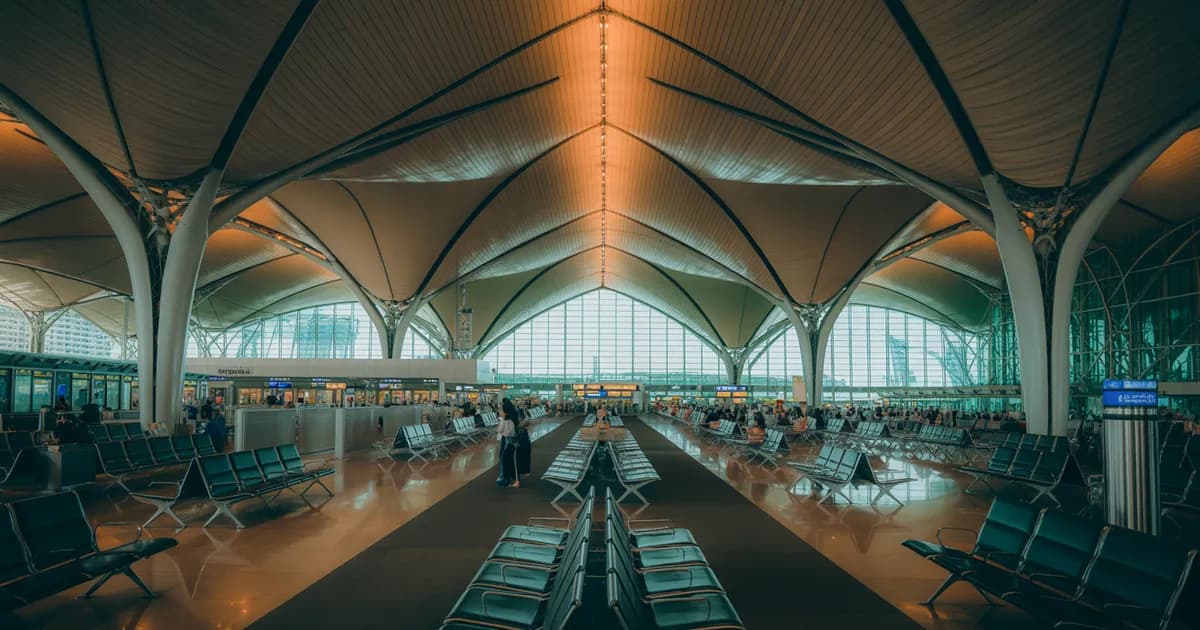
Changi is consistently rated among the world's best airports, and the experience on the ground lives up to it. Immigration halls are large, well-signed and, increasingly, automated. Singapore has invested heavily in passport-free and automated clearance for arriving travellers, using biometric gates that read your face rather than requiring you to present a passport at a manned counter. The exact eligibility rules keep expanding, so follow the signage and staff directions in the hall on the day; if you are directed to an automated lane, it is usually the fastest route through.
Do not rush straight out. If you have even an hour to spare, Changi rewards a slow wander, and its centrepiece, Jewel, is worth seeing whether you are arriving, departing or simply between flights. Jewel sits between the terminals and is built around the Rain Vortex, the tallest indoor waterfall in the world, ringed by an indoor forest. It is open to the public, connected directly to Terminals 1, 2 and 3, and makes a surprisingly pleasant first or last hour in the country. For a slow traveller, treating the airport as part of the trip rather than an obstacle to it is very much in the spirit of the place.
Practical basics still apply. Free wifi is easy to join, there are staffed information counters, and drinking water is safe from the tap across Singapore, so a refillable bottle earns its place in your bag from the moment you land.
Get matched with up to 5 trusted Singapore agencies
- Free
- No obligation
- Up to 5 agencies
Getting to the City from the Airport
Here is the good news that shapes the rest of your trip: you almost never need a taxi in Singapore, and that starts at the airport.
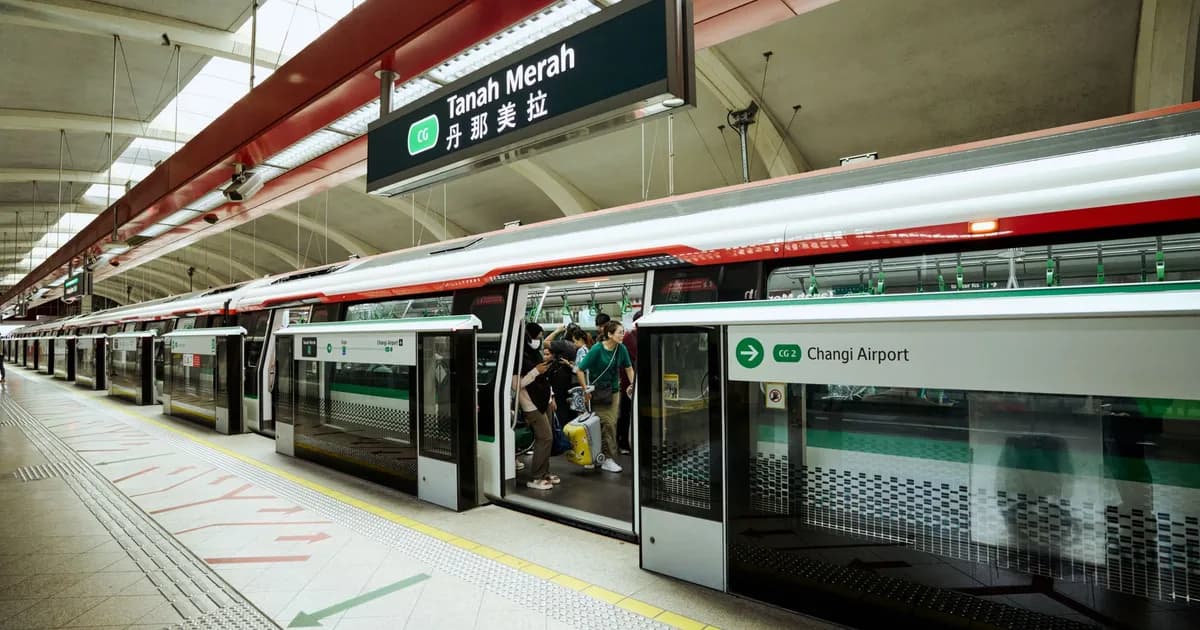
The MRT (the metro) runs directly from Changi Airport station, located under Terminals 2 and 3. The one quirk to know is that you take a short shuttle service one stop to Tanah Merah, then change onto the East West Line into town. All in, it is roughly 40 minutes to the City Hall area for around S$2.30, using the same tap-in, tap-out payment you will use for the rest of your stay. Trains run frequently from early morning until around midnight.
If you land late, after the trains stop, or you are simply tired and carrying a lot, a taxi from the official rank is straightforward and metered. Expect somewhere in the region of S$20 to S$40 to the city centre depending on the time of day, plus an airport surcharge, with higher costs during peak hours. Ride-hailing through Grab is comparable and sometimes a little more. There is also a public bus for the very budget-conscious, but with luggage and a long, stop-heavy route it is rarely worth it over the MRT.
For most arrivals, the MRT is the honest best choice: cheap, fast, air-conditioned and completely predictable. It also drops you straight into the network you will lean on for the days ahead. If you would rather someone else handle the logistics of an entire itinerary, a good local operator can arrange seamless transfers and a considered pace; you can start with our overview of how to plan your journey or browse vetted travel agencies.
SimplyGo and Paying for Transport
Singapore has quietly made paying for public transport almost invisible, and understanding the system saves both money and hassle.
The backbone is SimplyGo, the contactless account-based fare system. In plain terms, you can tap any contactless Visa, Mastercard or American Express card, or a phone or watch loaded with one, directly on the fare readers when you board and when you alight. The correct fare is calculated automatically and charged to your card. There is no need to buy a separate transit card, no top-up, and no minimum balance. For most visitors from countries where contactless bank cards are standard, this is the simplest option by a wide margin: bring the card you already own and tap.
The older model, a stored-value EZ-Link card that you topped up with cash, is being steadily wound down in favour of SimplyGo. Physical EZ-Link cards themselves still work on trains and buses, but the ecosystem around them is shrinking: the standalone EZ-Link app was discontinued in early 2026, and from late August 2026 you can no longer top up EZ-Link or SimplyGo EZ-Link cards at AXS machines. The direction of travel is clear. Unless you have a specific reason to use a stored-value card, tapping a contactless bank card or phone is the future-proof choice.
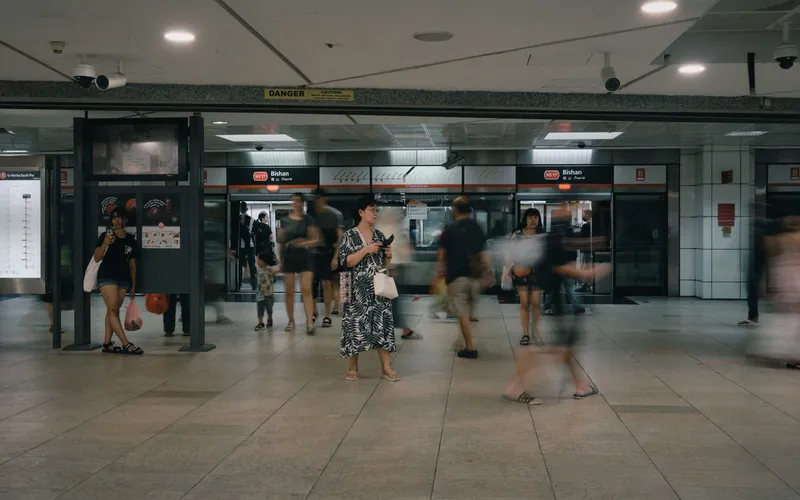
There is one classic mistake worth flagging, because it quietly doubles fares: you must tap out when you leave, not only tap in when you enter. Singapore charges by distance, so the system needs both taps to calculate the correct fare. Forget to tap out and you can be charged a maximum fare. Make tapping out a habit from your first ride.
If you would prefer a fixed cost and unlimited rides, the Singapore Tourist Pass is the alternative. It offers unlimited travel on MRT, LRT and basic bus services for a set number of days, priced from around S$17 for one day up to roughly S$45 for five days, and it includes a refundable S$10 deposit that you get back if you return the card at a TransitLink Ticket Office within five days. Do the maths honestly, though: individual fares in Singapore are low, so unless you plan to ride a great deal each day, tapping a contactless card often works out cheaper. The Tourist Pass shines if you intend to crisscross the island constantly; for a slower itinerary of a few thoughtful outings a day, pay-as-you-go usually wins. Our budget guide runs through these trade-offs in more detail.
The MRT and Buses in Practice
Once you are paying, the network itself is a pleasure to use. The MRT is clean, punctual, air-conditioned and remarkably easy to read, with colour-coded lines and clear English signage throughout. Several of its lines are fully driverless and automated, running on computer-controlled signalling with no driver on board; the North East Line, the Circle Line and the newer Thomson-East Coast Line all operate this way, which is part of why services are so frequent and consistent.
The Thomson-East Coast Line, the newest addition drawn in brown on the map, has been opening in stages and continues to extend, with its final stage toward the Upper East Coast expected in the second half of 2026. It is worth checking a current map when you arrive, because a station that was not yet open last year may be running by the time you visit. For the latest official detail on lines and fares, the Land Transport Authority (LTA) is the authoritative source.
Buses fill in everything the trains do not reach, and they use exactly the same tap-in, tap-out payment, so there is nothing extra to learn. They are a lovely, slow way to see the city at street level, and for a traveller who is not in a hurry, choosing the bus over the train now and then is one of the small pleasures of Singapore. Do remember to tap on both boarding and alighting here too.
Put together, the MRT and buses reach almost everywhere a visitor wants to go, which is why we say plainly: you do not need a taxi for daily sightseeing, and you certainly do not need to rent a car. Driving in Singapore is expensive and pointless for a visitor, and parking is a headache. Let the network carry you and save your energy for walking. If a particular corner of the island is off the rail map, that is usually a sign it is worth the slower approach; see our guide to going off the beaten path for a few such places.
What to Do Next
- Check your passport now. It must be valid for at least six months beyond your date of entry, with a couple of blank pages. If it is close to expiry, renew it before booking.
- Confirm whether your nationality needs a visa, using the official ICA website. Most tourists do not, but verify rather than assume.
- In the three days before you fly (and only then), submit your free SG Arrival Card at ica.gov.sg or via the MyICA app. Ignore any site that asks you to pay.
- Set up contactless payment. Make sure you have a contactless Visa, Mastercard or Amex card, or the same card loaded into your phone or watch, ready to tap for transport.
- Decide on pay-as-you-go versus the Tourist Pass based on how much you realistically expect to travel each day.
- Plan your route from the airport. For most, that is the MRT via Tanah Merah; note a late-arrival backup in case your flight lands after the trains stop.
- Map your first days loosely. Skim our where to go and when guide so your outings flow along the same rail lines rather than zigzagging.
Frequently Asked Questions
Is the SG Arrival Card really free?
Yes. It is completely free through the official ICA e-Service or the MyICA app. Any website charging a fee to submit it on your behalf is an unofficial third party. Always use ica.gov.sg or the official MyICA app, and if you are asked to pay, stop and go to the official channel instead.
When exactly should I submit the SG Arrival Card?
Within the three days immediately before you arrive, counting your arrival day. The system will not accept a submission made earlier than that window, so do not try to file it weeks ahead. It takes about five to ten minutes to complete.
Do I need a visa to visit Singapore?
Many nationalities, including US, UK, Australian, Canadian and most European travellers, can enter visa-free for tourism, often for up to 90 days. Some nationalities receive 30 days and others do require a visa. Check your specific case on the official ICA website, and remember that visa-free travellers still must submit the SG Arrival Card.
Should I buy an EZ-Link card or just tap my bank card?
For most visitors, simply tap a contactless Visa, Mastercard or Amex card, or a phone or watch loaded with one, through the SimplyGo system. There is no top-up and no separate card to buy. The older stored-value EZ-Link model is being wound down, so a contactless bank card is the simpler, future-proof choice.
Is the Singapore Tourist Pass worth it?
Only if you plan to travel a lot each day. It gives unlimited rides for a fixed price, from around S$17 for one day, but individual fares are cheap, so pay-as-you-go with a contactless card is often cheaper for a relaxed itinerary. Do the maths against how much you actually intend to ride.
How do I get from Changi Airport to the city?
The MRT is the best option for most people: take the short shuttle to Tanah Merah, change to the East West Line, and reach the City Hall area in about 40 minutes for roughly S$2.30. If you land after the trains stop, a metered taxi or a Grab ride to the centre typically costs somewhere between S$20 and S$40 plus surcharges.
Do I need to rent a car or rely on taxis?
No. Singapore's MRT and bus network reaches almost everywhere a visitor wants to go, is cheap, and runs frequently. Driving is expensive and unnecessary for tourists, and daily taxis add up fast. Tap a contactless card, use the trains and buses, and keep taxis for late nights or heavy luggage.
Keep reading
More from the ground · Singapore