

Luang Namtha is where northern Laos stops performing and simply exists. There is no famous temple here, no sunset bar strip, no queue for a photograph. There is one long main street, a valley of wet rice edged by forested ridges, and behind those ridges one of the largest protected forests in mainland Southeast Asia. Travellers tend to arrive for two nights and leave after five, which is the most reliable review a place can get.
Where Luang Namtha sits, and why that matters
Luang Namtha province occupies the far northwestern corner of Laos, pressed between China to the north and Myanmar to the west across the Mekong. The provincial capital, also called Luang Namtha, sits at around 600 metres in a broad agricultural valley about 60 kilometres south of the Boten border crossing with China.
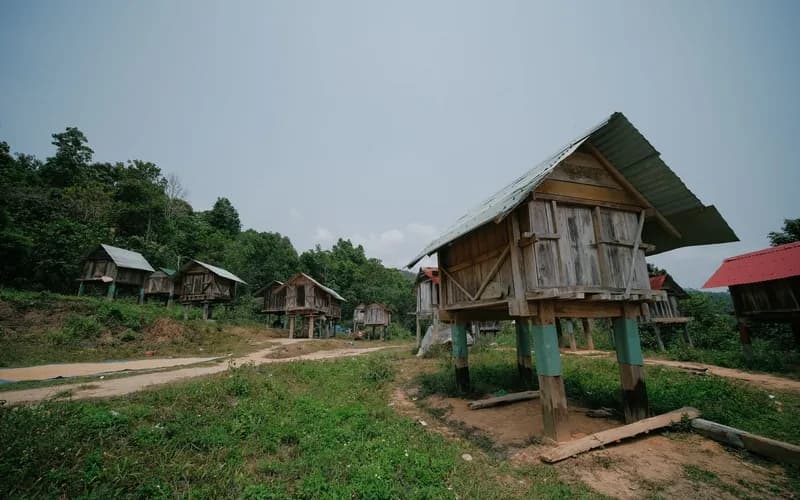
That position explains almost everything about the place. It is a frontier zone in the literal sense: a meeting point of Tai-speaking lowlanders, Khmu villages on the mid-slopes, Akha settlements on the ridges, and Lanten communities known for their indigo dyeing. The province counts more than twenty distinct ethnic groups, several of which live nowhere else in Laos in any number. Markets here are genuinely multilingual, and the person selling you bamboo shoots may not speak Lao as a first language.
It also means Luang Namtha has always been a corridor. Traders, armies, opium, and now freight trains have all passed through. What is unusual is how little of that traffic stops. The town remains small, low-rise and unhurried, with guesthouses charging what they charged five years ago and restaurants closing when the cook is tired. Downriver to the southwest, the border town of Huay Xai anchors the two-day slow boat to Luang Prabang, which pairs naturally with a stay up here.
One request. Up to five tailored proposals.
Skip contacting agencies one by one — share your trip once and let up to five trusted Laos agencies come to you. Free, with no obligation.
Get my free quotesThe Nam Ha protected area: an ecotourism prototype
The reason most people come is the Nam Ha National Protected Area, a block of roughly 222,000 hectares of mostly evergreen forest rising behind the valley. It was among the first protected areas declared in Laos and later recognised as an ASEAN Heritage Park. Inside are gibbons, sun bears, clouded leopards on paper if rarely in practice, and a bird list that runs to several hundred species.
What makes Nam Ha unusual is not its biodiversity but its governance. From the late 1990s, with support from UNESCO and international donors, the province built a community-based trekking model that has been copied across the region: village guides trained and paid, itineraries rotated between villages so no single settlement absorbs all the visitors, a cap on group sizes, and a share of every trek fee paid into a village development fund. It was not perfect and it has wobbled with funding cycles, but it remains the reference point for how forest trekking in Laos is supposed to work.
For a slow traveller this matters practically. It means the walking here is not a staged experience bolted onto a resort. It is a working arrangement between a forest, a set of villages, and a small number of licensed operators, and it behaves like one: sometimes rough, sometimes disorganised, almost always honest. It also means the safety rules are not decorative, and our briefing on staying safe from UXO explains why leaving a known path is a serious matter in this part of the country.
Getting there: the railway changed the arithmetic
Until recently Luang Namtha was a commitment. The road from Luang Prabang took the better part of a day, the road from Huay Xai four hours of switchbacks. Both still exist, and both are worth doing if you like your journeys earned.
The Laos-China Railway rewrote the maths. Trains stop at Nateuy, sometimes signposted as Boten Junction, roughly 35 kilometres east of Luang Namtha town on Highway 3. From the station a shared minivan or taxi covers the last stretch in about forty minutes. Vientiane to Nateuy takes roughly four hours on a fast service, which turns a two-day overland slog into a morning. If you are new to the line, our practical guide to riding the Laos-China Railway covers booking windows, station transfers and the quirks of the ticketing system.
The other classic approach is by water. Buses from Huay Xai on the Thai border take around four hours, which makes Luang Namtha a natural bookend to the Mekong journey. Doing one in each direction gives you a loop through the north that never repeats itself.
There is also a small airport with intermittent domestic flights to Vientiane. Schedules change with the season; treat them as a bonus rather than a plan.
Get matched with up to 5 trusted Laos agencies
- Free
- No obligation
- Up to 5 agencies
Choosing a trek without doing harm
Treks are sold from a cluster of offices along the main street and through the provincial tourism office. Typical formats run from a single day in the forest to three or four days sleeping in village homestays or a basic jungle camp. Distances of twelve to twenty kilometres a day are normal, with climbs that are steeper than the map suggests.
Prices move with group size rather than quality. A day walk generally lands somewhere between 40 and 80 US dollars a person, and a two- or three-day trek with homestays commonly falls between 100 and 180 dollars, with the per-person cost dropping sharply once four or more people are booked. Rates usually include a licensed guide, an assistant from the host village, all meals, entry and conservation fees, and transport to the trailhead.
A few questions separate a good operator from a mediocre one:
- Which villages will we sleep in, and how often do you take groups there?
- Is the guide from this province, and is there a village co-guide?
- What share of the fee reaches the village, and in what form?
- What is the maximum group size, and will we be merged with another booking?
An operator that answers those crisply is usually the one worth paying. The wider principles are the same everywhere in the country, and we set them out in more detail in our guide to choosing a community homestay trek.
One firm rule: stay on the path. Northern Laos carries unexploded ordnance from the war years, and while the Nam Ha trails in regular use are well known to guides, wandering off them to photograph something is a genuinely bad idea. Your guide will say the same on the first morning; take it literally.
Beyond the forest: bicycles, kayaks and the valley floor
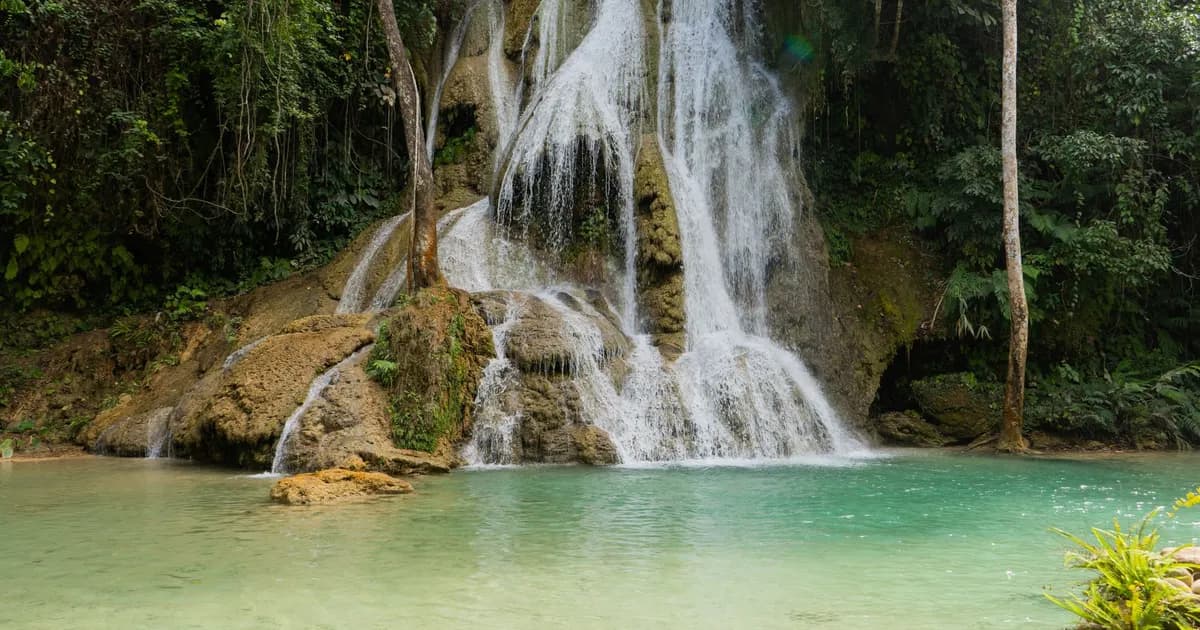
Not everything here requires boots. The valley itself is flat, quiet and laced with unpaved lanes, and a rented bicycle buys you a day of Tai Dam and Tai Lue villages, weaving sheds, and the small waterfall at Ban Nam Dee a few kilometres north of town. That Phoum Pouk, a stupa on a low hill west of the centre, is the standard sunset walk and is more interesting for its two versions, the bombed original and the rebuilt one, than for the view.
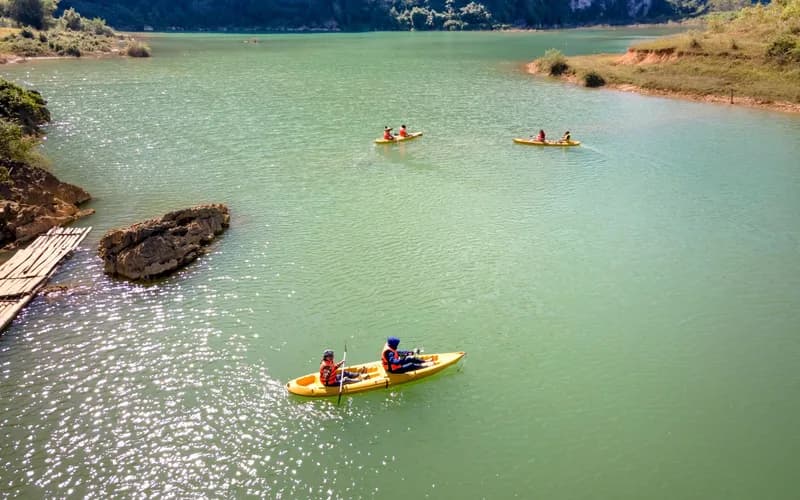
The Namtha River carries one- and two-day kayaking trips through easy rapids and past riverside villages, often combined with a night in a homestay. It is the gentlest way to see the same landscape the treks cross.
North of town, the road to Muang Sing climbs an hour through hills to an old trading settlement on the Chinese frontier that once sat at the centre of the opium economy. Muang Sing today is slow to the point of somnolence, with a morning market that fills before seven with Akha traders and empties by nine. It rewards an overnight stay and disappoints a day trip.
Back in town, the evening food market near the main street is the place to eat: grilled river fish, bamboo soup, sticky rice, and the northern larb that is spicier and more herbal than its Vientiane cousin. If Lao food is new to you, our guide to eating your way through Laos is a useful primer before you point at things.
Where to stay, and how long to give it
Accommodation is simple and cheap. Family-run guesthouses in town run from about 12 to 25 dollars a night, a handful of small eco-lodges and riverside bungalows sit in the 40 to 80 dollar range, and homestays on treks are included in the trek price. Nothing here is luxurious and very little needs to be booked far ahead outside the December to February peak.
Four nights is the sensible minimum: one to arrive and adjust, two or three on a trek, one to recover and cycle the valley. Six or seven nights lets you add Muang Sing or a kayak day without turning the visit into a checklist. Luang Namtha is not a place that yields much to a fast pass; the point of it is the pace. Bring cash for all of it: card acceptance is thin here, and our overview of paying for things in Laos explains why kip in small notes is worth the bulk.
The honest caveats
Three things regularly disappoint people, and it is better to know them in advance.
The first is the burning season. From roughly March to early May, agricultural fires across the northern uplands fill the valley with smoke. Visibility drops, ridge views vanish, and air quality can be genuinely poor for anyone with respiratory issues. Trekking still happens, but the photographs will not.
The second is the wet season. June to September brings leeches, slick clay trails and river crossings that can close a route without warning. Some travellers love it. Most do not.
The third is expectation. Villages in the Nam Ha are not museums. Concrete has arrived, so have satellite dishes and mobile phones, and the young people are often away working. If you want a frozen tableau you will be let down; if you want to sit in a real kitchen while someone explains what they planted this year, you will not.
One smaller irritation to plan for: mobile signal disappears within an hour of leaving town, and our guide to SIM cards, eSIMs and coverage in Laos explains where else in the country that happens.
What to Do Next
- Fix your season first. November to February is the clear window; if you can only travel in March or April, plan for haze and weight the trip towards the valley rather than the ridges.
- Book your rail leg early. Fast trains to Nateuy sell out days ahead in peak weeks, and the station transfer is easier to arrange in daylight.
- Give yourself two full days in town before committing to a trek, so you can walk into three or four offices and compare answers rather than accept the first itinerary offered.
- Match the trek to your actual fitness. A twenty-kilometre day with 700 metres of climb in humidity is harder than the same walk at home.
- Carry cash. ATMs exist but are unreliable and card acceptance is thin, so arrive with kip in small notes and top up in town rather than on the road.
- If you would rather have the logistics handled by someone who knows the province, compare vetted operators on our Laos travel agencies directory.
Frequently Asked Questions
How many days do I need in Luang Namtha?
Four nights is a workable minimum and six or seven is better. A two- or three-day trek is the core of most visits, and you want a day either side of it to arrive, arrange things properly and recover. Anything shorter turns the place into a transit stop.
Is trekking in Nam Ha suitable for beginners?
Yes, provided you choose the right length. One-day and two-day itineraries are designed for people with normal fitness and no technical experience. The difficulty comes from heat, humidity and gradient rather than terrain skill. Three- and four-day routes deserve some honest self-assessment first.
Can I reach Luang Namtha directly by train?
Not quite. The Laos-China Railway stops at Nateuy, around 35 kilometres east of town, and you finish the journey by shared van or taxi in about forty minutes. Vans meet the main arrivals, and the connection is straightforward in daylight.
When is the best time of year to visit?
November to February gives cool, dry, clear conditions and is the peak for a reason. March and April are hot and often smoky from agricultural burning. June to September is green and quiet but brings leeches, mud and unpredictable river levels.
Do I need a guide to walk in the protected area?
Yes. Entry to Nam Ha for trekking is organised through licensed operators with village co-guides, and independent walking inside the protected area is not permitted. That system is also what channels fees back to the communities along the routes.
Is Luang Namtha expensive?
No. It remains one of the better-value corners of Laos. Guesthouses start around 12 dollars, meals at the evening market cost a few dollars, and the main expense is the trek itself. Group size affects your bill more than anything else.
How does Luang Namtha compare with Nong Khiaw?
Nong Khiaw is more dramatic to look at, with limestone cliffs above a river, and easier to reach from Luang Prabang. Luang Namtha is flatter, quieter and stronger on structured community trekking. Many travellers do both, and our profile of Nong Khiaw and the Nam Ou valley is a useful comparison point.